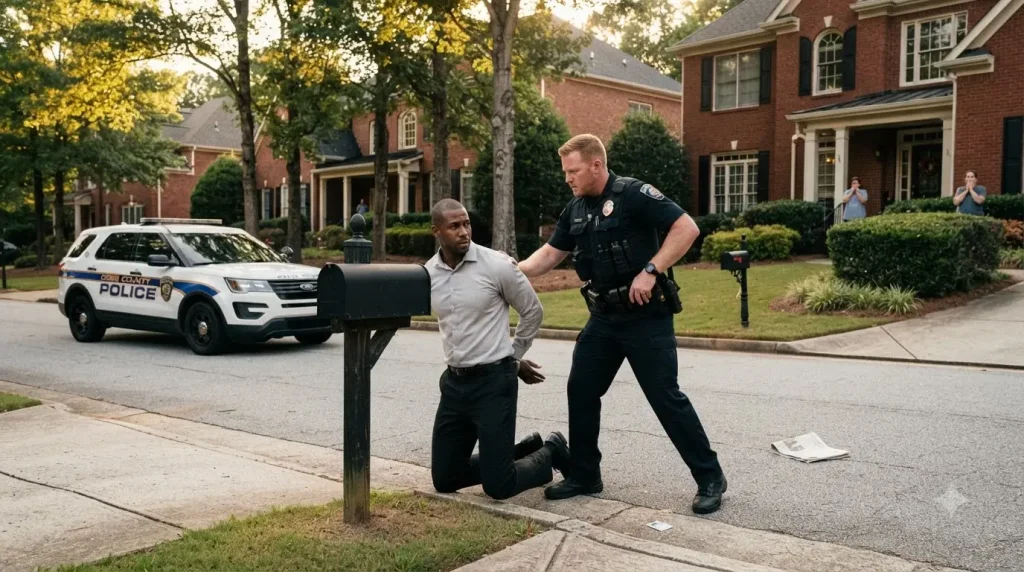
Marcus’s expression shifted—not into anger, not yet, just a sudden, sharp clarity. “Staying?”
“You heard me.”
“I’ve owned this house for six years.”
The officer’s gaze drifted past Marcus’s shoulder, sweeping the slate roof, the dark shutters, the late-model silver SUV parked cleanly in the concrete driveway, before returning slowly to Marcus’s face.
“An address on a license doesn’t prove ownership.”
Marcus stared at him. “No,” he said quietly. “But it does make your burglary theory significantly less persuasive.”
The officer’s jaw locked. “I didn’t say burglary.”
“You said suspicious person at a residence.”
“Don’t get smart with me.”
Marcus’s eyes flicked down for a fraction of a second to the center of the officer’s chest. A small rectangular body camera sat clipped to the placket of his shirt, a tiny green LED burning steady beside the lens. Active. Good.
Beyond the officer’s broad shoulder sat the patrol cruiser. Dash camera aimed straight down the driveway. Mobile data terminal glowing pale blue through the windshield. Potential witnesses up and down a quiet residential street. Good.
Marcus drew one slow, measured breath through his nose and kept his voice stripped of heat. “My vehicle is sitting ten feet behind me. Its registration matches this address. County property records are public and searchable from your car. There are twelve people inside my living room who can confirm who I am in ten seconds. What exactly would you like verified?”
The officer didn’t glance at the SUV. He didn’t turn toward the cruiser. Instead, he let his eyes travel slowly down Marcus’s frame—polished leather loafers, tailored trousers, gray button-down, face—and then back up to the Georgian brick colonial.
“I know this neighborhood,” the officer said.
Marcus said nothing.
“You don’t look like you belong here.”
There it was.
Not subtle. Not coded in dispatch jargon. Not buried beneath three layers of departmental policy. Just seven plain English words hanging in the crisp October air, captured cleanly by a chest-mounted microphone.
Marcus tilted his head a fraction of an inch. “What does someone who belongs here look like, Officer?”
The officer’s right hand twitched, fingers brushing the top of his utility belt. “Don’t turn this into a race thing.”
Marcus almost laughed. Not because anything about the afternoon was amusing, but because he had never once spoken the word race.
Across the street, in the bay window of number 419, a white lace curtain parted. A moment later, the screen door of the corner house creaked open, and Evelyn Holloway—a retired schoolteacher who had brought Marcus a pecan pie the week he moved in—stepped onto her porch, her smartphone already raised in both hands.
The officer caught the movement in his peripheral vision. He glanced over his shoulder, saw the phone, and his neck flushed a mottled, angry red.
Marcus knew that look, too. In the training binders sitting inside his foyer, there was an entire chapter devoted to it: The Audience Effect. Witnesses did not always restrain unchecked authority. When an officer’s ego was already bruised, a camera across the street often made him more aggressive, desperate to prove that he was in total command of the scene.
“Put the newspaper down,” the officer snapped, turning back to Marcus.
“Why?”
“Because I said so.”
Marcus looked down at the folded Register in his left hand. He didn’t argue. He bent slightly at the waist to lay it neatly across the flat top of the iron mailbox.
Before the paper touched the metal, the officer’s hand shot out and slapped it away.
The blow struck the side of the folded newsprint with a sharp crack. The paper flew from Marcus’s fingers, hit the concrete driveway, and broke open. The autumn breeze caught the sports and business sections instantly, sending pale gray sheets skittering across the asphalt toward the storm drain.
Marcus watched the pages tumble. Then he lifted his eyes slowly back to the officer’s face.
“That was unnecessary.”
“What did I just tell you about telling me how to do my job?”
“You told me not to get smart.”
The officer stepped directly into Marcus’s personal space, stopping less than eighteen inches away. Marcus could smell stale burnt coffee and wintergreen mint on his breath. He could read the stamped silver nameplate pinned above the officer’s right breast pocket: G. MILLER.
“You think this is funny?” Miller hissed.
“No,” Marcus said steadily. “I don’t.”
“Hands out. Where I can see them.”
Marcus raised both hands cleanly to waist height, palms open and empty.
Miller held Marcus’s driver’s license up between two thick fingers, stared at the photo one last time, and then simply opened his hand.
He didn’t hand it back. He dropped it.
The plastic card fluttered down, bounced once against the concrete beside the crumpled front page of the newspaper, and slid two inches toward Miller’s polished black boot.
For the first time since the cruiser had braked at his curb, a hot, sharp spike of genuine anger flared behind Marcus’s ribs. He felt it immediately—the rush of adrenaline, the instinctive tightening of his calves, the sudden urge to say something cutting and irreversible.
He locked it down.
Eleven years of civil-rights investigations had drilled one unbreakable truth into his marrow: anger and action were two completely separate things. Feeling insulted did not require moving. Feeling provoked did not require giving a man with a badge and a bruised ego the exact excuse he was hunting for.
Marcus stood motionless, his palms still open.
Miller looked down at the license, then back up at Marcus. “Pick it up.”
Marcus stared at him. “You just instructed me to keep my hands up where you can see them.”
A faint, humorless smile touched the corner of Miller’s mouth. “Now I’m telling you to pick it up.”





