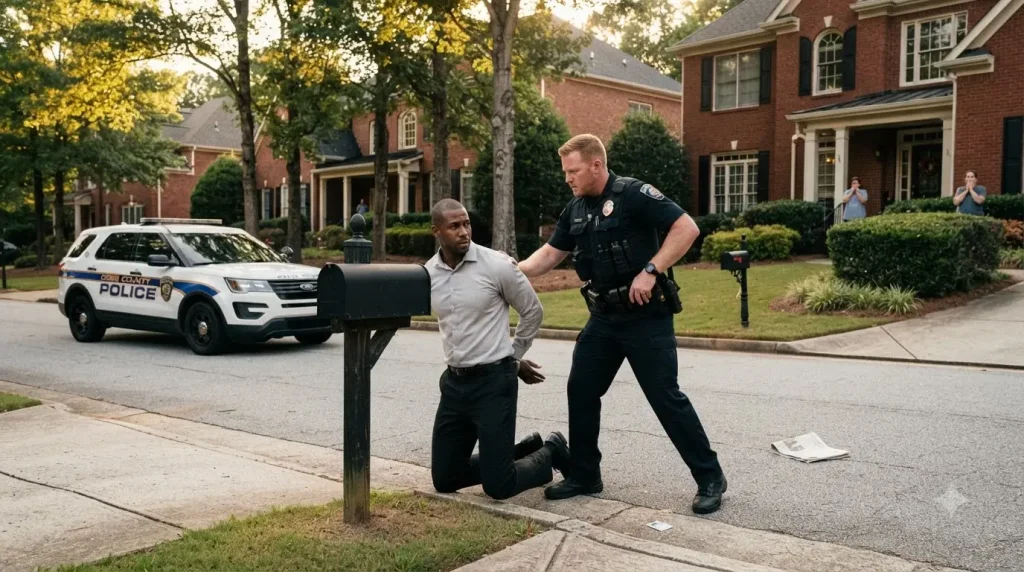
Marcus understood the mechanics instantly. Contradictory commands. One of the oldest, dirtiest traps in bad policing. Stay still, and it was failure to comply with a lawful order. Reach down, and it was furtive movement against a direct command to keep hands visible. Whichever path he chose could be written up in a clean, defensible report an hour later.
Marcus looked straight past Miller’s shoulder, fixing his eyes squarely on the glowing green lens of the body camera.
“For the record,” Marcus said, his voice clear and measured, “I am lowering my right hand to retrieve the identification you dropped on my driveway.”
He bent slowly at the knees, keeping his left hand raised and his eyes down.
As his fingertips brushed the edge of the laminated card, Miller’s heavy boot swung forward and kicked the crumpled center section of the newspaper. The paper skidded hard across the concrete, jamming beneath the black iron post of the mailbox, his boot stopping less than four inches from Marcus’s knuckles.
Marcus straightened slowly, leaving the license on the ground.
“Why did you do that?” he asked quietly.
“Back up.”
“This is my driveway, Officer Miller.”
“Back up!”
Marcus took one deliberate step backward, putting three feet of concrete between them.
It wasn’t enough for Miller. The officer lunged forward, his left hand clamping hard around Marcus’s upper right arm, fingers digging deep into the muscle beneath the rolled gray cotton.
Marcus’s body went rigid instinctively, every sinew bracing against the sudden violence, yet he forced his feet to stay flat. He did not yank away. He did not raise his free hand.
Miller shoved him hard sideways, driving him into the cast-iron mailbox post.
The impact struck Marcus’s shoulder blade with a dull, sickening thud. The hollow metal post rattled violently against its concrete footing, and across the street, Evelyn Holloway let out a sharp, audible gasp. A hot bolt of pain radiated from Marcus’s collarbone down to his elbow.
“Stop resisting!” Miller barked, his voice rising sharply for the benefit of the microphone.
“I am not resisting,” Marcus said through tight teeth.
Miller leaned his weight into Marcus’s chest, pinning him against the iron post. “Hands behind your head. Now.”
Marcus raised both hands slowly and laced his fingers behind his skull.
Over Miller’s shoulder, reflected cleanly in the glossy black paint of the mailbox door, a second patrol cruiser turned onto Sycamore Lane. It slowed as it approached the clustered sedans, then pulled neatly behind Miller’s unit, its overhead lightbar dark.
The driver’s door opened, and a younger white officer stepped out. He looked barely twenty-four—lean, clean-shaven, with dark hair cropped neat and a uniform that still carried the crisp, uncreased stiffness of the academy.
Marcus watched the rookie’s eyes sweep the driveway in two rapid seconds: a senior patrolman pinning a well-dressed Black man against a mailbox; a driver’s license lying face-up on the concrete; a Saturday newspaper scattered across the grass; a pristine brick colonial directly behind them; and a silver-haired neighbor standing on her porch across the street with a glowing smartphone.
The younger officer approached at a cautious, uneven pace, his hand resting nowhere near his belt.
“What do we have, Garrett?” he asked.
Miller didn’t loosen his grip on Marcus’s bicep. “Possible burglary suspect. Claims he lives here.”
The rookie’s eyes dropped to the laminated card lying by Miller’s boot. Then they shifted to Marcus’s tailored shirt, then to the silver SUV parked ten feet away in the driveway.
“Did we run the plate on the vehicle?” the rookie asked.
“No,” Miller snapped.
“What about the address on the license?”
Miller’s fingers dug harder into Marcus’s arm. “He says it’s his.”
The younger officer took half a step sideways and tilted his head down. The card was lying face-up, close enough to read in the bright afternoon sun. His brow furrowed deeply.
“Garrett… it matches,” the rookie said quietly. “418 Sycamore. That’s this house.”
Miller whipped his head around to glare at him, his eyes cold and flat. “An address on a card doesn’t prove ownership, Cole. People forge IDs. People use old addresses.”
Officer Evan Cole paused. His gaze flicked from the license to Marcus’s calm, unblinking face, then back to his senior officer. “No, I know, but—we can check the tax roll on the terminal in ten seconds, or knock on the—”
“I’ve got it, Cole,” Miller cut him off, his voice carrying the unmistakable, heavy weight of fourteen years on the job and a seat on the union’s disciplinary board. “Stand by.”
Evan Cole stopped talking.
Marcus held the rookie’s gaze for two long, silent seconds.
That silence mattered more than anything Miller had done so far. In the binders sitting inside Marcus’s house, there was a whole module built around this exact five-second window—not the beginning of misconduct, not the moment a bad officer crossed the line, but the moment a good officer saw something clearly wrong and had to decide whether hierarchy mattered more than judgment.
Cole’s jaw worked once. Then, slowly, he looked away, staring down at the edge of the grass.
Miller turned back to Marcus, his confidence fully restored by the rookie’s retreat. “Knees.”
Marcus thought for half a second he had misheard. “What?”
“Get on your knees.”
“For what?”
Miller’s face hardened into stone. “You’re being detained.”
“On reasonable suspicion of what crime?”
“Failure to cooperate with an active investigation.”
“I gave you my identification.”
“Knees.”
“My vehicle is registered to this address.”
“Knees.”
“I have people inside this house who—”
Miller’s right hand shot up and seized Marcus’s wrist, yanking it down from behind his head.
Marcus’s voice changed—not louder, just sharper, carrying the cold, precise authority that had once silenced hostile police union attorneys in federal courtrooms. “Do not twist my arm.”
“Then stop resisting!”
“I am standing completely still.”





