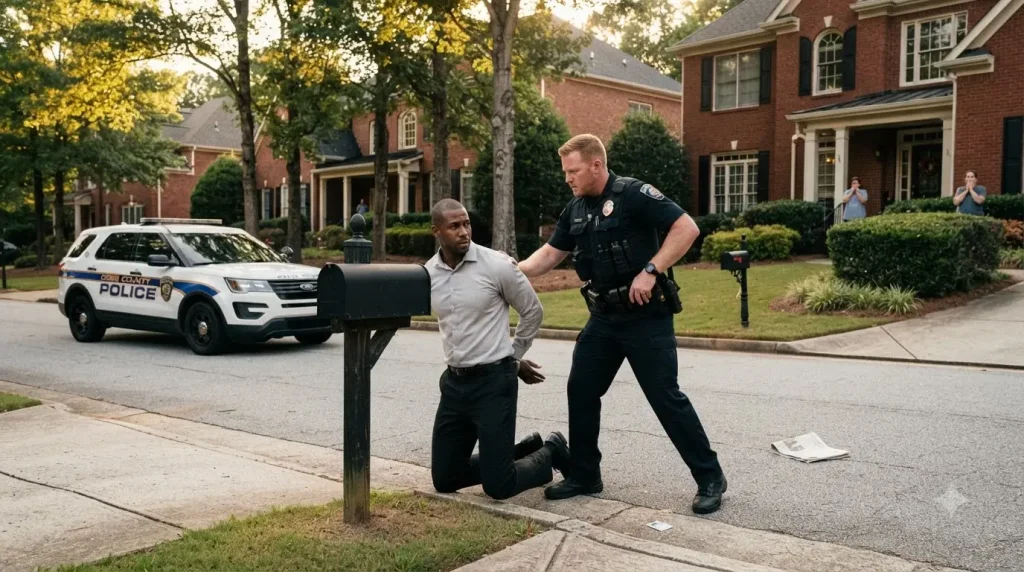
“No, they were already parked when I walked my dog. Just seemed unusual for a Saturday afternoon.”
“Understood. We’ll have a unit do a routine pass.”
Marcus tapped the spacebar. The audio cut off, leaving a silence so sharp it felt as though the oxygen had been vacuumed out of the room.
Deputy Chief Sandra Morales stared at the laptop. “She called about our cars.”
“She called about your cars,” Marcus confirmed softly. “Read the CAD log on the screen.”
He clicked to the next slide. The timestamped dispatch ticket glowed bright white above the fireplace: Code 10-15, Routine Area Check. Unfamiliar parked vehicles, 400 block Sycamore. No suspect description. No crime reported.
“There was no burglary call,” Marcus said, his voice carrying cleanly to every corner of the room. “There was no suspicious-person report. Garrett Miller drove down this street on a routine parking check, saw a Black man in a button-down shirt standing at a mailbox in an affluent neighborhood, and invented a burglary investigation in under four seconds. And when my driver’s license proved him wrong, his ego couldn’t survive backing down in front of a neighbor’s camera and a junior officer—so he escalated until I was on my knees in handcuffs.”
A heavy, miserable stillness settled over the commanders.
“Now,” Marcus said, turning his gaze slowly to Sandra Morales. “Deputy Chief, you oversee Professional Standards. Before you walked in here, I asked you to pull Officer Miller’s disciplinary jacket on your tablet. How many citizen complaints has Garrett Miller received in the last five years?”
Morales didn’t flinch. She looked down at her iPad, then lifted her dark eyes to meet Arthur Bennett’s gaze. “Seven,” she said flatly. “Five for discourtesy and unlawful detention. Two for excessive force during routine stops.”
“And how many were sustained?” Marcus asked.
“Zero,” Morales said. “Four were closed as Unfounded. Three were closed as Not Sustained due to ‘conflicting accounts.’”
Across the room, a broad-shouldered precinct commander—Commander Gary Hayes, who had spent twenty years in patrol—shifted uncomfortably in his armchair, staring at his polished shoes.
“Commander Hayes,” Marcus said quietly. “You were Miller’s district captain for three of those years. You signed off on four of those closures.”
Hayes’s neck reddened. “Look, Marcus, in two of those cases the bodycam wasn’t activated until after the physical contact, and the union rep—”
“Miller is the union rep, Gary,” Morales cut in sharply. “He sits on the patrolmen’s disciplinary review board. Every time a citizen filed a complaint, you treated it like a paperwork headache you didn’t want to fight with the union.”
“Which brings me,” Marcus said, stepping away from the mantel and walking slowly toward the corner of the room, “to the only person in this house who actually has a chance to change what happens next.”
Every head turned toward the wooden dining chair.
Officer Evan Cole sat rigid, his pale face drenched in quiet dread, braced for the hammer to fall.
Marcus stopped four feet in front of him. He didn’t tower over him; he pulled a spare dining chair around and sat down directly across from the rookie, at eye level.
“Officer Cole,” Marcus said, his voice devoid of anger. “You’ve been out of the academy how long?”
“Seven months, sir,” Cole whispered.
“Walk me through the driveway,” Marcus said gently. “You got out of your car. You saw my license lying on the concrete. You read the address. You saw it matched the house. You asked Miller if he’d run the plate. You knew the stop was bad.”
Cole’s throat worked. He stared down at his clasped hands. “Yes, sir.”
“Why did you stop talking?”
Silence stretched in the living room. Nobody coughed. Nobody breathed.
“Because he’s a fourteen-year veteran,” Cole said, his voice cracking slightly on the last word. “Because he’s my field-training coordinator’s best friend. Because if I step in front of Garrett Miller on a driveway in front of civilians and tell him he’s wrong, by Monday morning I’m labeled a rat who doesn’t back up his partners. And in a patrol car at two in the morning, if nobody backs you up…” He trailed off, his eyes bright with shame. “I froze, sir. I looked away.”
Marcus didn’t nod in pity, and he didn’t scold him. He simply turned his head slowly and looked back at Chief Arthur Bennett and the eleven commanders watching from the sofa.
“Listen to what he just told you,” Marcus said softly. “You spent two million dollars on body cameras. You rewrote your use-of-force manual. You hired me to print binders about implicit bias. And yet, seven months out of your academy, a good kid who knew the law and knew the truth was more afraid of Garrett Miller than he was of violating a citizen’s constitutional rights—because every single person in this room taught him that Miller was untouchable.”
Arthur Bennett looked down at his hands. When he lifted his eyes, the defensive polish of a politician was entirely gone, replaced by the stark, heavy clarity of a leader staring at a mirror he could no longer tilt away from.
“We don’t have a training problem,” Bennett said quietly to his command staff. “We have a courage problem. And it starts at the top.”
He looked at Evan Cole. “Officer Cole. You failed a citizen on that driveway today. You’re going to write a full, unvarnished supplemental report of everything you witnessed—every word Miller said, every command he gave—before you go off shift tonight. You will not be retaliated against. If anyone in your precinct so much as looks at you sideways for telling the truth, they answer directly to me. Do you understand?”
Cole straightened his spine, exhaling a long, shaky breath. “Yes, Chief. I understand.”





