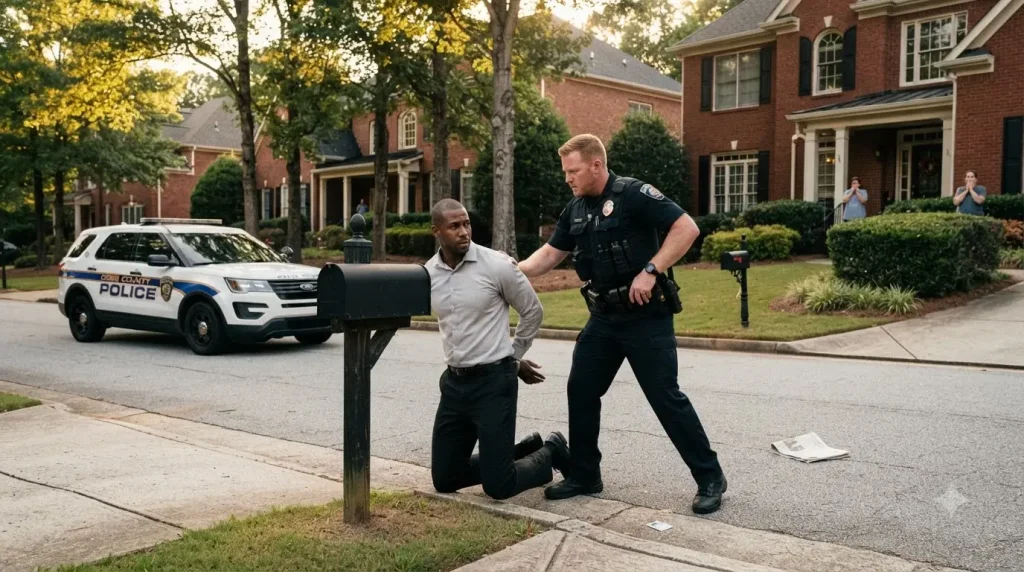
Marcus stood up slowly, resisting the urge to rub his aching shoulder. He brought his hands forward, flexing his fingers once to restore circulation. Angry red bands circled both wrists.
Arthur Bennett didn’t look away from Miller. “Did his identification match this address?”
Every drop of color had drained from Miller’s face, leaving his freckles standing out sharply against pale skin. “Yes, sir, but—”
“Did it?”
“Yes, Chief.”
“Did his vehicle registration contradict him?”
“We… hadn’t run it yet.”
Bennett turned his head a fraction of an inch toward the rookie. “Officer Cole. Run it.”
Cole pivoted on his heel and practically sprinted to his cruiser.
Bennett turned back to Miller. “Did he threaten you?”
“No, sir.”
“Attempt to flee?”
“No.”
“Refuse to provide identification?”
Miller swallowed hard, his Adam’s apple bobbing above his collar. “He questioned why I needed it, Chief. He was being uncooperative—”
“That is not what I asked you, Officer.”
“No, sir.”
“Did he hand you his license?”
“Yes.”
“And did the address match the house he was standing in front of?”
“Yes.”
Bennett looked past Miller toward the brick colonial, then back at Marcus, and finally at the glowing green LED on Miller’s chest.
“Your body camera has been running since you exited the vehicle?” Bennett asked.
“Yes, sir.”
“Leave it running until you are seated in the Internal Affairs interview room,” Bennett said, his voice flat and cold. He glanced over his shoulder at the commander of Internal Affairs, Captain Ray Torres, who was standing at the bottom of the porch steps. “Ray. Take Officer Miller’s cruiser keys. Have a sergeant drive him directly to headquarters, upload his BWC and dashcam footage under a sealed evidentiary hold, and place him on immediate administrative leave pending investigation.”
Miller’s eyes widened. “Chief—wait a second, I responded to a dispatch call—”
“Not another word, Officer,” Bennett cut him off. “Walk to Captain Torres’s vehicle.”
Miller’s jaw clenched, a flash of bitter, cornered pride flickering in his eyes before he turned stiffly and marched down the curb beside Torres.
From the second cruiser, Evan Cole walked slowly back toward the driveway, his face pale. “Registration came back clean, Chief. 2024 Lexus, registered to Marcus Vance at 418 Sycamore Lane. Zero wants, zero warrants.”
Bennett closed his eyes for one brief, exhausted second. When he opened them, he turned fully to Marcus, his posture dropping its command stiffness into something deeply, genuinely pained.
“Marcus,” Bennett said quietly. “I don’t even know where to begin. I am profoundly sorry. That should never have happened—not to you, not to anyone in this city. I’ll have Morales handle the formal complaint intake right now, and if you want to cancel today’s workshop, I completely understand. We’ll reschedule for whenever you’re ready.”
On the porch, several commanders murmured in uneasy agreement, already shifting toward their cars, eager to escape the burning humiliation of the driveway.
Marcus looked at the red marks on his wrists. Then he looked at the twelve senior officers standing on his porch. Then he looked at Evan Cole, who was still standing rigidly beside the mailbox, holding Marcus’s driver’s license like a piece of live shrapnel.
“We’re not canceling, Arthur,” Marcus said calmly.
Bennett blinked. “Marcus, you were just—”
“You paid my firm thirty thousand dollars to teach your command staff what happens when assumption becomes action,” Marcus said, reaching out to gently take his license back from Evan Cole’s trembling hand. “We just ran the most expensive live-fire exercise in the history of this department. Nobody is going home.”
Marcus turned toward the porch, his voice steady and clear.
“Gentlemen. Ladies. Inside. And Arthur?”
“Yes?”
“Bring Officer Cole with us. And have Dispatch send the raw 911 audio and CAD log for this call to my email in the next five minutes.”
Ten minutes later, the living room of 418 Sycamore Lane felt less like a suburban home and more like a federal courtroom.
The twelve commanders sat in a tight semicircle on Marcus’s leather sofa, armchairs, and dining chairs pulled in from the adjoining room. Nobody touched the coffee urn. Nobody opened the navy-blue binders resting on their laps. On the wooden easel beside the fireplace, the black board stared back at them in stark white lettering: WHEN ASSUMPTION BECOMES ACTION.
In the corner nearest the hallway, seated stiffly on a wooden dining chair, sat Officer Evan Cole, his hands clasped tightly between his knees, staring at the floorboards.
Marcus stood beside the fireplace, his laptop connected to the sixty-five-inch screen mounted above the mantel. He had washed his hands in the powder room and smoothed his gray shirt, though a faint streak of concrete dust still clung to the knees of his dark trousers. He hadn’t brushed it off.
“Before we watch anything,” Marcus said quietly, his eyes sweeping the semicircle of brass and silver insignia, “let’s strip away the easiest lie in policing. The lie that what just happened on my driveway was an anomaly. A single bad apple who slipped through the cracks.”
Chief Bennett leaned forward, elbows on his knees. “Marcus, Garrett Miller is going to be disciplined to the fullest extent of the—”
“Wait until you hear the call, Arthur,” Marcus interrupted gently.
He tapped the spacebar on his laptop. The speakers hummed, and the crisp, flat voice of a city dispatcher filled the quiet room.
“911, what is the location of your emergency?”
A woman’s voice—older, slightly breathless, unmistakably belonging to a resident three doors down—came through the speakers. “Hi, yes, I’m on Sycamore Lane. Near the four-hundred block. I don’t want to be a bother, but there are three dark cars—look like unmarked sedans, tinted windows—parked along the street outside the Vance house. We’ve had some package thefts in the subdivision lately, and I’ve never seen these vehicles before. Could somebody just swing by and check them out?”
“Ma’am, did you see anyone exit the vehicles or approach any houses?”





