“””Chapter 1: The Line on the Pavement

The October wind off the East River carried the sharp, metallic bite of autumn in New York, whipping fallen yellow leaves across the polished granite steps of St. Jude Academy. It was the kind of institution where limestone arches had been smoothed by a century of generational wealth, where third-graders arrived in town cars and discussed European holidays between morning violin and conversational French.

I adjusted Maya’s coat collar, tucking a stray curl behind her ear. Her small hand gripped mine tightly, her palm warm against my calloused fingers. At eight years old, she had her late mother’s wide, perceptive brown eyes and a quiet sensitivity that made me fiercely protective. For three years, since Clara passed, it had just been the two of us navigating the world.

“Daddy, do you think Mrs. Gable will like my watercolor?” Maya asked softly, her eyes darting toward the ornate double doors where parents in cashmere coats were kissing their children goodbye.

“She’s going to love it, bug,” I said, offering her my gentlest smile—a smile I had to practice in the mirror, because after twelve years with the United States Marshals Service, my default expression had settled into something hard and unreadable. “You spent three nights getting that bridge just right. Trust your work.”

“Okay,” she whispered, exhaling a breath that misted in the morning chill.

We stepped onto the sidewalk bordering the academy’s designated drop-off lane. It was a chaotic dance of idling black SUVs, private couriers, and harried nannies. But amid the morning rush, my professional instincts—honed through hundreds of fugitive apprehensions, high-threat federal escorts, and tactical operations across the country—tripped a silent alarm.

Twenty feet ahead, near a commercial delivery van with its hazard lights flashing, a confrontation was unfolding.

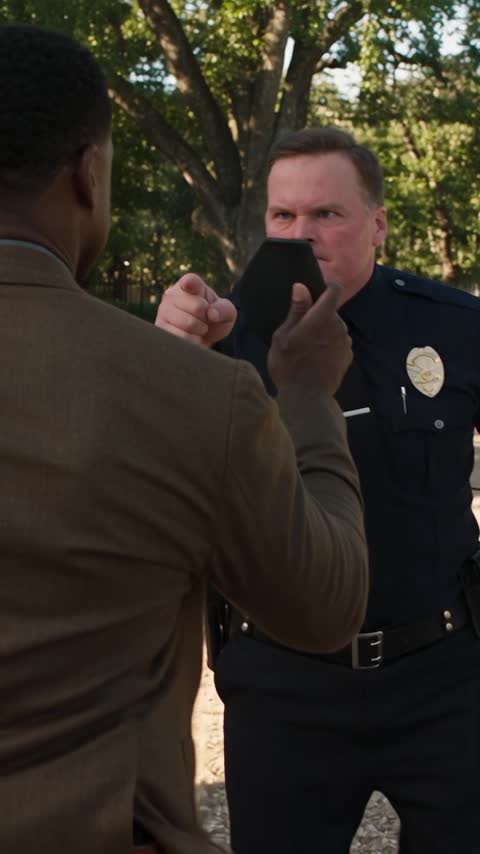
A young Hispanic courier wearing a red cap and matching polo stood frozen against the side of his truck, clutching a cardboard parcel against his chest. In front of him stood a broad-shouldered man in a dark navy uniform. At first glance, he looked like a school security guard, but the heavy leather duty belt, the active-duty Glock 17 holstered at his hip, and the distinct gold clip on his breast pocket marked him as an NYPD officer working an authorized off-duty security detail.

His nameplate caught the morning light: CONCINCAID.

Vance Concincaid wasn’t doing school safety work. He had the delivery driver backed against the van’s sliding door, his posture aggressively forward, his thumb hooked into the front of his utility belt.

“I told you yesterday, pal,” Concincaid was saying, his voice a low, grating rasp that carried over the murmur of traffic. “You want to idle at this curb during drop-off, you pay the morning expediting fee. Fifty bucks. Cash. Unless you want me to write you three different municipal citations for commercial obstruction, improper registration display, and idling over three minutes. You know what that does to your commercial driver’s license?”

The delivery driver was trembling, his fingers digging into the cardboard package. “Sir, please. I am just dropping off the art supplies for the school. I make twelve dollars an hour. I do not have fifty dollars to give you every morning.”

“Then find another route or find another job,” Concincaid sneered, leaning in until his nose was an inch from the young man’s brim. “Because on this block, my word is the law. Pay up, or your truck leaves on the back of a flatbed.”

The young man fumbled into his pocket, pulled out two crumpled twenty-dollar bills and a five, and held them out with a shaking hand. Concincaid snatched the cash with practiced ease, slipped it into his trouser pocket, and gave the young man a dismissive shove. “Next time, have it ready before you put it in park.”


“Right behind you, baby,” I said, intentionally shifting to keep myself between the officer and my daughter.

I walked Maya toward the central stone staircase. I wore a tailored charcoal blazer over a crisp slate-gray dress shirt and dark trousers—standard attire for a Senior Inspector assigned to the Special Operations Group who had an afternoon briefing at the Daniel Patrick Moynihan United States Courthouse downtown. There were no visible logos, no tactical nylon, nothing that screamed federal agent. To the untrained eye, I was simply an imposing Black man walking his child to class.

And to a predator like Vance Concincaid, that made me an immediate target.

“Hey!”

The shout sliced through the morning chatter. Heavy, rapid footsteps clicked against the stone behind us.

“You! In the gray jacket! Stop right where you are!”

I didn’t immediately turn. I kept my hand on Maya’s shoulder, guiding her up another two steps toward the safety of the main vestibule. Panic in front of a child is contagious, and I refused to let her day begin with terror.

Before we could reach the threshold, a heavy hand grabbed the fabric of my right shoulder and yanked backward with vicious force.

My tactical instincts reacted before my conscious mind finished processing the insult. I pivoted on my left heel, absorbing the pull, breaking the grip with a subtle outward rotation of my forearm, and planted my boots wide to shield Maya.

The momentum knocked Maya off balance. Her small purple backpack slipped from her grip, hitting the concrete with a dull thud. Her colored pencils and homework folder spilled across the pavement.

“Daddy!” she cried out, her voice shrill with shock, wrapping both arms around my thigh.

“Get your hands where I can see them! Right now!” Concincaid roared.

He stood six feet tall, heavy in the gut and thick in the neck, his face flushed an ugly, mottled crimson. Broken capillaries webbed across his cheeks, and his breath smelled of stale coffee and unearned authority. He wasn’t assessing a threat; he was performing dominance.

Around us, the morning bustle instantly ground to a halt. Wealthy parents in designer overcoats froze. Nannies pulled their charges backward into defensive clusters. The courier in the red hat stopped in his tracks, horror etched across his features. Near the heavy oak doors, the headmaster of St. Jude, Dr. Alistair Sterling, stepped out onto the landing, his manicured hands trembling as he took in the scene.

“Officer, step back,” I said. My voice was level, deadpan, dropping into the cold cadence I used when clearing barricaded structures. “You just put your hands on me in front of my daughter. Back up.”

“You don’t give me orders, boy!” Concincaid bellowed, his voice carrying down the entire block. He was playing to the audience, weaponizing the fear of every upper-crust onlooker. “You don’t belong on the Upper East Side! We’ve had three separate reports of suspicious individuals casing the perimeter during morning arrival. Turn around, face that wall, and interlock your fingers behind your head!”

“I am dropping off my daughter,” I replied, keeping my hands visible at waist level, palms open, every muscle coiled and ready. “Her name is Maya Thorne. She is a registered third-grader in room 204. Her name is on the front-office roster. You can verify that with Headmaster Sterling right behind you.”

“I don’t give a damn about your roster!” Concincaid screamed, his eyes bulging with rage. He had publicly committed to the confrontation, and men like him would burn down the world before admitting an error in judgment. “I said you match the description of a suspect! You’re trespassing on private academy grounds, you’re failing to comply with a lawful order, and you just made an aggressive move toward a police officer!”

“You grabbed me from behind while I was holding a child’s hand,” I stated evenly.



