I knelt down on both knees so I was eye-to-eye with her. I took her small hands in mine, rubbing warmth back into her fingers. “I have to make a couple of phone calls for work, bug. You know how work gets. But I am right outside. Nobody is getting past those doors, and nobody is ever going to scare you like that again. Do you trust me?”
The October wind blowing off the East River carried the sharp, metallic taste of coming winter, curling down East 79th Street and driving brittle sycamore leaves across the polished granite steps of St. Jude Academy. It was a block built to remind ordinary people of their place. Limestone facades rose behind wrought-iron fences, brass plaques gleamed beside mahogany doors, and third-graders climbed out of idling black town cars discussing autumn breaks in Geneva between morning violin and conversational French.
Three blocks away, in the kitchen of our walk-up off Second Avenue, I had spent ten minutes smoothing the collar of Maya’s navy peacoat and tucking a stray curl behind her ear. At eight years old, she had inherited her mother’s wide, perceptive brown eyes and a quiet, observant stillness that made me ache with pride and terror in equal measure. For three years—ever since Clara’s cancer had hollowed out the center of our lives—it had been just the two of us learning how to move through a city that never slowed down for grief.
“Daddy, do you think Mrs. Gable will notice the sky is a little crooked?” Maya asked as we crossed Lexington Avenue, her small hand tucked warmly inside my calloused palm. Under her other arm, she clutched a stiff cardboard portfolio nearly half as tall as she was.
“I think she’s going to hang it right at the front of the room, bug,” I said, giving her the gentlest smile I owned. It was a smile I still had to practice in the bathroom mirror while shaving. Twelve years with the United States Marshals Service—the last six in the Special Operations Group—had carved a permanent stillness into my face, the kind of flat, unreadable mask men wear after too many pre-dawn door breaches and high-threat prisoner transports. Maya deserved the father underneath the armor, not the operator. “You spent three nights getting the cables on the Queensboro Bridge to line up. Your mother would’ve framed that thing before the paint dried.”
A small, bright smile broke across her face, her breath misting in the crisp morning air. “Okay. Don’t forget you promised to look at the science fair board tonight.”
“Cross my heart,” I said.
We turned onto the wide sidewalk bordering St. Jude’s designated drop-off lane. It was the usual eight-o’clock ballet of gleaming Mercedes SUVs, harried nannies, and uniformed doormen waving white-gloved hands at delivery trucks. I wore a tailored charcoal blazer over a slate-gray dress shirt and dark wool trousers—standard courtroom attire for an afternoon federal threat-assessment briefing at the Daniel Patrick Moynihan Courthouse downtown. Beneath the left lapel of my jacket, invisible beneath the cut of the wool, sat my leather credential case; my service weapon was locked in the biometric safe back in my apartment, since I never carried iron onto a school threshold unless I was on an active protective detail. To anyone glancing across the pavement, I was simply a broad-shouldered Black man walking his daughter to third grade.
Even off the clock, though, the machinery in the back of my skull never fully powered down. Half a block from the academy’s iron gates, that quiet internal alarm tripped.
Twenty feet ahead, parked beside a white commercial delivery van with its hazard lights blinking against the curb, a man in a dark navy uniform had a young courier pinned against the sliding steel door.
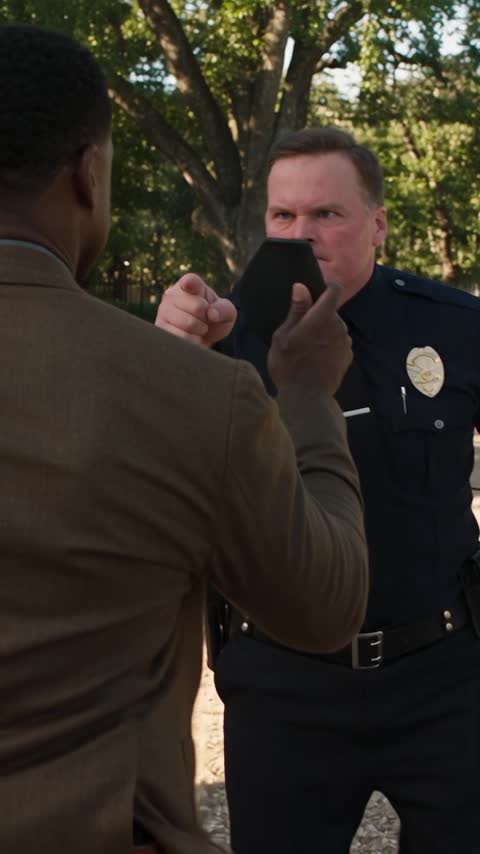
At first glance, the uniformed man looked like a private school guard, the kind hired to shepherd kids across the crosswalk. A closer look told a different story. The heavy basket-weave duty belt, the active-duty Glock 17 riding in a Level III Safariland holster, and the distinctive silver-and-gold shield pinned above his left pocket marked him as NYPD—an active-duty supervisor working an authorized paid detail. His brass nameplate caught the pale morning sun: CONCINCAID.
Sergeant Vance Concincaid wasn’t directing traffic. He stood six feet tall, thick through the neck and heavy around the midsection, his shoulders angled forward in a textbook intimidation stance. Broken capillaries webbed across his flushed cheeks. He had his left thumb hooked lazily into the front of his gun belt, crowding the personal space of a slender Hispanic driver wearing a red cap and a matching polo shirt.
“I told you Tuesday, pal,” Concincaid said, his voice a low, gravelly rasp that cut cleanly beneath the murmur of idling engines. “You want to drop a commercial load on this curb between seven-thirty and nine, you pay the morning expediting fee. Fifty bucks. Cash. Otherwise, I write you three separate municipal summonses—commercial obstruction, improper placard display, and idling over three minutes in a school zone. You know what three moving-adjacent violations do to a probationary CDL?”
The courier—he couldn’t have been more than twenty-three, a laminated ID tag reading MATEO CRUZ swinging from his collar—was trembling so hard his knuckles had gone white against the cardboard box of art supplies clutched to his chest. “Sergeant, please. I’m just dropping off tempera paint and canvas for the third floor. The dispatcher gave me a fifteen-minute window. I make fourteen dollars an hour. I don’t have fifty dollars to give you every week.”
“Then tell your dispatcher to hire somebody who understands how the Upper East Side works,” Concincaid sneered, leaning in until the visor of his cap nearly brushed the young man’s forehead. “On this block, I’m the traffic court, the judge, and the tow truck. Pay up, or your van leaves 79th Street on the back of a flatbed.”
Two mothers in camel-hair coats walked past three feet away, pushing a double stroller. Neither broke stride. Neither even glanced sideways. They paid St. Jude fifty-eight thousand dollars a year in tuition to keep the sidewalks frictionless, and if a precinct sergeant kept the delivery trucks moving by shaking down the help, nobody in cashmere was going to ask how the sausage got made.





