“Interstate commerce,” I said softly, the legal framework locking into place with surgical clarity. “Commercial couriers hauling out-of-state freight. That’s a federal Hobbs Act extortion conspiracy under 18 U.S.C. Section 1951.”
“And pulling a loaded firearm on a federal officer while threatening his child under color of law,” Cole added, his voice dropping to a low, lethal growl, “is 18 U.S.C. Section 242—Deprivation of Rights Under Color of Law—plus 18 U.S.C. Section 111, felony assault on a federal officer. I just got off the phone with Assistant U.S. Attorney Marissa Vance—no relation—at the Southern District. She’s been waiting six months for a clean hook into that precinct crew, because every local witness they approached was too terrified to testify.”
“They have a federal witness now,” I said.
“You’re the complainant, Elias, which means defense counsel will scream personal bias from the rooftops if it’s just your word against five cops,” Cole warned, stepping right in front of me. “Especially if Concincaid’s buddies lean on the school to erase that archway video. To bury them permanently—to strip their badges, seize Aegis’s accounts, and put Concincaid in a federal penitentiary before he can blink—we need two things before dismissal at three-fifteen.”
“The St. Jude video,” I said, “and Mateo Cruz.”
“Exactly,” Nadia chimed in, spinning her chair around. “I pulled the registration on Mateo’s white van from the plate number you gave me. He drives for Tri-State Art & Educational Supply out of a warehouse in Long Island City. His GPS transponder—Wait a second.”
Nadia froze, leaning forward toward her screen. Her brow furrowed.
“Elias,” she said sharply, “did Concincaid see you look at that courier this morning?”
“He saw me watch the whole shakedown. And I mentioned the fifty dollars right to his face.”
“Then we have a problem,” Nadia said, pointing at a live dispatch feed scrolling across her left monitor. “Ten minutes ago, an unmarked Nineteenth Precinct detective sedan—registered to the Nineteenth’s anti-crime unit, currently signed out to Officer Daniel Kowalski—crossed the Queensboro Bridge heading straight toward Long Island City.”
I didn’t wait for Cole to finish his sentence. I was already grabbing my jacket off the back of the chair.
“They’re going to intimidate the witness before I can get a statement,” I said, striding toward the door. “Chief, call AUSA Vance. Tell her to have an emergency Title III wiretap authorization and a federal arrest warrant drafted and sitting on the magistrate’s desk. And give me two SOG operators on standby.“
“You’re not rolling into Queens unarmed, Thorne,” Cole called out, tossing me a heavy nylon pouch from his desk drawer—my spare tactical rig, radio earpiece, and a compact federal body-wire kit. “Take Miller and Delgado in the black Durango. And Elias—keep it by the book. Don’t give Concincaid’s union lawyer a single inch of daylight.”
“I don’t need to bend the book, Chief,” I said over my shoulder, pushing through the glass doors. “Concincaid’s already hanging himself with it.”
Chapter Four
The warehouse district of Long Island City smelled of diesel exhaust, wet cardboard, and river mud. Tri-State Art & Educational Supply occupied a squat cinderblock loading bay tucked beneath the concrete underpass of the Queensboro Bridge, where the rumble of overhead traffic vibrated faintly through the asphalt.
We arrived twenty-two minutes later in an unmarked charcoal Dodge Durango, my two Special Operations Group teammates—Hector Delgado and Sarah Vance-free, wait—Hector Delgado and Sarah Mercer—riding quiet and sharp in the front seats. I sat in the back, strapping my spare Glock 19 into a belt holster beneath my blazer and sliding a discreet acoustic tube behind my left ear.
“Eyes on,” Delgado murmured from the driver’s seat, easing the Durango to the curb half a block down, tucked behind a parked box truck. “White delivery van backed into Bay Three. And there’s our boy—dark blue Ford Fusion with municipal plates double-parked right across the apron, blocking him in.“
Through the windshield, I could see Mateo Cruz standing beside the open rear doors of his van, holding a clipboard. Two men in plainclothes had him hemmed against the steel bumper. Even from eighty yards away, I recognized Kowalski’s sharp, predatory posture. The second man was stockier, wearing a faded NYPD PBA windbreaker, his hand resting casually on the grip of a holstered pistol just visible beneath the hem.
“They’re out of their borough,” Mercer observed quietly, checking the live feed of a directional parabolic mic she had just clipped to the cracked passenger window. “Nineteenth Precinct has zero jurisdiction in Queens unless they’re in hot pursuit or running a joint warrant.“
“They aren’t running a warrant,” I said, popping my door latch. “They’re running damage control. Give me thirty seconds to get behind the pillar, then roll the truck forward and box their bumper. Keep the dashcam rolling.“
I slipped out into the damp shadow of the bridge overpass, moving briskly along the cinderblock wall until I was twenty feet behind Bay Three, shielded by a stack of wooden shipping pallets. Even without Mercer’s mic, Kowalski’s voice echoed sharply beneath the concrete arches.
“—don’t know what you think you saw this morning, kid,” Kowalski was saying, tapping a thick finger right against the center of Mateo’s chest. “You didn’t hand Sergeant Concincaid fifty bucks. You asked him for directions to the loading dock, and he gave you a courtesy pass. Say it back to me.”
“Please, Officer,” Mateo’s voice shook, barely audible over the rumble of a subway train rattling overhead. “I just want to do my route. I didn’t tell anybody anything. I don’t even know who that man in the gray jacket was.“
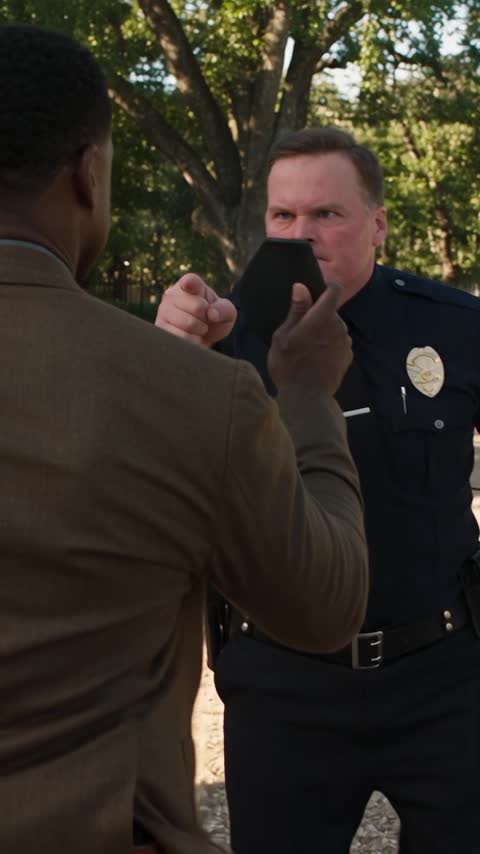
A corrupt police officer draws his gun and points it at a father who is reaching for some hidden federal documents.