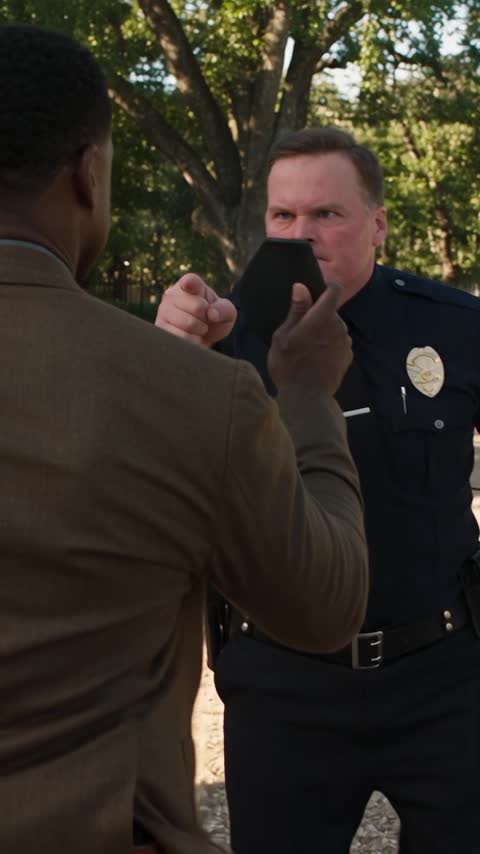
His right hand dropped from his belt and went straight to the retention hood of his Safariland holster. With a crisp, practiced snap, the thumb-break released.
The sound was unmistakable. Every parent within thirty feet gasped, several women screaming as they dragged their children behind parked Mercedes and Audis. Headmaster Sterling took a frantic step forward, his voice cracking. “Sergeant Concincaid! Please! This is a school zone—”
Concincaid didn’t hear him. The red mist had taken him completely.
He drew his service weapon, bringing the heavy black muzzle up in a two-handed combat grip, aiming it directly at the center of my chest from less than five feet away.
“On your knees!” he screamed, his spittle flying through the cold air and speckling the lapel of my blazer. “On your knees right now, or I will put you down in front of your kid! Hands behind your head! Down!”
The world slowed to a crawl.
In tactical training, they call it auditory exclusion and perceptual narrowing. The screams of the bystanders faded into an ambient hum. The horn blaring on Lexington Avenue became a distant echo. All that existed was the steel bore of that 9mm barrel, the nervous tremor in Concincaid’s index finger resting flat against the slide, and the shuddering sobs of my little girl clinging to my leg.
I could have disarmed him. At five feet, an off-balance officer leaning forward with locked elbows is vulnerable to an inside sweep and an elbow strike to the radial nerve. But disarming a cop on a public street with forty civilian witnesses ends in one of two ways: either you take his gun and get shot by his arriving partner, or you end up in a legal meat grinder where the initial narrative is written by the very department covering for him.
More importantly, my daughter was standing right beside me. A stray round ricocheting off the limestone steps would destroy my entire universe.
“You have five seconds to rethink what you’re doing, Sergeant,” I said. My tone wasn’t pleading. It wasn’t frightened. It was the terrifyingly flat voice of a federal operator who had signed warrants on international cartel operatives and lived through ambushes that made this sidewalk squabble look like child’s play.
“Down! On! Your! Knees!” Concincaid roared, his finger slipping off the slide and landing directly inside the trigger guard.
He was going to shoot. Not because he was in danger, but because his fragile ego could not survive an unarmed Black man refusing to grovel at his feet on a public street.
“Slowly,” I said, making sure every word was crystal clear for the school’s high-definition security cameras mounted above the archway. “I am reaching inside my left breast pocket to produce identification. Do not fire.”
“Don’t move, you son of a—”
I didn’t reach fast. I moved with deliberate, microscopic smoothness. Two fingers slipped inside the custom-cut pocket of my jacket. I gripped the thick leather of my credential case, pulling it upward into the daylight.
I didn’t drop to my knees. I didn’t flinch.
With a sharp flick of my wrist, the leather bi-fold snapped open, revealing the polished gold star enclosed within a circular laurel wreath—the historic shield of the United States Marshals Service—flanked by my laminated Department of Justice credentials, holographic federal seal, and rank: Senior Inspector Elias Thorne, Special Operations Group.
I held the badge six inches from Concincaid’s nose, right above the sightline of his drawn weapon.
“Senior Inspector Thorne, United States Marshals Service,” I projected, my voice booming across the courtyard with the unquestioned authority of federal law. “Identify yourself, holster your weapon immediately, and step the hell back before I charge you with aggravated assault on a federal officer.”
Concincaid’s eyes locked onto the gold star.
“Holster that weapon,” I repeated, stepping forward half an inch. The dynamic had completely inverted. I was unarmed in that moment, but behind that gold star stood the entire weight of Title 18 of the United States Code and the oldest federal law enforcement agency in the republic. “Right now. Put it in the leather.”
Behind him, Dr. Sterling rushed down the stairs, his face pale with horror. “Sergeant! Stand down! For God’s sake, put that gun away! Mr. Thorne is an enrolled parent! His daughter was admitted on full academic standing!”
Concincaid’s fingers fumbled clumsily against the holster as he jammed the Glock back into the retention hood. The mechanical click of the safety latch sounded like a surrender, but as his eyes came back up to meet mine, the shock was already curdling into something far more dangerous: vindictive, cornered panic.
“You… you didn’t identify yourself,” Concincaid lied, his voice cracking as he tried to rebuild his shattered posture in front of the gathered parents. “You reached into your jacket without warning. In this precinct, that’s considered a hostile movement. You’re lucky you didn’t get shot.”
“You drew a service weapon on an unarmed father escorting an eight-year-old girl into third grade,” I said, stepping between him and Maya, scooping up her purple backpack from the ground with one hand while keeping my credentials displayed with the other. “You shoved me. You assaulted a federal agent. And five minutes ago, I watched you shake down that delivery driver for fifty dollars in cash to let him park at a public curb.”
At the mention of the money, Concincaid’s jaw clenched so hard the muscles in his temples bulged. His eyes darted toward the delivery driver, who was now backing away toward his truck, terrified of being drawn into the blast radius.
“You don’t know what you’re talking about, Thorne,” Concincaid hissed, lowering his voice so only I could hear. “You might carry a federal tin, but you’re in the Nineteenth Precinct now. This is my house. You think you can walk in here, act like you own the place, and throw your weight around? You just made the biggest mistake of your career.”
“Is that a threat, Sergeant?”
A corrupt police officer draws his gun and points it at a father who is reaching for some hidden federal documents.