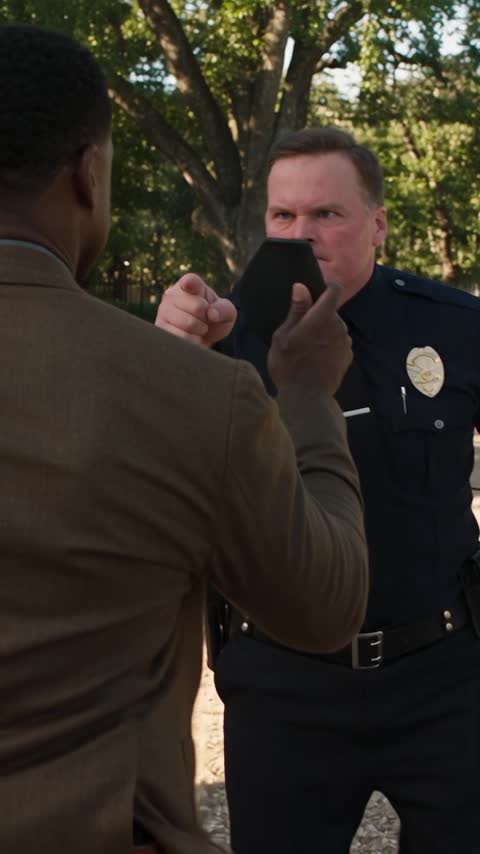
“That man in the gray jacket is a troublemaker who’s about to lose his job,” the stocky cop in the PBA windbreaker sneered, reaching out and snatching Mateo’s smartphone straight out of his shirt pocket. “Let’s just make sure you didn’t accidentally record anything stupid on this, huh? And by the way, your taillight looks cracked to me. Might have to impound this van for a forty-eight-hour safety inspection. Wonder what your boss says when you miss two days of deliveries.”
“No, please, I have a baby at home—”
I stepped cleanly out from behind the wooden pallets, my gold USMS star hanging openly from a steel chain against my slate-gray shirt, my blazer swept slightly back so both men could see the dark grip of my holstered weapon without me ever touching it.
“Put the kid’s phone back on the bumper, Officer Kowalski,” I said, my voice cutting like a razor through the damp bay. “And step three feet away from a federal witness.“
Both NYPD officers spun around as if they’d been hit with live voltage.
Kowalski’s face went rigid with shock, his hand twitching instinctively toward his hip before freezing as the heavy rumble of our Durango’s V8 roared into the apron, sliding smoothly across the nose of their unmarked Ford Fusion to pin them in. Delgado and Mercer stepped out instantly, dark tactical windbreakers pulled over their chests with gleaming gold U.S. MARSHALS lettering stamped across the front.
“What the hell is this?” Kowalski barked, trying to summon the arrogant bluster he’d worn on 79th Street, though his eyes darted wildly from Delgado’s slung rifle to the camera lens blinking red on our dashboard. “We’re conducting an active NYPD follow-up investigation! You’re interfering with local police business!“
“You’re in the Hundred-and-Eighth Precinct in Queens, off-sector, in an unmarked city vehicle, confiscating a civilian’s personal property without a warrant and attempting to coerce a witness in an active federal extortion inquiry,” I said, walking steadily forward until I stood between Mateo and the two officers. “Give me the phone.”
The stocky cop looked to Kowalski, sweat suddenly beading on his upper lip. Kowalski stared at me for three long, venomous seconds, calculating his odds against three federal operators and a rolling camera. Slowly, he nodded once. The stocky cop tossed Mateo’s smartphone onto the steel bumper, where it clattered loudly.
“You’re playing a dangerous game, Thorne,” Kowalski muttered, backing slowly toward the driver’s door of the Fusion. “Concincaid’s got friends at One Police Plaza you couldn’t get on the phone in a million years. You think you’re untouchable?”
“I don’t think I’m untouchable, Officer,” I said quietly. “I think you just committed witness tampering under 18 U.S.C. Section 1512 on federal audio. Get in your car and drive back to Manhattan. Tell Sergeant Concincaid I’ll see him at dismissal.”
Kowalski’s jaw worked furiously, but he didn’t say another word. Both men climbed into the Fusion. Delgado backed the Durango just enough to clear their nose, and the unmarked sedan peeled out onto Queens Boulevard with a shriek of tires.
The moment their taillights vanished under the overpass, Mateo Cruz sagged back against his delivery van, sliding half an inch down the steel door as his knees gave out. He buried his face in his hands, his shoulders shaking.
I stepped over, picked up his phone from the bumper, and held it out to him. “Are you hurt, Mateo?”
He looked up slowly, his eyes wide and wet with lingering terror. “They’re going to ruin me, sir. They know where I work. They know my plate. If I go back to St. Jude tomorrow, they’re going to plant something in my van like they did to Luis from the bakery last year.”
“Nobody is planting anything on you,” I said, lowering myself slightly so I was speaking to him man-to-man, not badge-to-civilian. “And you’re not going back there alone. Listen to me very carefully. Sergeant Concincaid thinks he owns East 79th Street because every single person he’s shaken down has been too scared to stand up to him. Today, he made a mistake. He pointed a gun at me in front of my eight-year-old daughter, and he threatened her.”
Mateo swallowed hard, staring at the gold star against my chest. “Your little girl… she was the one with the purple backpack?”
“Yeah,” I said softly. “Her name is Maya. And she’s still inside that school right now.”
Something shifted in Mateo’s young face—the quiet, fierce solidarity of one father looking at another. He wiped his cheek with the back of his red sleeve and straightened his spine. “What do you need me to do?”
“The assistant U.S. Attorney is signing an emergency federal authorization right now,” I said. “You still have a second afternoon drop-off scheduled for St. Jude Academy at three o’clock—the canvas rolls for the art department?”
Mateo glanced at his clipboard. “Yes. Three o’clock sharp. Before the buses clear out.”
“You’re going to make that delivery,” I told him. “Only this time, you’re going to be wearing a federal transmitter under your polo shirt, and you’re going to hand Sergeant Concincaid fifty dollars in serialized Department of Justice bills. You don’t have to act tough. You just have to let him talk. And the second he puts that money in his pocket, you walk back to your van, and my team ends his career forever.”
Mateo looked down at the phone in his palm, then up at the massive steel span of the Queensboro Bridge towering above us. He let out a long, steady breath.
“Okay,” Mateo said, his voice no longer trembling. “Give me the wire.”
Chapter Five
By two-forty-five that afternoon, the autumn sky over Manhattan had bruised into a heavy, slate-colored overcast, threatening rain.
A corrupt police officer draws his gun and points it at a father who is reaching for some hidden federal documents.