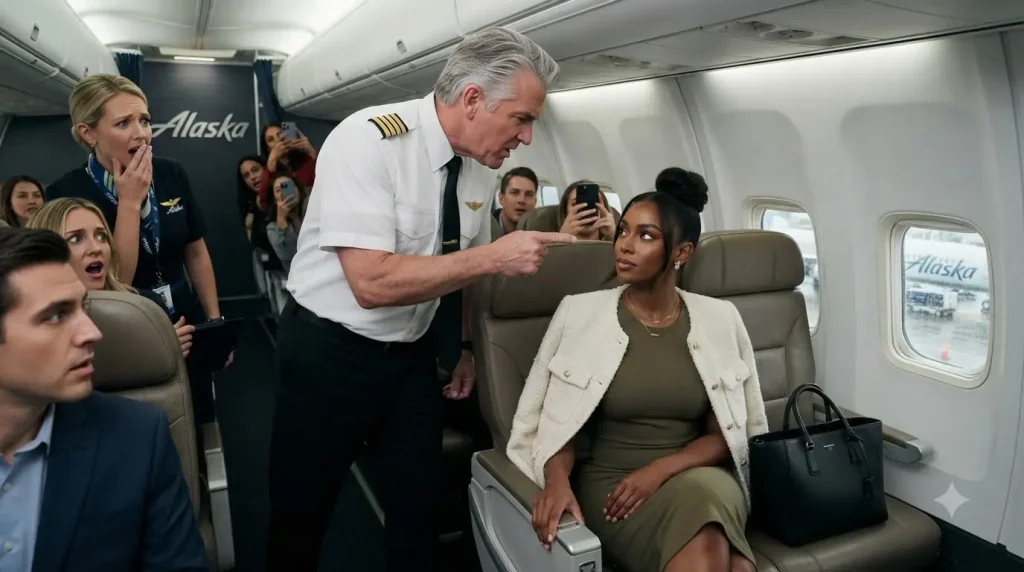
Leading the charge was David Lang, the interim chief executive officer of Northstar Atlantic—a man who had spent the last seventy-two hours not sleeping, trying to keep the airline out of Chapter 11. Behind him were Marcus Cole and Elaine Porter, Vanguard’s COO and General Counsel, both looking as though they had just sprinted an obstacle course in business attire.
Lang reached Door 1L, took one look at the tableau in the forward cabin—Arrington pale and sweating in his uniform, Maya standing with her torn jacket on the seat beside her, eight passengers recording on their phones—and grabbed the doorframe as if he were about to vomit.
“Maya,” Lang wheezed, his chest heaving under his damp shirt. “Maya, thank God. We saw your location ping at the gate. Elaine said the flight was delayed on a ground hold—”
Arrington turned toward the CEO, grasping at the final, desperate shred of his corporate reality. “Mr. Lang… David. This woman… she refused my orders. She was disruptive at the gate. I was exercising captain’s emergency authority under Part 121—”
“Shut up, Thomas,” Lang whispered.
The captain blinked, stunned. “David, I have absolute command of this aircraft—”
“I said shut your mouth!” Lang yelled, his voice cracking with a raw, terrifying rage that shocked the entire cabin. He stepped into the aisle, his finger trembling as he pointed it at Arrington’s nose. “Do you have any idea what you have done? Do you have the slightest, most remote conception of what has happened in the last two hours?”
Elaine Porter stepped past the CEO. Vanguard’s General Counsel did not raise her voice. She pulled a thick, leather-bound portfolio from under her arm, opened it, and extracted a single sheet of heavy legal parchment bearing the seal of the Delaware Chancery Court.
She picked up Maya’s torn bouclé jacket from seat 1C with two fingers, inspecting the shredded shoulder seam with clinical disgust.
“Captain Arrington,” Elaine said, her tone as dry as bone dust. “For the record, and for the benefit of the Port Authority officers currently walking down this bridge: did you apply physical force to remove this article of clothing from Ms. Washington’s person?”
Arrington’s mouth opened, closed, and opened again. He looked toward Melissa, his lead purser, his eyes begging for solidarity.
Melissa didn’t hesitate. She looked directly at Lang and the attorneys. “Yes, he did. He snatched it off her shoulders and threw it across the cabin after I told him the situation was resolved.”
Arrington’s knees seemed to loosen. He leaned back against the galley bulkhead, his silver wings drooping against his chest.
“I… I didn’t know who she was,” Arrington croaked, the words spilling out in a pathetic, desperate rush. “If someone had informed me… if the manifest had been flagged with VIP status… David, you have to understand, we’ve had five security incidents this month alone—”
“Stop,” Maya said.
One word. The cabin fell so silent that the hum of the fuel pumps seemed deafening.
Maya stepped forward until she was standing eighteen inches from Arrington. She did not look angry. That was the most terrifying thing about her; she looked like a judge reading a deed of foreclosure.
“You didn’t know who I was,” Maya repeated quietly. “That is your defense?”
Arrington could not hold her gaze. He stared at the blue carpet beneath his polished oxfords.
“You believe,” Maya said, her voice cutting through the cabin with surgical precision, “that if I had been an ordinary woman—if I had been a schoolteacher from Tacoma, or a nurse from Spokane, or an economy passenger whose company could only afford a cheap upgrade—you would have been fully justified in tearing her clothes off her back and having her dragged through this terminal in chains because an arrogant man in 2B was inconvenienced?”
Arrington swallowed hard. A drop of sweat traced a path down his temple, glistening in the harsh LED light.
“The failure of this airline,” Maya continued, turning her eyes slowly from Arrington to Brenda, who was cowering behind the galley curtain with her hands over her mouth, “is not your balance sheet, David. It is not your maintenance cycles or your software migrations. It is the fact that you have built a culture where small, miserable people with four stripes and plastic badges believe that authority is a weapon to be used against the vulnerable.”
She turned to Lang. “Are the police outside?”
“Yes,” Lang said, his voice trembling. “Two Port of Seattle officers. Maya, please, we can handle this internally. We don’t need an arrest on the tarmac. The publicity—”
“Bring them in,” Maya said.
Lang flinched, then nodded to Marcus, who stepped to the door and waved the officers forward. Two uniformed Port of Seattle police officers entered the cabin, their hands resting cautiously near their utility belts, their eyes wide as they took in the suit-clad executives, the crying gate agent, and the hollowed-out shell of Captain Thomas Arrington.
“Officers,” Maya said, her tone shifting into crisp, executive clarity. “I am Maya Washington, the managing partner of Vanguard Aero and the majority owner of Northstar Atlantic Airways.”
The lead officer, a sergeant with a weathered face, blinked in surprise. “Ma’am?”
“I called your dispatch through my corporate security desk fifteen minutes ago,” Maya said. “Captain Arrington engaged in an unlawful physical battery by tearing personal property from my body during an unjustified deplaning attempt. I do not wish to file criminal charges at this time.”
Arrington let out a long, ragged exhale of relief, his shoulders slumping.
“However,” Maya added, her voice dropping like an iron grate, “I require a formal police incident report filed documenting the battery, the witness statements of purser Melissa Grant and flight attendant Chloe Bennett, and the preservation of all onboard security camera footage. The legal department of Vanguard Aero will be filing a formal safety and conduct complaint with the Federal Aviation Administration’s Flight Standards District Office this afternoon.”





