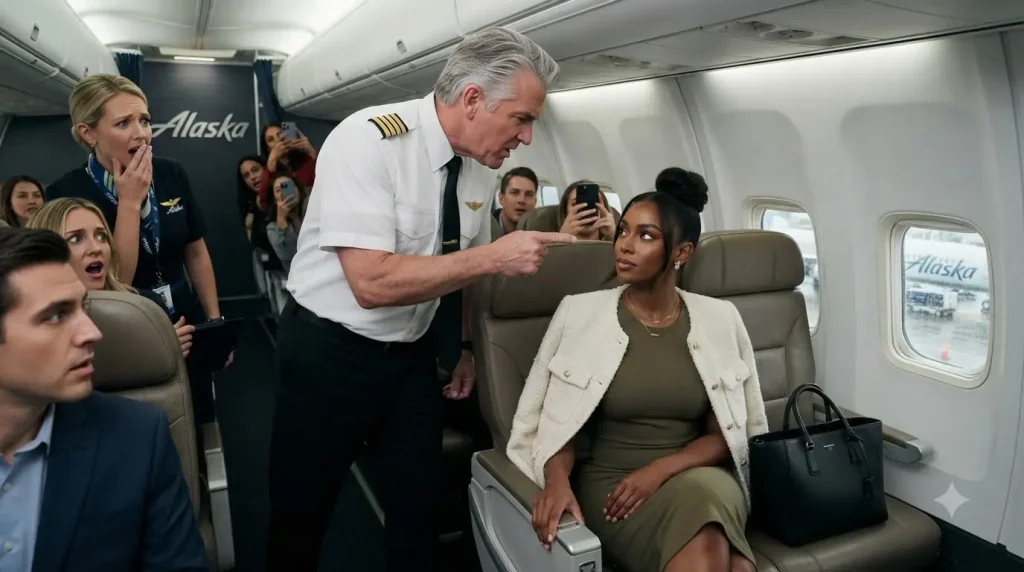
Maya leaned back into the charcoal leather, her gaze drifting out the oval window toward the gray, misty expanse of the taxiways.
“Adult supervision,” she repeated softly.
“Every time,” Richard said with a smug grin. “Every single time.”
At 8:28, the boarding door was supposed to be cross-checked and armed.
Instead, the passenger stream stalled. A cold draft gusted down the aisle as Brenda, the gate agent from the podium, stepped back onboard the aircraft, her eyes darting through the forward cabin until they locked onto Richard Hayes.
She hurried down the carpeted aisle, her low heels clicking against the composite flooring, and crouched beside his seat.
“Mr. Hayes?” she whispered, though her voice carried cleanly over the engine hum. “I’m sorry to disturb you. Did you say there was an incident at the gate with the passenger in 2A?”
Richard’s face underwent an instant, dramatic transformation. The easy, swaggering financier disappeared, replaced by the grave, wounded countenance of a civic-minded citizen who had witnessed a gross breach of public order.
“It wasn’t just an incident, Brenda,” Richard said, lowering his voice into a conspiratorial rumble. “She pushed past me in the boarding lane. When I told her to wait her turn, she became verbally aggressive. Told me to watch my back. Frankly, the way she was acting toward you at the counter was completely unhinged. She’s hostile.”
Maya did not move. She sat with her arms resting loosely on the armrests, listening to the fabrication with the cold curiosity of a scientist observing an insect twitch under ethanol.
Brenda looked across the console at Maya. “Ms. Washington, would you step into the galley with me, please?”
“No,” Maya said.
Brenda’s mouth dropped open. “Excuse me?”
“If you have an operational inquiry regarding my presence on this flight, you may conduct it right here,” Maya said. “There are twenty witnesses in this cabin. I prefer an open record.”
“You’re creating a scene,” Brenda hissed, her face turning crimson.
“Mr. Hayes is creating a narrative,” Maya replied. “You are facilitating it. I am sitting in the seat I purchased, waiting for pushback.”
“That’s it,” Richard said, throwing his hands up in mock exasperation. “See? Look at the attitude. She’s belligerent. I don’t feel comfortable flying six hours across the country with someone who’s clearly unstable.”
Brenda stood up immediately, her jaw set. “I’m getting the purser.”
Two minutes later, Melissa Grant arrived. The lead flight attendant was a veteran of thirty years, her gray hair cut into a sensible bob, her uniform impeccable. She did not look angry; she looked tired, bearing the accumulated weight of thousands of passenger disputes that had nothing to do with aviation and everything to do with ego.
Melissa knelt between the suites, listening first to Richard’s polished, indignant monologue, then to Brenda’s defensive interjections.
When they finished, Melissa turned to Maya. “Ma’am? Did you make any threatening statements to this gentleman?”
“I told him he was in the wrong line,” Maya said evenly. “Then I showed my boarding pass to the gate agent. When she questioned whether I bought the ticket, I showed her my government identification. I took my seat. I have not addressed Mr. Hayes except to decline his conversation.”
Melissa looked at Maya. She looked at the posture, the calm, unblinking eyes, the tablet open to an FAA engine-utilization database. Then she looked at Richard, whose face was flushed with the triumphant heat of an executive who believed he had just successfully orchestrated a boardroom ambush.
Melissa sighed. “All right. We’re ten minutes behind our departure slot. Mr. Hayes, you have an assigned seat. Ms. Washington, you have an assigned seat. We are going to close the door and take this flight to New York. Can we all agree to that?”
“I’m satisfied,” Maya said.
Richard scoffed, crossing his arms. “I want it noted that I’m flying under protest. If she says one word to me, I’m holding Northstar liable.”
“Understood, sir,” Melissa said, turning back toward the galley. “Brenda, let’s clear the bridge and pull the door.”
That should have been the end of it. It would have been the end of it on an airline that functioned with professional discipline.
Then Captain Thomas Arrington walked out of the flight deck.
Arrington had not come out to investigate. He had come out because his flight management computer had just flagged a fifteen-minute delay due to a missed departure slot in the Seattle corridor, and a late departure meant his monthly on-time bonus was currently evaporating into the wet Pacific air.
He was a line captain with twenty-eight years of seniority, a former naval aviator who ran his cockpits like a personal frigate and treated cabin crew as domestic staff.
“What’s the hold-up?” Arrington’s voice boomed down the narrow entranceway. “We’re burning fuel at the gate. Why isn’t that door armed?”
Brenda pounced. “Captain, we have a disruptive passenger in row two. Refusing crew instructions, threatening other passengers.”
Melissa turned sharply. “Thomas, it’s handled. It was a minor disagreement at the gate. Both passengers are seated. Let’s close the door.”
Arrington ignored her. He pushed past the galley curtain, his cap tucked under his arm, his eyes sweeping the cabin until they settled on Maya. He did not look at Richard. He looked at the Black woman sitting in 2A who was not looking at him with fear or deference, but with a cool, measuring indifference.
“Is this the one?” Arrington asked Brenda.
“Yes,” Brenda said. “She’s been uncooperative since the podium.”
Richard leaned into the aisle, his voice dripping with synthetic regret. “Captain, I really hate to cause a delay, but she’s been erratic. Threatening behavior. I don’t think it’s safe.”
Arrington stepped into Maya’s pod entrance, towering over her, using his height and his four gold stripes as an instrument of intimidation.
“Ma’am, stand up,” he ordered.
Maya didn’t flinch. “Why?”





