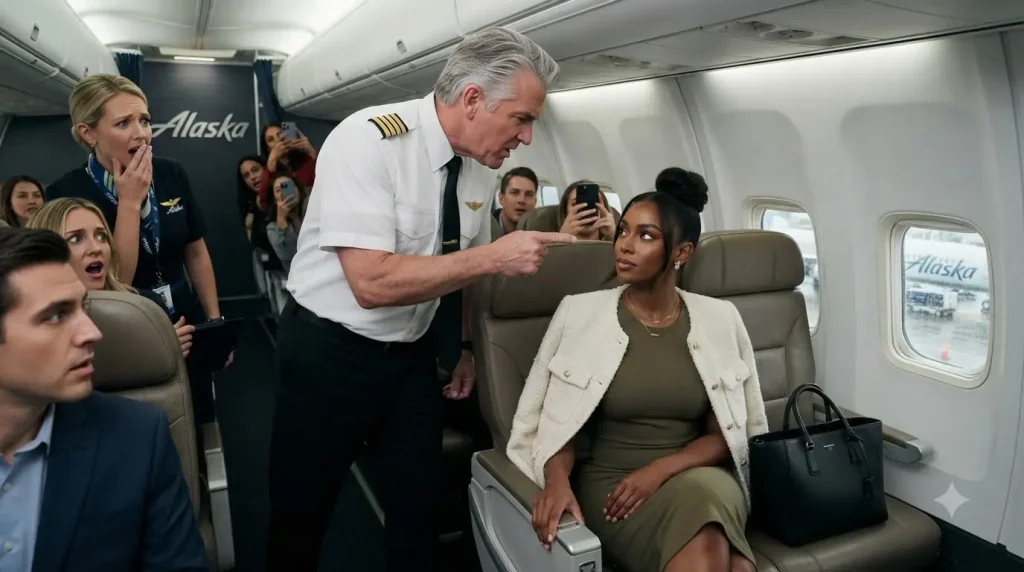
Captain Thomas Arrington, however, was not thinking about block hours or turbine cycles. He was thinking about territory. He stood planted in the forward aisle of the premium cabin, six feet two inches of crisp poly-wool uniform, gold bullion sleeve braid, and institutional certainty. His chest was puffed against his double-breasted jacket, the silver wings pinned above his heart catching the cold, blue-white LED boarding wash.
“You have two choices,” he said, his voice dropped to that measured, performative pitch men used when they wished to appear reasonable to everyone except the person they were cornering. “You walk off voluntarily, or Port of Seattle police remove you in irons. It’s that simple.”
Maya Washington did not uncross her legs.
She sat in 2A, the charcoal-leather window suite, her posture completely upright without stiffening. She wore an olive-drab silk jersey dress beneath an ivory bouclé tailored jacket—soft wool, unpadded shoulders, structured only by the precision of its cut. Her dark hair was wound into a severe chignon at the base of her skull, exposing diamond studs so small they looked like pinpricks of light against her deep brown skin.
She did not raise her voice. She did not reach for her purse, nor did she look down the aisle for an ally among the twenty-four executives, venture partners, and high-tier frequent flyers watching the scene over the rims of their laptops.
Slowly, using the deliberate, unhurried cadence of someone adjusting a microphone, she unlocked her phone, tapped the crimson shutter of the voice recorder, and laid the screen face-up on the slate-gray console separating her suite from the aisle.
“Say it again,” she said.
Arrington blinked. A tiny, rhythmic twitch rippled beneath his left eyelid. “Excuse me?”
“Clearly, this time,” Maya said. Her gaze had the flat, absolute stillness of water over deep rock. “The microphone is right beside your thumb. State the choice again.”
A muffled rustle swept through rows one through four. The boarding music—a sanitized, acoustic guitar cover of an eighties pop ballad—piped through the overhead speakers with grotesque cheerfulness. In the galley just behind Arrington’s broad back, a junior flight attendant named Chloe Bennett stood frozen against the coffee maker, both hands clutching a passenger manifest to her apron as though it were a blast shield.
The ruddy flush climbing out of Arrington’s starched collar deepened to the color of brick dust.
“You think recording me changes the reality of this aircraft?” he asked, a thin edge of a sneer breaking through his baritone.
“No,” Maya said, adjusting the cuff of her jacket by a single millimeter. “It preserves what happens next.”
“What happens next is that you leave.” He jabbed an index finger toward the boarding door. “Get off my airplane.”
Maya looked at the finger, then back to his eyes.
“Your airplane.”
“That is what I said.”
Maya almost let the corner of her mouth twitch upward. It was not amusement; it was the cold, cerebral satisfaction of an auditor watching an embezzler sign his own voucher.
For fourteen unbroken hours, locked inside the frosted-glass annex of a private terminal across the airfield, Maya had breathed recycled HVAC air and stared at three-hundred-page loan covenants. She had parsed definitions of operational authority, title transfer, senior secured collateral, and post-closing governance. She had signed her legal name forty-two times with a weighted fountain pen while an army of investment bankers chewed their knuckles.
Technically, Thomas Arrington was closer to the operational truth than he understood. The Federal Aviation Administration granted him absolute command authority under Part 121 once the main cabin door was sealed.
The trouble for Thomas was that the door was still wide open.
And the ink on the stock purchase agreement was already dry.
At 6:40 that morning, the final wire had cleared the clearinghouse in New York.
Maya had stood at the plate-glass window of the Signature Flight Support suite, watching the rain slant across the runway lights in silver needles. Behind her, the conference table looked like the aftermath of a siege: cold bagels drying out on plastic trays, crumpled drafts of Schedule 4.12, and four white-shoe corporate attorneys who looked as though they had been beaten with their own briefcases.
Vanguard Aero Holdings had acquired fifty-eight percent of the voting common equity of Northstar Atlantic Airways.
Not an alliance. Not a DIP financing facility with conversion options. Control.
Maya had founded Vanguard nine years prior in a windowless sublet in Chicago, armed with a spreadsheet model and three hundred thousand dollars of seed capital pulled together from family trusts after she walked out of a mid-tier private equity firm. The managing partners at that firm had patted her shoulder, praised her “analytical fire,” and told her that commercial aviation was too operationally messy, too capital-intensive, and far too dependent on legacy union relationships for a thirty-something Black woman with an engineering degree to navigate without a leash.
So she had built the leash herself.
She had bypassed the passenger sector initially, learning the brutal, cash-generative machinery of the trade from the bottom up. She bought expiring CFM56 engine leases from bankrupt cargo operators. She studied the metallurgical fatigue cycles of high-pressure turbine blades. She leased narrowbody freighters to regional freight operators in Memphis and Louisville, monetized secondary takeoff and landing slots at Gatwick, and mastered the Byzantine arcana of cross-border fuel-hedging swaps.
When legacy airlines choked on debt during the last fuel spike, Vanguard had the balance sheet of an offshore bank and the risk tolerance of an apex predator. By thirty-four, she was managing eight point four billion dollars in aviation assets.
Northstar Atlantic was the crown jewel, or rather, the battered heirloom she had stalked for two years.





