A federal clerk had sent a routine request to the county camera vendor under sealed authority but accidentally included an internal routing code identifying McKetric County as subject to enhanced preservation.
Someone at the vendor mentioned it to a former employee.
That former employee was Lieutenant Price’s cousin.
The cousin told Price federal investigators were mirroring certain cameras.
But Price apparently misunderstood when the mirror would begin.
He believed the federal duplication started after footage uploaded at the end of a shift.
Not live.
That explained the deletion attempts.
It did not explain Nia.
Then Dylan Laam’s hidden station footage produced another answer.
At 10:58 p.m., forty-two minutes before Keller approached Nia, Captain Vance entered Laam’s Gas & Go wearing civilian clothes.
He bought coffee.
He remained inside six minutes.
At 11:03, a dark sedan entered the lot.
A man stepped out and handed Vance an envelope.
They spoke beside the ice machine.
The camera had no audio.
But the man’s face was clear.
Rebecca identified him.
Calvin Ross.
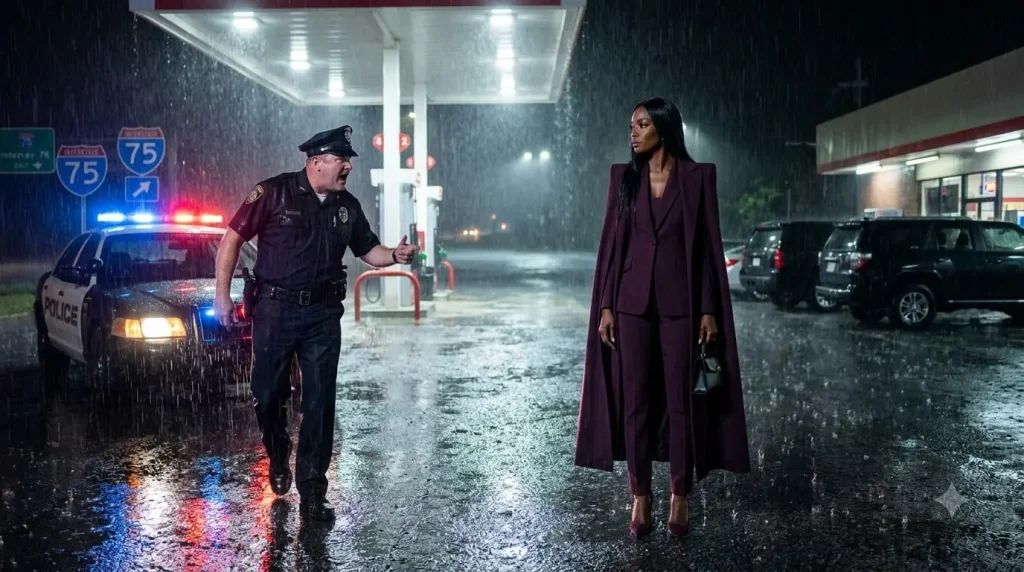
The October rain came off Interstate 75 in thick, wind-whipped sheets, hard enough to swallow the tree line at the edge of the asphalt and turn the neon signage of Laam’s Gas & Go into bleeding ribbons of crimson and cobalt across the flooded tarmac. At eleven-forty on a Tuesday night, Exit 41 looked less like a highway interchange and more like a drowned outpost at the edge of the world—a lone rectangle of harsh sodium light surrounded by forty miles of dripping Georgia loblolly pines and black clay.
Beneath the rust-streaked fiberglass canopy, the overhead ballast above Pump 6 buzzed like an angry hornet, flickering twice every few seconds before snapping back to a jaundiced glare. Semi-trucks thundered past on the elevated southbound lanes a hundred yards away, their eighteen wheels throwing blind white plumes of spray into the darkness.
Special Agent Nia Brooks stood beside the open fuel door of a dark obsidian Cadillac Escalade, one hand resting smoothly on the cold steel latch of the diesel nozzle while the other remained tucked inside the pocket of a floor-length, deep-plum cashmere coat. To any passing motorist squinting through dirty windshield wipers, she looked like a high-priced corporate litigator or a pharmaceutical executive who had misjudged her fuel gauge between Macon and Valdosta and taken the wrong rural ramp out of a much wealthier universe.
At thirty-eight, Nia carried herself with an unhurried, architectural stillness. Beneath the outer coat, she wore a custom-tailored plum trouser suit with sharp shoulders, a cream silk camisole, and pointed leather heels that had already collected a fine crescent of pine needles and gritty puddle water along the welts. Her black hair fell straight and immaculate past her collarblades. On the butter-soft leather of the front passenger seat sat a structured Givenchy handbag, resting just above the floor well where a slim, matte-black Pelican currency case lay deliberately angled beneath the dome light’s shadow.
No one glancing across the wet concrete would have noticed the slight, reinforced drop of her left jacket lining that concealed a chambered Glock 19M in a zero-cant pancake holster. No one would have spotted the sub-miniature bone-conduction microphone stitched behind the silk lapel of her coat, or understood that a single double-tap on the bezel of her stainless-steel Chronograph watch would bring six heavily armed federal agents out of the dark in under eighteen seconds.
That carefully calibrated contrast—apparent vulnerability wrapped around lethal institutional precision—was the entire premise of Operation Lantern.
Nia did not turn her head when the white-and-charcoal Dodge Charger rolled off the county access road and glided beneath the far corner of the canopy. Instead, she watched its distorted silhouette stretch across the wet, curved sheet metal of the Escalade’s rear passenger door.
McKetric County Police Department. Unit 214.
Officer Wade Keller was right on schedule.
The cruiser crept past the outer row of pumps at five miles per hour, its wide push-bumper glistening in the rain, tires hissing over the rainbow slicks of spilled diesel. Through the tinted side glass, Nia caught the pale blur of a broad face turned toward her license plate. The Charger rolled past the glowing windows of the convenience store, reached the edge of the drainage ditch at the back of the lot, and stopped. Its red brake lights flared against the wet weeds. A heartbeat later, the white reverse lamps kicked on, and the heavy V8 hummed backward until the cruiser sat angled at forty-five degrees across the exit lane, thirty feet off her rear quarter-panel.
Nia’s pulse remained a flat, disciplined sixty-two beats per minute.
Three hundred yards west, inside a blacked-out Ford Transit utility van tucked behind the collapsed cinderblock wall of an abandoned radial-tire warehouse, Supervisory Special Agent Marcus Hale leaned closer to a glowing triple-monitor rack. The air inside the van smelled of damp wool, ozone, and lukewarm coffee.
“Unit 214 just boxed the south apron,” Marcus murmured into his throat mic. “He’s running her tag through the mobile terminal now.”
Beside him on the narrow metal bench, Assistant United States Attorney Rebecca Sloan adjusted her wire-rimmed glasses, her eyes fixed on the center screen. “Does Brooks have visual?“
“In her door mirror. She’s holding position.“
“Do we roll the blocking vehicles to the road edge?” Rebecca asked, her fingers tightening around a rolled manila indictment draft.
“Negative,” Marcus said without blinking. “If Keller catches headlights staging in the scrub before he commits to a seizure, he writes a courtesy warning for a dirty license plate lamp and drives away. We don’t move a tire until he crosses the Fourth Amendment threshold or she triggers the watch.“





