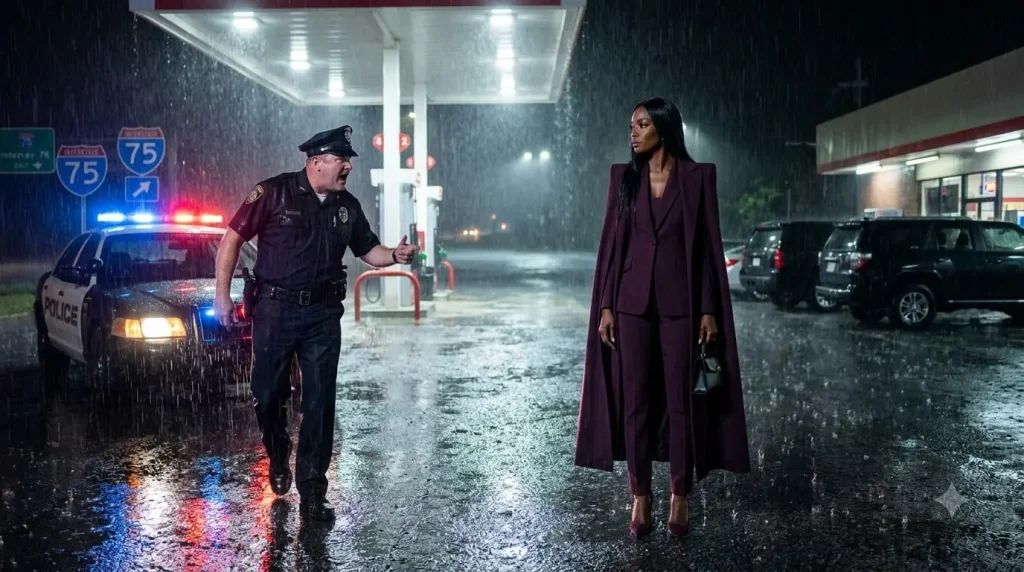
Rebecca shifted her gaze to the right-hand monitor. The video feed displaying there did not come from the pin-hole optical sensor disguised as a screw head on Nia’s rooftop luggage rack, nor from the long-range infrared lens poking through the tire shop’s broken window. It was a wide-angle, fish-eye view looking straight out over a thick steering wheel and a mounted patrol shotgun, stamped in the upper corner with a live yellow serial watermark: MCPD-AXON-214-KELLER, W.
It was Wade Keller’s own chest-mounted body camera.
For eleven weeks, ever since a career regional engineer at the cloud-storage contractor grew disgusted with McKetric County’s blatant administrative purges and walked into the FBI’s Atlanta Resident Agency with a thumb drive, a sealed Title III wiretap and digital-mirror order signed by a federal district judge had been sitting directly on the vendor’s central ingestion server. Whenever four specific officers in the McKetric County patrol division activated their cameras—or whenever the units automatically entered pre-event buffering triggered by the cruiser’s light-bar switch—the raw high-definition cellular uplink bifurcated. One stream went to the county server in the basement of the McKetric courthouse, where Lieutenant Owen Price and Captain Harold Vance routinely marked inconvenient encounters as corrupted upload or accidental activation—purged.
The second stream went straight to a write-once federal evidence vault in Atlanta—and, tonight, directly to the satellite transceiver bolted to the roof of Marcus Hale’s surveillance van.
On the screen, Keller’s gloved thumb flicked the auxiliary toggle for his rear amber deck lights. Instantly, the body-cam audio kicked from silent buffering to live capture. The microphone picked up the wet squeak of Keller’s leather Sam Browne belt, a heavy nasal exhale, and the metallic clack of his door handle.
“Audio is hot,” Marcus said softly. “Here we go.“
At Pump 6, the fuel nozzle clicked off automatically. Nia gave the trigger a single neat squeeze to round the digital display to an even fifty dollars, lifted the nozzle from the neck, seated it back into the cradle, and screwed the tether cap until it clicked. She had taken two measured steps toward her driver’s door when a flat, gravel-rough voice boomed under the tin canopy.
“Hold up right there. You.“
Nia paused with her fingers an inch from the chrome door pull. She turned cleanly on the ball of her foot, keeping her posture open and unhurried.
Wade Keller was forty-six years old, built like an oak stump stuffed into dark navy polyester. He had a thick neck, pale sun-freckled skin, and bristling blond-gray hair shaved to the scalp above his ears. He walked with the rolling, slightly bow-legged gait of a veteran patrolman who had spent two decades learning that nobody within thirty miles of the county line had the authority to audit his shift. He wore no rain jacket; dark beads of moisture clung to the gold-plated badge pinned over his left pectoral and the glossy black lens of the camera clipped to his center placket. His right palm rested squarely on the hood of his level-three retention holster.
“Step back away from the vehicle, ma’am,” Keller ordered, halting ten feet out, keeping the corner of the concrete pump island between them.
Nia tilted her head half an inch, pitching her voice to project clearly over the rush of the interstate and the hum of the bad fluorescent ballast. “Is there a problem, Officer?”
“I told you to step away from the truck. Put some daylight between you and that door.“
Nia took three slow steps backward toward the rear wheel well, letting the wind-driven mist catch the right shoulder of her plum wool coat. If she invoked federal supremacy now, or cited Terry v. Ohio before he committed himself on tape, four months of forensic accounting and grand jury subpoenas would evaporate into a jurisdictional shouting match. She needed him to hunt.
Keller swept his flashlight beam across the Escalade’s tinted rear windows, lingered on the clean Fulton County license plate, and finally brought the harsh white LED cone up to chest level, letting the spill blind her slightly.
“Who does this rig belong to?” Keller demanded.
“It belongs to me,” Nia answered evenly.
“Registered in your name?”
“Registered to my consulting firm in Atlanta. The registration card and proof of insurance are in the glove box.”
“And your operator’s license?”
“Inside my handbag on the front passenger seat.”
Keller took a step closer, his eyes narrowing as they traveled from her immaculate silk lapel down to her wet pointed heels. “Don’t you reach for that door handle.”
“My hands haven’t moved, Officer.”
“Get ’em out of the coat pockets. Keep ’em up above your waist where I can see all ten fingers.”
Nia slowly withdrew her left hand from the cashmere pocket and held both palms open at rib height, wrists relaxed. Inside the convenience store fifty feet away, behind a wall of humming beverage coolers and neon lottery signs, nineteen-year-old Dylan Laam stopped wiping down the hot-dog rollers and stared through the rain-streaked plate glass.
Dylan knew that posture. Over the three years he had worked the graveyard shift for his father, Kareem, he had watched Wade Keller and two other night-shift regulars execute that exact routine at least a dozen times under the outer pumps. It was never locals in beat-up F-150s with rusted tailgates. It was always solo drivers with out-of-county tags—Florida plates, Fulton County plates, North Carolina rentals—usually Black or Latino motorists stopping for coffee or fuel after midnight when the highway thinned out.
Kareem Laam had emigrated from Beirut twenty-four years ago and bought the run-down Gulf station when Exit 41 was nothing but dirt and timber slashes. He had taught his son two iron rules about surviving in McKetric County: always pay the county fire inspector in cash before Thanksgiving, and never stand near the glass when Unit 214 had a motorist braced against a fender.





