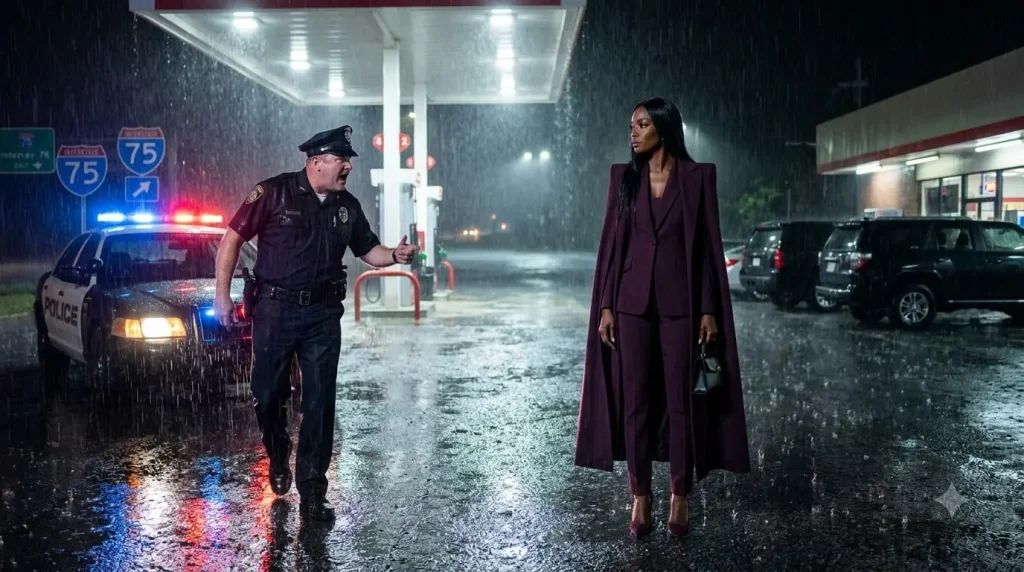
Six months earlier, after Lieutenant Price had walked into the back office unannounced and seized the station’s primary DVR hard drive following a disputed arrest at Pump 4—claiming the unit had “suffered a power surge” when it was returned blank three days later—Kareem had spent four thousand dollars on a secondary, hardwired 4K solid-state recorder. Its micro-lenses were recessed inside the decorative soffit vents above the ice chest, and its storage drive was bolted inside a dummy septic junction box beneath the concrete floor of the stockroom.
Watching the tall woman in the plum coat hold her hands up in the cold rain while Keller prowled around her passenger window, Dylan felt a familiar, sick knot tighten beneath his ribs. Without taking his eyes off the lot, he reached beneath the cigarette register and flipped the recessed red toggle switch that locked the hidden SSD into permanent write-protect mode.
Outside, Keller shone his flashlight directly through the Escalade’s front passenger glass. The beam illuminated the structured designer handbag—and then slid lower, catching the heavy brass padlock lug on the corner of the matte-black Pelican case wedged partially beneath the seat track.
Inside the case, banded in neat federal reserve straps, sat eighteen thousand dollars in sequential twenty- and fifty-dollar bills whose serial numbers had been optically scanned and notarized by an FBI evidence technician at sixteen hundred hours that afternoon.
Keller’s flashlight froze on the edge of the plastic case for three full seconds. When he turned back toward Nia, the sleepy routine boredom of a graveyard patrolman had vanished, replaced by a hard, predatory stillness.
“What are you doing off the highway at midnight in McKetric County?” Keller asked.
“Buying diesel,” Nia said.
“Smart mouth don’t play well out here, lady. Where are you coming from?”
“South of Macon.”
“Heading where?”
“Back to Atlanta.”
Keller sneered, stepping within arm’s reach. “You came down from Atlanta three hours ago according to the tag reader at mile marker sixty-two. Why is a woman dressed for a country-club dinner driving circles down I-75 in the middle of a storm with a locked hard-case on her floorboard?”
Nia met his gaze steadily. “My travel schedule isn’t a traffic infraction, Officer. Have I violated a statute?”
Instead of answering, Keller’s eyes dropped to the tailored drape of her coat over her left hip. Twenty years of street intuition made him tilt his head. “You carrying anything on your person I need to know about?”
This was the compliance fork Rebecca Sloan had drilled into the operational plan. Under Georgia law and Bureau protocol, if directly asked about weapons during an investigative contact, Nia could not fabricate a denial without tainting the subsequent entrapment review at trial.
“Yes,” Nia said calmly. “I have a cellular telephone in my right coat pocket, and I am wearing a holstered handgun on my left hip.”
Keller’s body stiffened like a pointer hitting scent. His right hand snapped the leather hood off his Glock 22 holster and wrapped around the checkered grip. “Don’t you fucking breathe! Get those hands up! Higher—up by your ears!”
“My hands are raised and completely clear of my garment,” Nia said, lifting her palms calmly to shoulder height. “I am legally authorized to carry it.”
“You got a Georgia weapons carry license?”
“I carry under federal statutory authorization.”
In ninety-nine out of a hundred roadside police encounters across the United States, those five words acted as an immediate de-escalation valve. A local patrolman hearing federal authorization from an articulate, composed driver in a seventy-thousand-dollar vehicle stepped back half a pace, called for a backup unit, and asked slowly where the credentials were located.
Wade Keller did not step back.
Instead, the blood rushed out of his wind-chapped cheeks, leaving two pale, blotchy crescents beneath his cheekbones. His eyes didn’t widen with confusion; they narrowed with sudden, vicious comprehension.
“Federal?” Keller repeated, his voice dropping to a low, ragged rasp that barely carried past the drip of the canopy gutter. “What kind of federal?”
Nia felt the geometry of the entire night shift beneath her heels. That wasn’t the reaction of a crooked beat cop surprised by a random off-duty government employee. That was the reaction of a man who had been warned to watch for a trap.
“My credentials and shield are in the upper left interior breast pocket of my jacket,” Nia said carefully, watching his trigger finger through the falling mist. “You may retrieve them yourself if you wish.”
“Shut up!” Keller hissed. He stepped straight into her personal space, so close the brim of his wet campaign hat nearly brushed her forehead and the sour stench of wintergreen dip and stale coffee washed over her face. He glanced wildly over his left shoulder toward the dark, empty tree line across the two-lane highway, then back at the black Pelican case visible through her window. “Who sent you down here? Did Calvin Ross cut a deal with the state?”
Inside the surveillance van three hundred yards away, Marcus Hale bolted upright in his seat, knocking his coffee mug off the console shelf.
“What did he just say?” Rebecca whispered, her hand flying to her mouth. “Did he just say Calvin Ross?”
“Wait,” Marcus barked, his eyes glued to the physiological telemetry and the close-up body-cam image of Nia’s calm face. “He’s not fishing. Somebody burned the drop.”
Beneath the canopy, Nia’s mind raced through the operational firewall in half a second. Calvin Ross was a regional bail bondsman and real-estate fixer in neighboring Bleckley County whom the IRS Criminal Investigation division had quietly subpoenaed forty-eight hours ago regarding laundered tow-yard receipts. Nobody in McKetric County was supposed to know Ross had even been served.
“I don’t know anyone named Calvin Ross,” Nia said, keeping her voice flat and level. “Officer, you initiated this contact while I was pumping fuel.”





