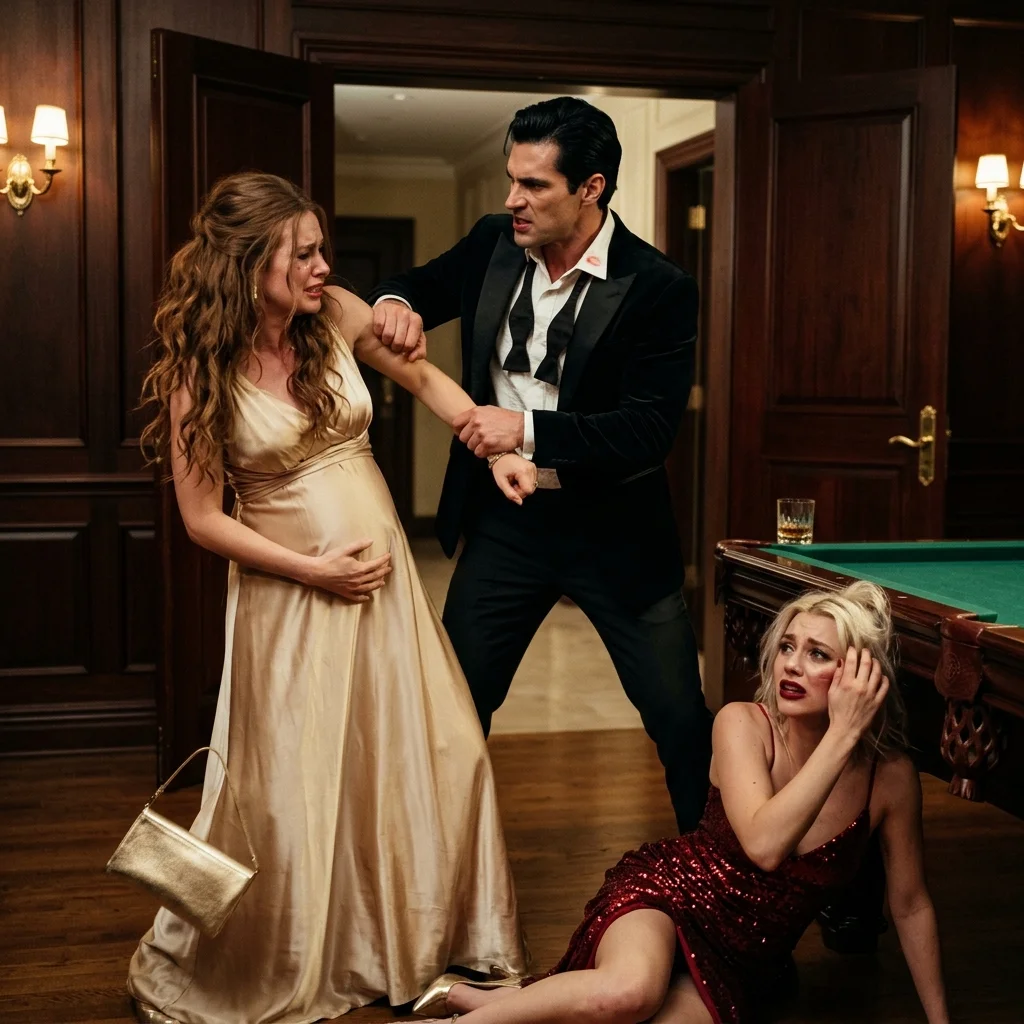
Before she could back away further down the hall, Matteo closed the gap between them. This time, when he took her by the right elbow, his grip wasn’t rough. It was terrifyingly gentle—firm, practiced, and utterly irresistible, guiding her five paces down the corridor toward the tall mahogany double doors of their bedroom suite as if he were merely escorting an overtired invalid back to her pillows.
“Let go of me,” she whispered, trying to plant her swollen feet on the runner, her fingers scrabbling uselessly against the black wool of his sleeve. “Matteo, stop—”
“You’re shaking, and your face is flushed,” he said smoothly, turning the brass lever of the master suite with his free hand and ushering her across the threshold into the vast, shadowy bedroom where a low fire burned behind a brass screen. “Dr. Vance said stress could trigger a spike. You need to lie down before you hurt yourself or the boy.”
“Don’t do that,” Vivian said, backing away toward the four-poster bed as he stepped inside and pulled the door shut behind his back. “Don’t use my son as a shield so you don’t have to look at what you did downstairs!”
“You’re hysterical right now, Viv. You’re running on hormones and shock, and you aren’t thinking clearly.”
“I am thinking more clearly than I have in four years,” she said, standing straight in the middle of the Aubusson rug. “And I am not staying in this house while my sister sleeps down the hall and you treat me like breeding stock. I’m packing a bag in the morning.”
Matteo stood with his hand resting on the interior brass doorknob. In the dim amber flicker of the hearth, the suave Manhattan developer was gone. He looked at his pregnant wife with the exact same calm, merciless finality he had used the night he ordered Luca to shut down the docks in Bayonne.
“Get some sleep, Vivian,” he said quietly. “I have to go down and make the midnight toast with the capos so nobody asks why you left early. We’ll talk about how we’re going to arrange the spring when you’ve calmed down.”
“I told you, I am leaving in the morning.”
Matteo stepped backward across the threshold into the hallway, drawing the heavy, solid-core mahogany door toward him.
“No,” he said softly through the narrowing gap. “You won’t.”
The latch clicked home.
Then, half a second later, came a sound that had never once occurred in the four years Vivian had slept in this room.
Clack-tunk.
The heavy, antique deadbolt—whose brass keyhole had been retrofitted on the exterior hallway side during the security overhaul after the Hoboken bombing so the panic-room sector could be isolated—turned from the outside.Followed two seconds later by Matteo’s quiet voice speaking in Italian to someone stationed in the corridor:
“Rocco. Stay on the gallery chair until I come up at two. Nobody goes in, and she doesn’t come out.”
“Sì, Boss.”
Vivian stood completely paralyzed in the center of the bedroom rug, five feet from the locked door, one hand pressed flat against her breastbone and the other cradling the lower curve of her belly where the baby was still shifting restlessly.
Downstairs, the muffled roar of three hundred voices swelled as the band leader took the microphone to announce the final ten-minute warning to midnight.
For ten seconds, the walls of the thirty-by-forty-foot suite seemed to contract around her, the silk wall coverings and museum-grade oil paintings pressing inward like the lid of a velvet-lined coffin. If she waited until morning, she knew with absolute, bone-deep certainty what would happen. At eight o’clock, Dr. Vance—who sat on the payroll of Matteo’s private clinic in Englewood—would arrive with a leather bag, take her blood pressure, declare her at imminent risk for eclampsia, and place her on mandatory, twenty-four-hour sedated bed rest with two private nurses hired by Luca Rossini stationed inside her sitting room until the day they induced labor and took her son into the nursery across the hall.
Once that baby was out of her body, Matteo wouldn’t need her alive, let alone free. And Camille was already waiting at the bottom of the stairs in a gold dress, practicing how to wear the dead wife’s pearls.
Vivian closed her eyes. She drew in one slow, four-count breath through her nose, held it for four counts, and let it out through her lips—the exact Lamaze breathing cadence she had been practicing alone in the afternoons.
When she opened her eyes, the tears were gone.
She did not walk to the bedroom windows—she knew the second-floor casements were wired into the Honeywell security loop in the gatehouse, and dropping twenty-five feet onto frozen flagstones at seven months pregnant was suicide. She did not pick up the cream-colored landline extension on the nightstand, which routed directly through the estate’s switchboard.
Instead, Vivian walked swiftly and silently across the bedroom into her private cedar-lined dressing room, pushed the pocket door almost closed so no chink of light would show beneath the main hallway threshold, and knelt down behind the island of glass-fronted shoe cabinets.
Her knees protested, and the bulk of her stomach made bending forward an exercise in geometry, yet her fingers moved with practiced, unhesitating memory.
Eight months ago—in early April, three weeks before she discovered she was pregnant—Vivian had gone down into the estate’s wine cellar to fetch a bottle of 1996 Barolo for Matteo’s birthday dinner and had overheard Luca Rossini and Matteo’s chief accountant, Arthur Vane, talking behind the racking room door while feeding documents into a cross-cut shredder.
They hadn’t been discussing gambling or union dues. They had been discussing a patient named Thomas Hale at the Silver Crest Neurological Pavilion in Greenwich.
Vivian’s father.





