Then the final strobe of a white titanium salute mortar flared outside the window, illuminating the linen pillow on his side of the mattress.
Matteo stopped.
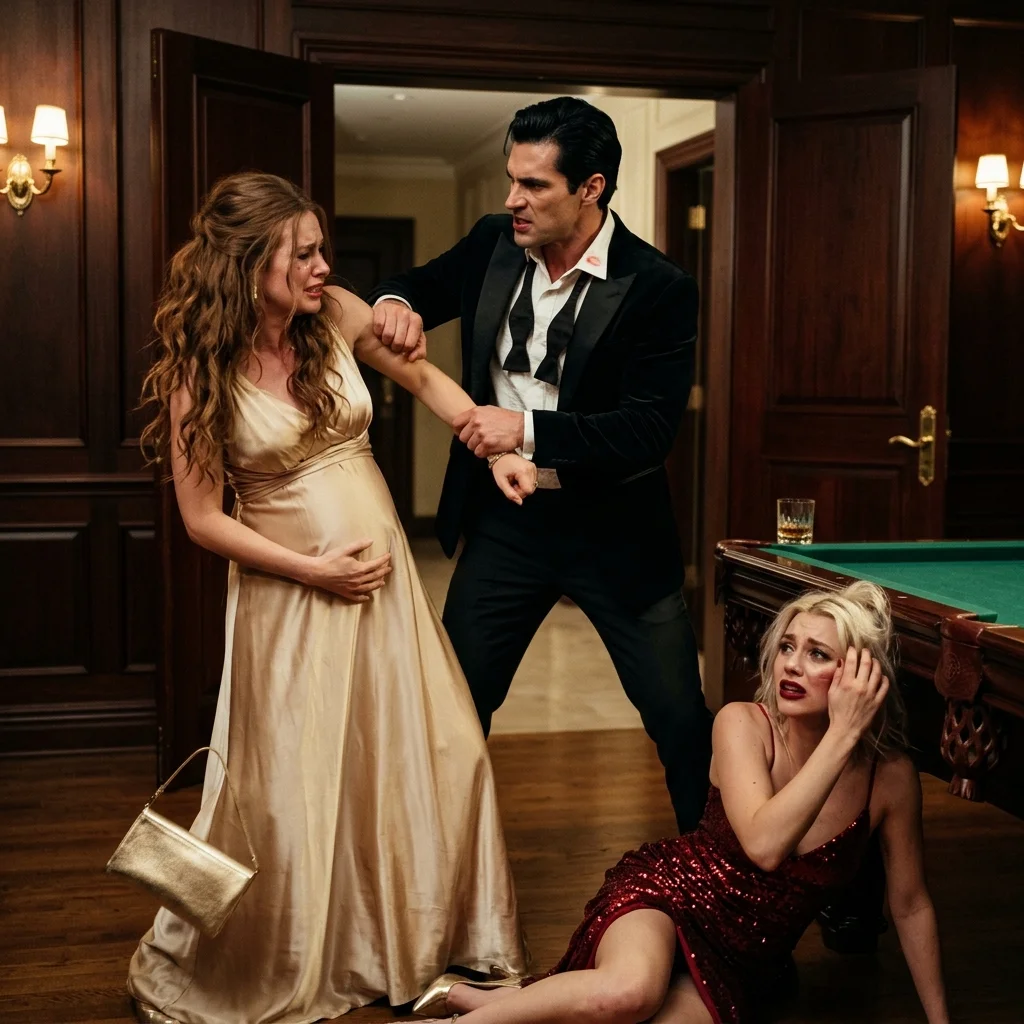
Sitting dead center on the white Egyptian cotton were two objects: her four-carat diamond engagement ring stacked neatly inside her platinum wedding band, and right beside them, the antique sapphire bracelet Camille had been wearing in the billiard room—with a distinct smudge of green pool-cue chalk across the clasp.
The silence in the bedroom suddenly changed density.
“Vivian?” Matteo’s voice was no longer soft.
He strode across the rug in three long steps and shoved the pocket door of the master bathroom all the way into the wall. The marble tub was dry. The lights were off.
He spun around and crossed into her cedar dressing room, flipping the wall switch so the recessed halogen spots blazed to life.
The emerald maternity gown lay in a neat circle near the shoe island. And three feet behind it, beneath the rack of winter coats, the third cedar floorboard had been lifted out and laid neatly beside an empty rectangular cavity between the floor joists—a cavity whose dusty interior still held the sharp, clean rectangular outline of a bag that had been sitting there for months.
And at the very back of the closet, where five of Matteo’s heavy cashmere overcoats had been pushed aside on the brass rod, a twenty-four-inch-wide rectangular doorway yawned open into pitch-black, centuries-old brick.
Matteo stared at the open hole in the wall of his own fortress.
For three full seconds, the head of the Draven family couldn’t process what his eyes were reporting. He had twelve armed guards patrolling a twelve-foot stone perimeter wall; he had thermal motion sensors on the lawn and license-plate readers on the quarter-mile driveway; he had locked her behind a two-inch solid-core mahogany door with a soldier sitting ten feet away.
And she had walked straight through the bones of the house while three hundred people clapped at the sky.
Matteo didn’t shout for Rocco. He lunged back to his nightstand, snatched up his encrypted satellite iPhone, and hit the speed-dial for the security command post in the gatehouse while pulling his Sig Sauer P365 from the biometric safe in his bedside drawer.
“Gatehouse, Gerry,” the head of night security answered over the roar of the wind outside.
“Lock the main gates and the service road right now,” Matteo snarled, his heart hammering against his ribs with a cold, unfamiliar violence as he shoved the nine-millimeter into the waistband of his tuxedo trousers and sprinted out of the bedroom toward the back stairs. “Drop the hydraulic bollards on Route 9. Nobody leaves the property—not a waiter, not a musician, not a catering van. Search the north orchard and the greenhouse wall on foot. Now!”
Half a mile away, where the crumbling nineteenth-century brick retaining wall of the Ravenscroft orchard met the unplowed county drainage ditch along Old Post Road, the air was nineteen degrees and smelled of pine needles and frozen mud.
Twenty minutes earlier, while the midnight fireworks were still shaking the sky above the river, Vivian had emerged from the rusted iron grate of the greenhouse root cellar. She hadn’t run toward the main driveway where the catering trucks and town cars were lined up; she knew the cameras covered every inch of the asphalt. Instead, using the red-lensed penlight and a path she had mapped out during her autumn morning walks when the guards thought she was gathering dried hydrangeas, she had followed the dry stone bed of the estate’s storm culvert underneath the northern perimeter wall—a three-foot-wide granite drainage arch whose iron bar-grate had rusted through its bottom hinge during Hurricane Irene twelve years ago and had been hidden behind a dense thicket of overgrown winterberry bushes ever since.
It had taken every ounce of strength in her thirty-one-week-pregnant body to wedge herself sideways through the eighteen-inch gap in the rusted iron bars in the pitch dark, scraping the knuckles of her right hand raw against the frozen granite and soaking the knees of her fleece leggings in icy ditch water.
Waiting two hundred yards down the dark, tree-lined shoulder of Old Post Road—parked with its lights off behind an abandoned county salt-storage shed—was a dented, 2011 beige Subaru Outback with Vermont license plates.
Standing beside the driver’s door, stamping his insulated boots against the frost and holding a thermos of hot ginger tea, was a sixty-two-year-old man in a faded Carhartt jacket named Julian Vance.
Julian was not related to Dr. Vance. Julian was her father’s oldest friend—the former Chief Structural Investigator for the New York State Inspector General’s office, who had retired to a cabin in the Adirondacks three years ago after the state closed the investigation into Thomas Hale’s “natural” stroke for lack of evidence.
When Vivian had called Julian from a payphone outside a Queens laundromat in May and played him the recording she had made outside Matteo’s wine cellar door, the old investigator had driven down from Lake Placid the very next week, bought the beige Subaru for cash off a farm lot in New Hampshire, and set up a twenty-four-hour dead-drop protocol that waited only for a single text code from her burner phone.
She had sent that code inside the brick chimney shaft at twelve-zero-two AM.
“Easy, Vivie, I’ve got you,” Julian whispered as she stumbled out of the frozen ditch line, her breath coming in ragged white plumes in the freezing air. He caught her under the elbows, supporting her weight as he helped her up into the pre-warmed passenger seat of the Subaru and pulled a heavy wool Hudson’s Bay blanket up to her chin. “Are you hurt? Is the baby okay?”
“He’s kicking like a mule,” Vivian gasped, pressing her scraped, bleeding knuckles against the wool blanket over her stomach as Julian slid behind the wheel and pulled the Subaru smoothly onto the dark two-lane county road with his parking lights off until they cleared the first bend. “Julian—my father. Did the ambulance crew clear the Greenwich facility?”





