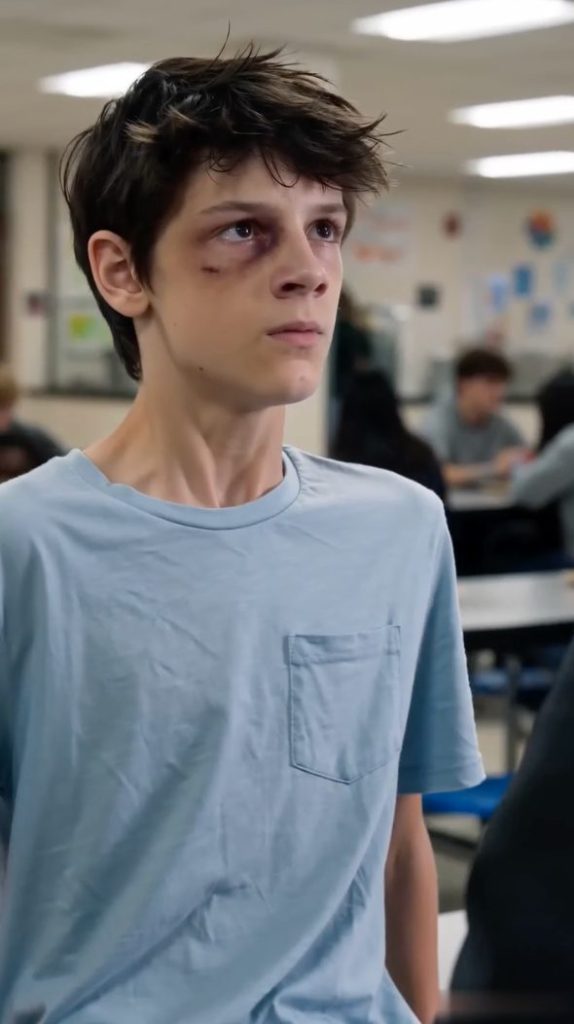
There were more than two hundred students in the cafeteria when Brody pushed me against the edge of a table, but for one terrible moment, I felt as though I were the only person in the room.
The metal edge pressed into my lower back.
My lunch tray had slipped from my hands, and a carton of milk lay on its side beneath the table, spilling white liquid across the polished floor.
Somewhere behind Brody, somebody was laughing, and two of his friends were holding their phones high enough to capture every expression on my face.
I could already feel the swelling near my left eye.
Brody noticed it too.
He stood close enough that I could smell the mint gum on his breath, wearing the confident smile of someone who had never seriously considered the possibility of being told no.
I kept my arms at my sides.
My left hand remained open.
And although nobody in that cafeteria understood what I was doing, I was trying with everything I had to make sure the next few seconds didn’t become something I would regret for the rest of my life.
That was the strange thing about being afraid.
People imagined fear always looked like trembling, crying, or running away.
Sometimes it looked like a quiet boy standing perfectly still while everyone around him waited for him to do something foolish.
I had been that quiet boy for most of my life.
Not because I had nothing to say.
Not because I never got angry.
And certainly not because I couldn’t recognize cruelty when it was standing directly in front of me.
I was quiet because I understood something that Brody had never seemed interested in learning: a person could make a terrible decision in one second and spend years living with the consequences.
That understanding didn’t make the cafeteria any less frightening.
It didn’t make the bruise hurt less.
And it didn’t stop the laughter.
But it helped me remember that I still had a choice.
Earlier that morning, before the entire cafeteria seemed to turn against me, the school had looked like any other American high school on a weekday.
Students hurried through the main entrance carrying backpacks, coffee cups, and unfinished homework.
Sneakers squeaked against the hallway tiles, locker doors slammed, and voices echoed beneath the fluorescent lights.
Someone was complaining about an algebra test, while someone else was trying to persuade a friend to trade lunches.
I walked through all of it without attracting much attention.
That was usually how I preferred things.
I wasn’t invisible, exactly.
My teachers knew my name, a few classmates occasionally asked to borrow a pencil, and the people who sat near me in class recognized my face.
But I wasn’t the kind of person who made a room turn when I entered it.
I didn’t have a crowd waiting at my locker.
I didn’t walk through the hallways with three friends moving around me like an escort.
And I had never understood why some people seemed to believe that every conversation needed an audience.

Brody was different.
When he entered a hallway, people noticed.
He was tall for his age, broad through the shoulders, and carried himself with an easy confidence that made even ordinary movements look deliberate.
He had the kind of loud, familiar voice that could cut through a crowded room without much effort.
Most people knew who he was.
Some liked him.
Some wanted him to like them.
And others had learned to move out of his way before he had to ask.
I belonged to that last group, though I hated admitting it.
It hadn’t always been that way.
At first, Brody was simply another student.
He sat several rows away from me in one class, laughed loudly at jokes I didn’t find particularly funny, and occasionally answered questions without raising his hand.
I never paid much attention to him.
Then, somewhere along the way, he started paying attention to me.
There wasn’t one remarkable event that explained it.
No dramatic argument.
No terrible misunderstanding.
He simply discovered that I didn’t respond the way other students did when he tried to embarrass them.
The first few times, it was little things.
A comment about how quietly I spoke.
A mocking imitation of the way I stepped aside when the hallway got crowded.
A question asked loudly enough for everyone nearby to hear.
“Do you ever actually talk?”
I had looked at him and answered, “Sometimes.”
His friends laughed.
That answer apparently amused him more than an argument would have.
From then on, my silence became entertainment.
Whenever Brody saw me, there was a chance he would say something.
Not always.
Sometimes he walked past without looking at me, and those were the days I felt a small, embarrassing sense of relief.
Other times he would lean into my path or call something after me, waiting to see whether I would react.
I usually didn’t.
I told myself that ignoring him was the easiest way to make him lose interest.
Some days I even believed it.
But people like Brody could mistake patience for permission.
And when nobody challenged that misunderstanding, it sometimes grew.
By the time that particular lunch period arrived, I had become familiar with the feeling of seeing him across a room and immediately wondering whether he had noticed me.
I didn’t think of it as fear at first.
I thought of it as paying attention.
I learned which hallway he usually used after class.
I noticed where he sat during lunch and which doors his friends preferred.
I became good at recognizing his laughter before I saw his face.
None of those habits felt particularly brave.
They felt practical.
But they also made school smaller.
There were tables where I stopped sitting, routes I no longer took, and moments when I waited a few extra seconds before leaving a classroom because I could hear his voice outside.
Those choices seemed insignificant individually.





