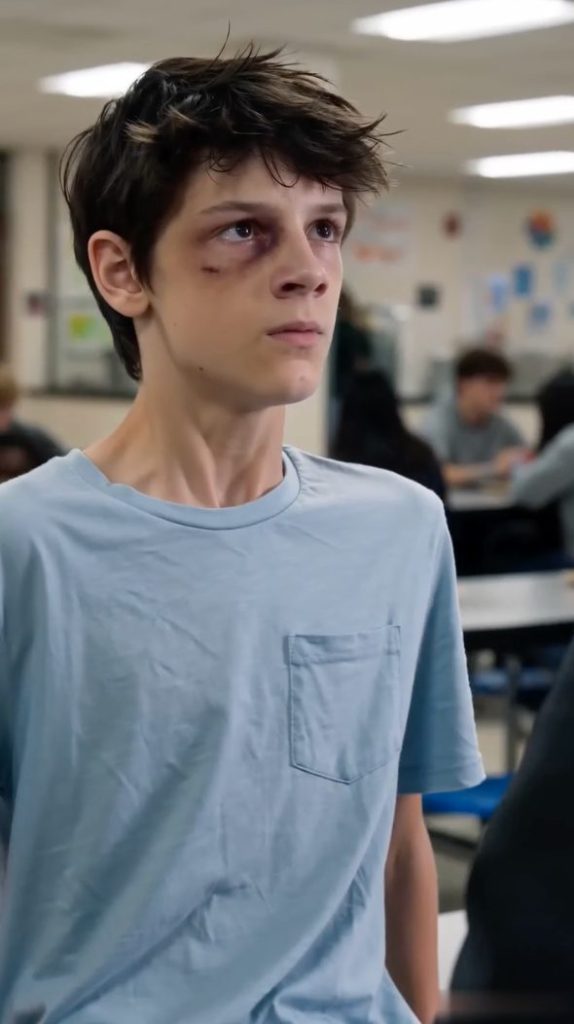
Together, they began to shape my entire day.
I disliked that more than anything.
I disliked realizing that someone I barely knew could decide which hallway I walked through or how quickly I finished eating lunch.

It made me angry in a way that was difficult to explain.
The anger was quiet.
It didn’t make me want to shout or throw anything.
It sat somewhere beneath my ribs, heavy and uncomfortable, waiting for me to acknowledge it.
That morning, while putting my books away, I caught sight of Brody at the far end of the hallway.
He was leaning beside a row of lockers, laughing with two boys who seemed to find everything he said hilarious.
One held a phone.
The other kept glancing at passing students as though searching for something interesting.
I lowered my eyes toward the books in my hands.
It wasn’t a dramatic surrender.
It was a habit.
I hated how automatic it had become.
For a moment, I considered walking the other direction.
Then I looked at the classroom door ahead of me.
I needed to go through it.
Brody happened to be standing nearby.
Those two facts shouldn’t have required a difficult decision.
So I kept walking.
He noticed me halfway down the hall.
“Hey, quiet kid.”
I heard him clearly.
Several other students probably did too.
I continued toward my classroom.
“Didn’t hear me?”
His voice followed me.
I stopped near the door and looked back.
“What?”
He smiled as though my response had been the only thing he wanted.
“Nothing.”
His friends laughed.
I stood there a moment longer, waiting for a reason the exchange had needed to happen.
There wasn’t one.
Brody shrugged and turned back toward his friends.
I entered the classroom.
Nobody mentioned what had happened.
There wasn’t much to mention, I supposed.
A boy had called out to another boy, and the second boy had answered.
Nothing had been thrown.
Nobody had been hurt.
But the encounter stayed with me longer than I wanted.
Not because the words were especially cruel.
Because they were pointless.
Brody had interrupted my morning simply to prove that he could.
I spent the next class trying not to think about it.
The teacher explained an assignment.
Students opened notebooks, whispered questions, and passed papers toward the front.
I copied what I needed and answered when someone beside me asked whether I had an extra pen.
Everything looked normal.
That was one of the difficult things about being singled out by someone.
Most of your day still looked normal.
The world didn’t stop because you were uncomfortable.
Teachers continued teaching.
Students continued laughing.
Clocks kept moving from one period to the next.
You could carry a growing sense of humiliation through an entire school day while everyone around you saw nothing unusual.
Sometimes I wondered whether that made it easier for people not to notice.
If something terrible happened suddenly, people might react.
But when something happened a little at a time, it became part of the scenery.
A joke here.
A shove there.
A nickname repeated until other students started using it without remembering where it came from.
No single moment seemed important enough to interrupt everything.
Yet the collection of those moments could feel enormous to the person living through them.

I knew that because I lived through them.
And by lunchtime, I was tired.
Not physically tired.
I had slept well enough the night before, and the morning classes hadn’t been particularly difficult.
I was tired of calculating where to stand.
Tired of wondering whether a laugh across the room had something to do with me.
Tired of trying to look completely unaffected whenever Brody decided I would be his entertainment.
I wanted lunch to be ordinary.
That was all.
I wanted to buy my food, find somewhere to sit, and spend twenty minutes thinking about something other than another person’s opinion of me.
It didn’t seem like an unreasonable wish.
The cafeteria was crowded when I arrived.
Sunlight entered through the tall windows along one wall, creating bright rectangular patches on the floor.
The lunch line curved past a row of tables, and students stood shoulder to shoulder while trying to decide what they wanted.
The room smelled of warm food, cleaning solution, and the faint sweetness of fruit cups.
A plastic fork snapped somewhere behind me.
A student shouted that someone had taken his seat.
Another group burst into laughter over something displayed on a phone.
All of it formed the ordinary background noise of school life.
I found a place in line.
I kept my backpack on one shoulder and waited.
For a few minutes, nothing happened.
I remember that because afterward, I thought about how easily the entire afternoon might have continued that way.
I could have collected my lunch.
I could have sat down.
I could have finished eating without giving Brody another thought.
The difference between an ordinary day and a terrible one sometimes seemed to be no more than a few steps.
I picked up my tray and started toward a table with an empty seat.
It was near the middle of the cafeteria, not far from the windows.
There were other students around it, but nobody I knew well enough to call a close friend.
That didn’t bother me.
I had never needed a crowd to enjoy a meal.
I liked the freedom of being able to sit quietly without having to compete for attention.
I was approaching the table when I heard Brody’s voice.
“Well, look who’s here.”
My stomach tightened.
I kept walking for another step before I looked up.
Brody was standing a short distance away with the same two boys I had seen in the hallway.
One was looking down at his phone.
The other had a wide grin that suggested he was already expecting something entertaining.
Brody looked directly at me.
“Where you going?”
I glanced at the empty seat.
“To eat lunch.”
He smiled.





