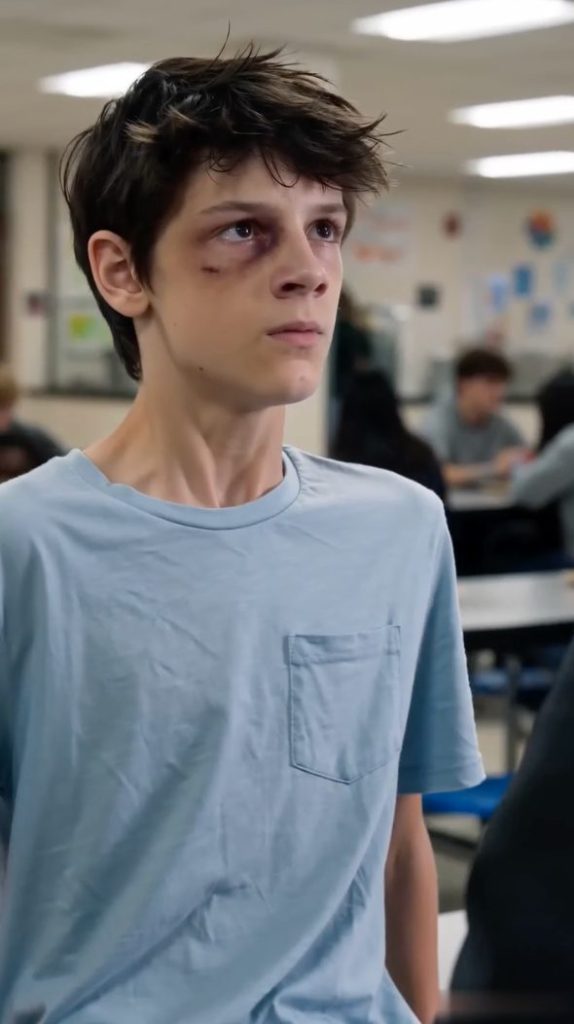
I was simply looking at him because he had told me to.
“I don’t know,” I said.
He stepped forward again.
My back touched the table.
There was nowhere farther to go without climbing over it or pushing past him.
The metal edge pressed into my lower back.
I could feel the small gap between the table and the chair behind my knees.
Brody had placed himself directly between me and the open walkway.
His friends stood to either side.

Their positions weren’t carefully planned.
They didn’t need to be.
Together, they made the space feel closed.
I looked past Brody’s shoulder.
Students were gathering.
A few still sat at nearby tables, watching over their trays.
Others had risen from their seats.
The boy holding the phone had shifted closer.
He seemed excited.
The camera stayed pointed toward my face.
I suddenly understood that what was happening no longer belonged entirely to Brody.
His friends had become part of it.
The crowd had become part of it.
Every laugh encouraged him.
Every phone made it harder for him to stop without feeling embarrassed.
I was trapped in a situation where the people watching were helping decide what the person in front of me would do.
That realization frightened me more than his size.
Because a person acting alone might eventually grow tired of a confrontation.
A person performing for an audience could keep going long after the original reason had disappeared.
I tried again.
“Brody, just let me leave.”
He leaned forward.
“Don’t tell me what to do.”
“I’m not.”
“You keep saying that.”
“Because I’m not trying to fight.”
The word fight changed the atmosphere.
I felt it immediately.
One of his friends repeated it.
“Fight?”
Another laughed.
Brody raised his eyebrows.
“Who said anything about fighting?”
I wished I hadn’t used the word.
It had been the most natural way to explain myself.
Now it sounded like a challenge.
“I don’t want one,” I said.
Brody looked over his shoulder toward the phones.
Then he turned back.
“Good.
Because you wouldn’t last.”
A few people laughed.
I felt something twist inside my chest.
It wasn’t just embarrassment.
It was anger.
Not the kind that arrived in an explosion.
The kind that grew stronger every time a person who had done nothing wrong was told to apologize for existing in someone else’s way.
I wanted to ask him why this mattered so much.
Why he needed to embarrass me.
Why letting me eat lunch seemed less satisfying than forcing me to stand there while everyone laughed.
But I didn’t think the answers would help.
I doubted he knew them himself.
I glanced down at my hands.
My right hand was gripping the strap of my backpack.
My left hand hung beside my leg.
The fingers were slightly curled.
I noticed that small detail because I could feel tension gathering in my arms.
My shoulders had risen.
My jaw was tight.
My body was preparing for something even while I was trying to convince myself that nothing worse would happen.
I loosened my left hand.
One finger at a time.
It felt like a tiny movement.
Nobody noticed.
But it mattered to me.
I didn’t want to raise a fist.
I didn’t want to strike Brody.
I didn’t want to give him the reaction he seemed so determined to force out of me.
Most of all, I didn’t want to discover what would happen if I allowed my anger to make the decision.
He was standing so close that the temptation to push him away was real.
I could imagine doing it.
I could imagine the brief satisfaction of creating enough distance to breathe.
But I could also imagine him shoving me back.
I could imagine his friends cheering.
I could imagine the entire situation becoming something neither of us could stop.
That frightened me.
And there was another truth beneath it.
I had no desire to hurt him.
Even then.
Even with my lunch on the floor.
Even with his friends laughing.
I wanted him to stop.
Those were different things.
People sometimes treated them as though they were the same.
If someone was hurting you, they assumed you must want to hurt that person in return.
But I didn’t.
I wanted him to understand what he was doing.
I wanted him to move.
I wanted the afternoon back.
Brody saw me looking down.
“What, you gonna cry?”
I lifted my head.
“No.”
He smiled.
“Sure looks like it.”
I could feel my eyes watering slightly.
That embarrassed me more than I wanted to admit.
The watering wasn’t entirely emotional.
The pressure in my face, the bright cafeteria lights, and the uncomfortable closeness were all making it difficult to focus.
But Brody was watching for anything he could call weakness.
I blinked.
His friends laughed again.
I wondered how many people in the room could tell that I was trying not to cry.
I wondered whether any of them understood how much effort that required.
There were so many things I wanted to say.
I wanted to tell them that being quiet didn’t mean I had no feelings.
That standing alone wasn’t an invitation.
That someone could dislike fighting without being incapable of defending himself.
But I had already discovered how little my explanations mattered to Brody.
So I remained silent.
That silence seemed to irritate him more than words.
He raised one hand and gestured toward my face.
“What’s with that look?”
I didn’t answer.
“Seriously.
Say something.”
I swallowed.
“Please stop.”
It was the simplest request I could make.
No insult.
No accusation.
Just two words.
For an instant, Brody’s expression shifted.
I thought he might actually listen.
Then someone behind him laughed.
It wasn’t especially loud.
But he heard it.
I saw his eyes flick toward the sound.
When he looked back at me, his mouth had hardened.
“Stop what?”
I stared at him.
He knew.
There was no possible way he didn’t know.





