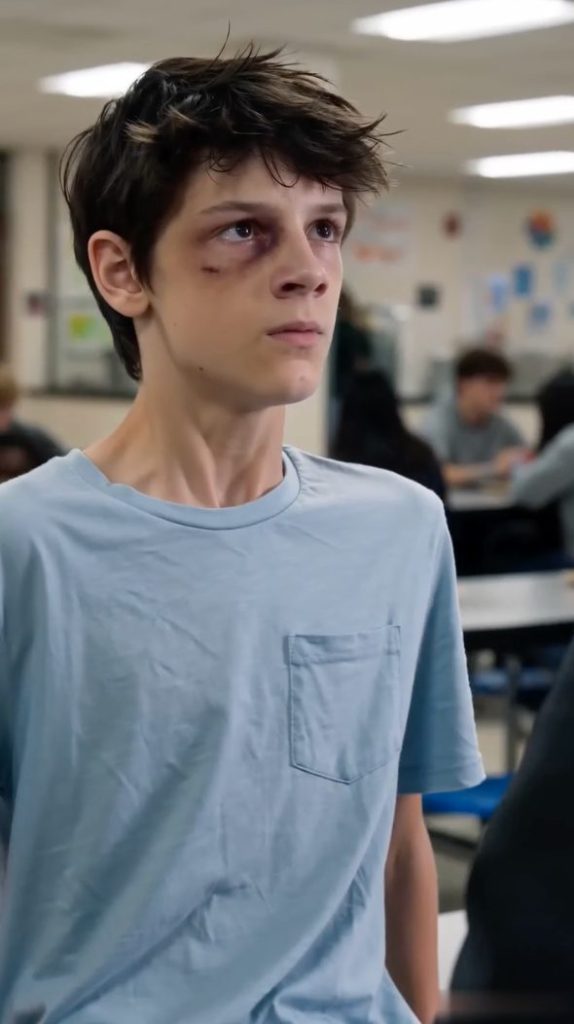
He knew I wanted him to stop blocking me.
He knew I wanted his friends to stop filming.
He knew I wanted to get away from the table and clean up my lunch.
But he wanted me to explain it again.
He wanted the request spoken loudly enough that everyone could hear how badly I wanted the situation to end.
I understood that.
And understanding it made me feel strangely older than I had a moment before.
I wasn’t looking at a powerful person.
I was looking at someone who needed other people to confirm that he was powerful.
That didn’t make him harmless.
If anything, it made the situation less predictable.
But it changed how I saw him.
“Just let me go,” I said.
His face flushed slightly.
“You think you can just walk away?”
I looked at the space beside him.
“I’d like to.”
The reply was honest.
It was also apparently the wrong thing to say.
Brody moved forward.
His hand struck against my shoulder, driving me more firmly against the table.
The edge pressed into my back.
I caught myself before losing my balance.
A small sound escaped the students watching.
Someone said, “Whoa.”
I stared at Brody.
He stared back.
There was a strange moment when I thought he might be surprised by what he had done.
Not sorry.
Not frightened.
Just surprised that the confrontation had become physical.
Then his friends reacted.
One laughed.
The boy holding the phone raised it higher.
And Brody’s uncertainty vanished.
He was smiling again.
I felt a cold heaviness settle in my stomach.
The situation was moving in a direction I had been trying to avoid since the beginning.
I could feel it happening.
Each little exchange had become slightly worse than the one before it.
Each attempt to leave had failed.
Each attempt to explain myself had given him something else to mock.
Now he had pushed me twice.
The second time, with everyone watching.
I wanted to believe that would be enough for him.
I wanted to believe he would see that I wasn’t going to challenge him, laugh one last time, and move away.
But he wasn’t looking at me as a person who wanted lunch anymore.
He was looking at me as the center of a performance.
And the audience was waiting.
“Come on,” one of his friends said.
“What’s he gonna do?”
Brody tilted his head.
“Yeah.
What are you gonna do?”
I looked at the phone.
Then at his face.
“Nothing.”
He laughed.
“Exactly.”
I hated the satisfaction in his voice.
Not because I thought doing nothing was shameful.
But because he interpreted my refusal to fight as proof that I deserved whatever happened next.
His friends responded immediately.
One repeated the word nothing in a mocking voice.
Another shook his head as though I had disappointed him.
The students closest to us watched with expressions I couldn’t read.
Some seemed entertained.
Others looked uncomfortable.
One student near the end of the table lowered his eyes toward his lunch, although he wasn’t eating anymore.
I remember seeing that.
It was such a small gesture.
He didn’t join the laughter.
He didn’t say anything either.
I couldn’t blame him entirely.
I understood how difficult it was to speak when a group had already decided what everyone was supposed to find funny.
But I wondered whether he would remember my face afterward.
I wondered whether he would remember that I had asked to leave.
And I wondered whether, if our positions were reversed, I would have found the courage to do something more than look away.
The thought made me uncomfortable.
It also reminded me that I was not the only person making a choice.
Everybody watching had one.
Some had already chosen to laugh.
Others had chosen to record.
Still others were trying to pretend that nothing unusual was happening.
I didn’t know what choice I wanted them to make.
I only knew that I wished someone would stop treating my embarrassment like entertainment.
Brody leaned closer.
“You’re not even gonna defend yourself?”
I looked at him.
“I don’t want trouble.”
He laughed at that.
“You keep saying that.”
“Because I don’t.”
He glanced at his friends.
“Listen to him.”
The phones remained raised.
I realized how carefully he was choosing his words.
He wasn’t simply insulting me.
He was asking questions designed to make my answers sound ridiculous.
If I said I didn’t want trouble, he called me afraid.
If I said I wasn’t afraid, he called me arrogant.
If I said nothing, he called me weak.
I began to understand that I couldn’t talk my way out of an argument he had no intention of ending fairly.
I looked toward the open area beyond his right shoulder.
There was space there.
Not much.
A narrow path between the table and the students gathering nearby.
If I could move sideways, I might be able to step around him.
But he was watching my face.
And every time I shifted, he reacted.
I didn’t want to make a sudden move.
So I stayed where I was.
Brody noticed my hesitation.
His smile widened.
“There you go.”
He leaned forward slightly.
“Stay right there.”
It was such a small sentence.
Only three words.
But something about it made my anger sharpen.
He wasn’t my teacher.
He wasn’t my parent.
He wasn’t someone with any right to decide where I could stand.
Yet he spoke as though the space around me belonged to him.
I felt the urge to say so.
I almost did.
Then I noticed his friends again.
One had moved beside the table to capture us from another angle.
The other was laughing so hard that he had to steady his phone with both hands.
I realized that speaking might only give them another moment to replay.
So I took a slow breath.
I could hear it inside my own head.
The cafeteria was still loud, but my attention had narrowed.





