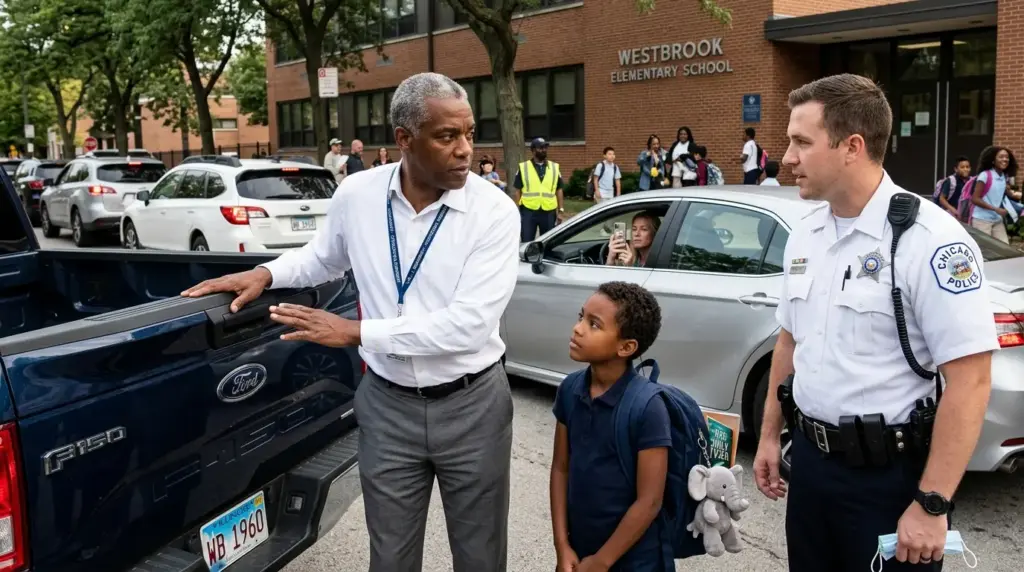
His daughter Amara was nine years old and in fourth grade. She had her mother’s eyes and her father’s capacity for stillness, which was the quality that teachers most often mentioned when they described her. She was a listener, they said, in the particular appreciative tone of adults who have discovered that some children listen before they speak, and who find this remarkable because it is.
She attended Westbrook because the school had an advanced learning program in mathematics and science that her parents had researched and chosen deliberately, which required a drive across two school districts, but which they had agreed was worth the drive. Amara had not been consulted about whether it was worth the drive. She had, in her second week of second grade, told her father on the way home that she liked it here because the teacher let her read a book when she finished the assignment.
He had said, “That’s a good teacher.”
She had said, “Yes, she is.”
He had said, “You can finish your assignment by now.”
She had said, “That’s the point.”
She was in the same advanced mathematics cohort that had been together since second grade: seven children who moved through the math curriculum at a pace that was two grade levels ahead of their chronological grade, and who had the particular bond of people who share a specific kind of intelligence that not everyone in their immediate community shares. She liked all seven of them, but her closest friend was a girl named Priya, who lived two blocks from Westbrook and who was the only person Amara had met her age whom she consistently had to think fast to keep up with. She found this satisfying.
She had told her mother, “Priya is very fast.”
Her mother had said, “Good. You need people around you who are faster than you.”
Amara had said, “Why?”
Her mother had said, “Because that is how you get faster.”
Amara had thought about this for a week and then said, “I understand now.”
Her mother had said, “I know you do.”
She carried the elephant keychain because her grandmother—Winston’s mother, Dr. Eleanor Beaumont, Professor of Mechanical Engineering Emerita—had given it to her at the start of first grade with the instruction that it was a good luck charm for people who never stop thinking about new things.
Amara had said, “What does the elephant have to do with thinking about new things?”
Her grandmother had said, “Elephants remember everything they ever learned.”
Amara had said, “That’s a metaphor.”
Her grandmother had looked at Winston, who was standing in the kitchen doorway, and they had both smiled in the specific way that adults smile when a child says something that reveals they are going to be fine. Eleanor Beaumont was 78 now, still mathematically sharp, and Amara called her every Sunday morning without being reminded.
He pulled into the pickup line at 2:40. The pickup window was 3:00. He was 20 minutes early, which was his habit. He had found in three years of pickup line management that arriving 20 minutes early meant a position in the first third of the line, which meant exiting Thorndale Avenue before the main departure congestion, which saved 11 to 14 minutes on the route home. He had timed this. He was a civil engineer, and he timed things as a natural consequence of being someone who thinks about flow and capacity and optimization. He had not mentioned to Amara that he timed the pickup line; she would have found this interesting and asked many questions, and he would have enjoyed the questions, but they had not been on that subject yet.
He had been thinking about the city’s water authority project during the drive. It was a stormwater drainage capacity assessment for a district that had experienced three significant flooding events in the previous eight years, each more severe than the last, each traced to the same underestimated peak flow coefficient that had been in the original 1987 drainage plan and had never been corrected because the correction would require acknowledging the original miscalculation.
He had presented his preliminary findings to the authority’s engineering review board two weeks ago. The board had said the findings were—and he remembered the exact word—inconvenient.
He had said, “Inconvenient for the infrastructure, or inconvenient for the 1987 assessment?”
The board chair had said, “Both.”
He had said, “I understand. The findings are still accurate.”
The board had scheduled a follow-up meeting. He had prepared a supplemental analysis for the follow-up meeting that contained 12 additional data points that made the original findings, if anything, more emphatic.
He had been thinking about this when he pulled into the pickup line. He had been thinking about it when he parked behind the white Subaru. He was still thinking about it in the specific, productive background way that civil engineers think about problems when they are doing other things, when Officer Pruitt knocked on the window.
He looked at the time when he lowered the window: 2:43. He noted it without deciding to note it, because noting times was a practice so deeply built into his professional habits that it operated automatically in any situation that might subsequently require documentation. He did not know yet that it would require documentation; he noted the time anyway.
The afternoon was warm, and the elm trees along Thorndale Avenue were still in full leaf—the specific thick green of August into September, the green that would be changing in six weeks, but was not changing yet. The pickup line had the particular atmosphere of pickup lines at the beginning of the school year, when parents have not yet fallen into the complete routine of it, and are still arriving with slightly more alertness than they will have by November. He had been in this line enough times to know its full annual rhythm. He was, at 2:43 on this particular Wednesday, exactly where he belonged.





