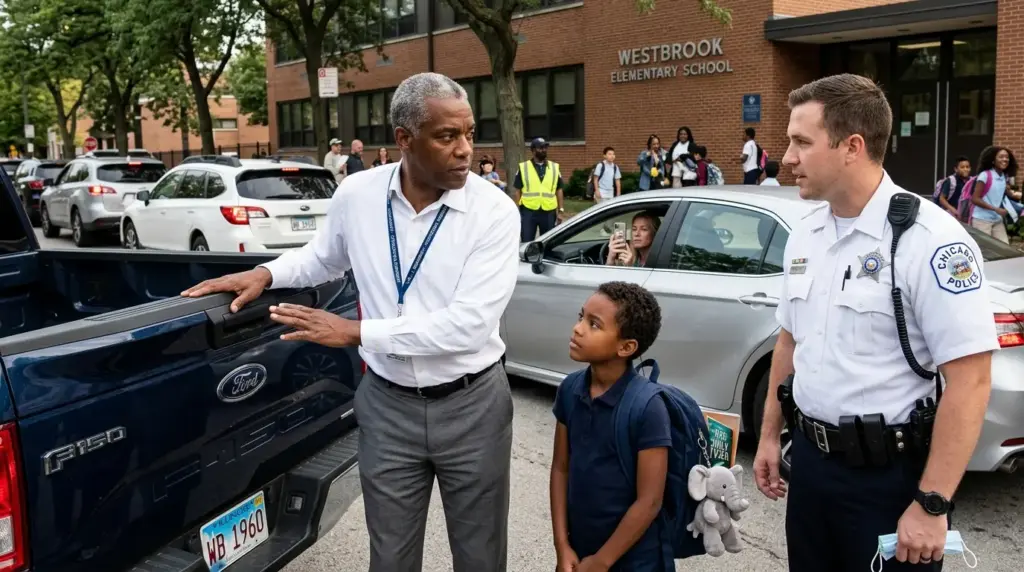
Winston Beaumont had been in enough meetings where someone’s position was not supported by the facts, but their authority in the room was not going to be challenged by most people in the room, to recognize the register. He recognized it now.
He said, “I am going to step out of the vehicle.” He said, “I want you to know that I am complying voluntarily, that I have not engaged in any behavior that justifies this instruction, and that I have a daughter who will be coming through those school doors in 17 minutes and will be looking for this vehicle.”
He stepped out. He stepped out the way he did everything: without haste and without hesitation, because haste and hesitation both produce the same result in a situation like this, which is that you lose the quality of attention that is your best protection. He had learned this not from any single event, but from the accumulated knowledge of 59 years of being a Black man in America, which is a form of education that is not available in any classroom, and that has its own curriculum, its own sequence, its own terminal degree.
He was 6’1″, and the posture of a man who has been managing rooms and job sites for 31 years is specific and visible. He stood straight. He put his phone in his shirt pocket. He looked at Pruitt with the patient, specific attention of a person who is maintaining composure as a deliberate choice.
Pruitt said, “Do you have your license and registration?”
Winston said, “Yes.” He reached back into the truck for his wallet, which was in the center console, and produced his license. He produced his registration from the glove compartment. He held both out.
Pruitt took them. He looked at them. He looked at Winston. He went to his cruiser and ran the license. The license came back clean: no warrants, no violations, valid. The truck’s registration was current.
He came back. He said, “I’ve had reports of a vehicle matching this description making repeated passes near the school.”
Winston said, “This is the first time I have been in this pickup line today. I arrive at 2:40 every Tuesday, Wednesday, and Thursday because those are the days I pick up my daughter. I park in the pickup line with the other parents. The pickup line is the designated area.” He said, “What vehicle description was reported?”
Pruitt said, “A dark blue pickup truck.”
Winston looked at the pickup line. There were three dark-colored pickup trucks in the line within his line of sight. He said, “I am one of approximately three dark-colored pickup trucks currently in this pickup line.” He said, “Is there anything specific about this vehicle that distinguishes it from the other vehicles matching that description?”
Pruitt said, “I need you to move the vehicle.”
Winston said, “My daughter is going to come through those doors in 15 minutes, and she will be looking for this vehicle, and I will be here waiting for her when she comes out.”
Pruitt said, “Sir, I’m not going to ask you again.”
The woman in the white Subaru ahead of Winston’s truck had her window down. She had been listening. She was a woman named Claire Hawthorne, 44 years old, a pediatric occupational therapist whose son was in third grade at Westbrook, and who had been in the pickup line on Tuesdays and Wednesdays for two years, and who had seen Winston Beaumont in this line many times—enough times to recognize his truck and his face, and the fact that his daughter always ran to the truck and jumped in with the specific enthusiasm of a child who is glad to see her parent.
She said from her window, “Officer, that man parks here every week. He’s a pickup parent. His daughter is in fourth grade.”
Pruitt said, “Ma’am, please remain in your vehicle.”
Claire said, “I am in my vehicle.”
Winston said quietly, “It’s all right.” He said it the way fathers say things when they do not want the situation to escalate in front of a school. He said it because in 14 minutes Amara was going to come through those doors, and he did not want Amara to come through those doors and see what was happening.
He knew with the specific knowledge of a Black father in America that this was not a neutral calculation; that the desire to protect a child from witnessing the treatment of her father is a desire that requires the father to absorb the treatment, which is not a neutral thing, which costs something, and which he had been paying versions of that cost for 59 years, and was paying now, standing on the curb in the school pickup line in front of Westbrook Elementary with his registration in an officer’s hand and the math of 15 minutes turning in his head.
Pruitt said, “Step to the back of the vehicle.”
Winston stepped to the back of the vehicle. He walked around the truck bed, past the tool organizer, to the back bumper. He stood at the back bumper of his truck on Thorndale Avenue, and he watched the school doors.
Pruitt said, “Put your hands on the vehicle.”
Winston said, “On what charge?”
Pruitt said, “I am conducting an investigation.”
Winston said, “I will comply with lawful instructions. Placing my hands on my personal vehicle is not something I am legally required to do without a specific lawful basis.”
Pruitt said it again. He said it differently this time.
The woman in the silver sedan behind Winston’s truck had been watching through her windshield. She was a woman named Deborah Osei—no relation to Dr. Osei, that coincidence of surnames—who was 52, a paralegal with 24 years of experience, and who had been in this pickup line long enough to have seen many things that she found unremarkable, and who was now watching something she found very remarkable.





