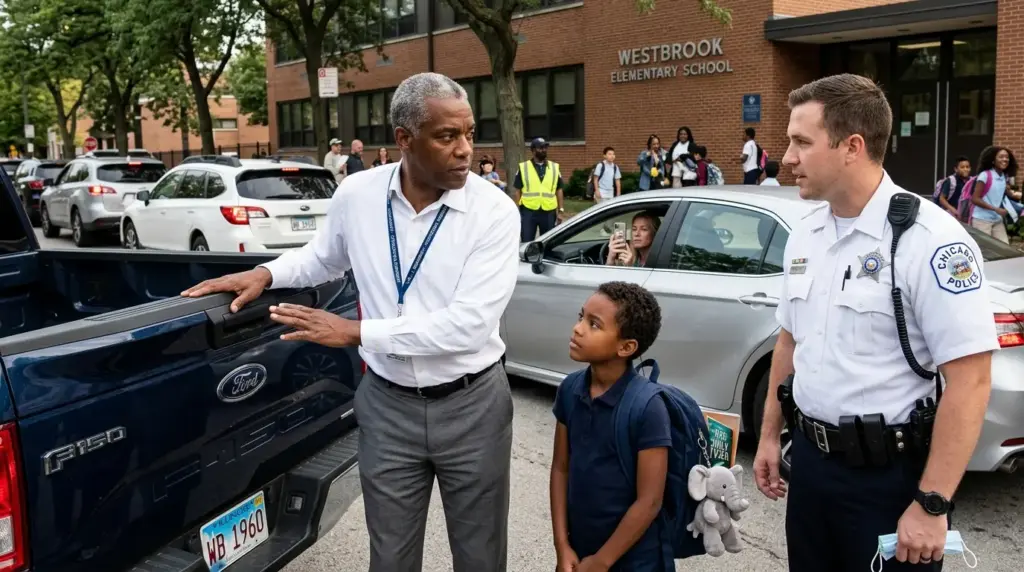
He pulled his truck to the curb in the pickup line behind a white Subaru and ahead of a silver sedan. He turned off the engine. He picked up his phone to return two emails that had come in while he was driving. The phone’s screen was on when Officer David Pruitt walked up to the driver’s side window.
David Pruitt was 31 years old, three years on the force. He had grown up in a suburb of the city and had joined the department after two years at the community college, where he had studied criminal justice and had received grades that were adequate, and an attitude toward the material that his professors had described in neutral terms because there was nothing specific to criticize and nothing specific to celebrate. He had been in the top half of his academy class on the physical requirements, and in the bottom third on the community relations assessments—which was a profile that his hiring supervisor had noted and then not acted on because the department needed officers and Pruitt had met the minimum requirements.
He was assigned to the school zone patrol, which covered a two-block radius around Westbrook Elementary during pickup and drop-off hours. The school zone patrol had been established 18 months earlier after a parent had reported a suspicious vehicle idling near the school. The vehicle had turned out to be a maintenance contractor who serviced the district’s HVAC systems. The suspicious vehicle report had been resolved without incident, and the contractor had explained himself in two sentences. The school zone patrol had been established anyway because the school board had decided that visible police presence during school hours was a component of its safety commitment, and the city council had approved the funding, and David Pruitt had been assigned.
He had three prior complaints on his record: one for an improper vehicle stop in which a driver had been asked to exit a vehicle on a highway shoulder without legal basis, and two for conduct during citizen interactions that had been described in the complaints as aggressive without basis—one of which included a witness statement from a passerby who had observed the interaction and had used the specific word “escalated” to describe the officer’s behavior, which was a word that appeared in the complainant’s account as well.
All three had been reviewed internally and closed without formal discipline. In one case, the review note said: Insufficient evidence to establish misconduct. In the other two cases, the review notes said: Complaint reviewed; officer counseled informally. The informal counseling was not in the written record in any form that would allow a subsequent reviewer to confirm that it had occurred.
He had been assigned to the school zone patrol because his supervisor had assessed him as suitable for community-facing work. This was an assessment that the prior complaints complicated in ways the supervisor had not examined. The supervisor had read the three closed complaint files before making the assessment and had concluded that because all three were closed without formal discipline, they did not factor into the assessment. He had not read the three closed complaint files in sequence and considered what they formed together; he had read each one as a closed file and moved to the next.
He had seen Winston Beaumont’s truck in the pickup line from a block away. He had seen the navy blue F-150 with the tool organizer in the bed, driven by a man in a white shirt, and he had walked toward the truck with the specific forward lean of someone who has a purpose that preceded the observation.
He knocked on the driver’s side window with the back of his knuckle the way police officers knock on windows, which is the knock of authority rather than the knock of request.
Winston lowered the window. He said, “Afternoon, officer.”
Pruitt said, “I need you to pull forward and move the vehicle out of the pickup zone.”
Winston said, “I’m in the pickup line for Westbrook Elementary. My daughter’s in fourth grade. Pickup is at 3:00.”
Pruitt said, “This area is restricted during pickup hours. I need you to move.”
Winston looked at the pickup line. The white Subaru was immediately ahead of him. Behind that were six more vehicles. Ahead of the Subaru were twelve. He said, “The school’s pickup line runs along this entire block. I’m behind a white Subaru, and there are vehicles ahead and behind me. I’ll pull forward when the line moves.”
He said it the way he said things on job sites when a contractor raised a question about a specification: with complete patience and complete clarity, because patient clarity is how you get the right answer to arrive at the right place.
Pruitt said, “Sir, I’ve had reports of a vehicle matching this description circling the area.”
Winston said, “There are at least three dark-colored pickup trucks in this line right now.” He said it without moving his head. He said, “My name is Winston Beaumont. My daughter’s name is Amara. She’s in fourth grade, Room 12, Mrs. Abernathy’s class.” He said, “You can call the school office.”
Pruitt said, “Sir, step out of the vehicle.”
Winston said, “On what basis?”
Pruitt said, “I’m asking you to step out of the vehicle.”
Winston said, “I’ve explained that I’m in the school pickup line for my daughter. My engine is off. I’m not blocking traffic. I’m waiting in the designated pickup area at the correct time for pickup. Can you explain the legal basis for your request?”
Pruitt said, “Step out of the vehicle, sir.” He said it a third time with the edge that words acquire when the person saying them has decided that the words need to produce an effect, and is willing to escalate in the direction that produces one.





