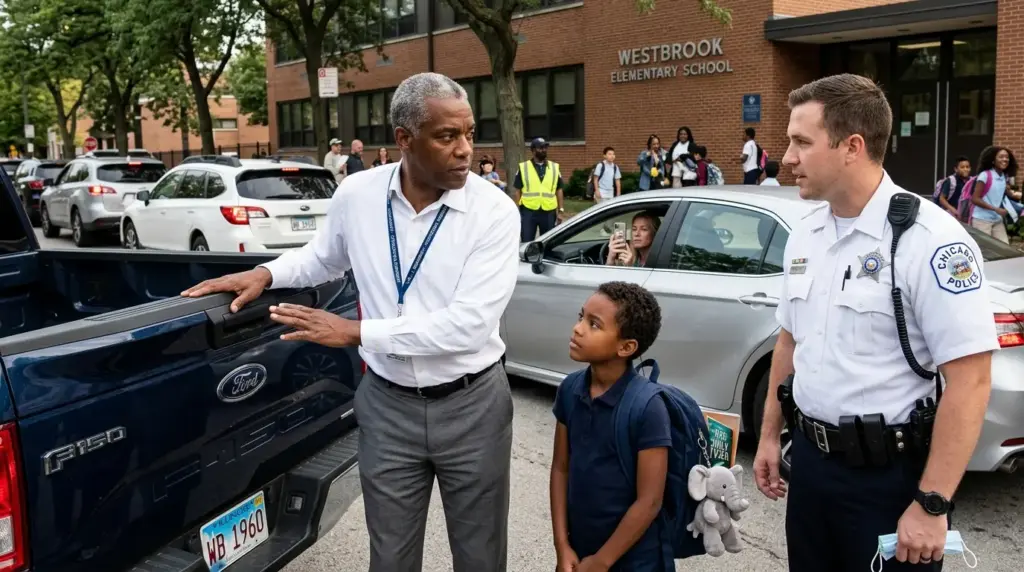
He said, “Yes.” He said it and he meant it, and he also meant the full context of yes, which was that he was all right the way he was always all right, which was with effort; and that the effort was not visible to her, and he preferred it that way, and that she was the reason the effort was not visible.
She said, “That officer shouldn’t have done that.”
He said, “No, he shouldn’t.”
She said, “I’m going to tell Mom.”
He said, “I know you are.”
She said, “Will you tell her, too?”
He said, “Yes.”
She said, “Good.”
She settled back in her seat. She opened her backpack. The library book was a thick one, the kind she preferred: 412 pages of close-printed type. A story about a girl who could hear what machines were thinking, which Amara had chosen from the school library three weeks ago, and which she had already read once and was now reading again because the second reading showed you things the first reading missed. She opened it to her bookmark. She read.
He drove.
He thought about the tailgate warm from the sun. He thought about his father’s sentence: Yielding is tactical. Accepting is something you do to the inside of yourself. He thought about Amara at the back bumper of his truck in the school pickup line with the elephant keychain and the dark blue backpack and the library book sticking out of the unzipped top, asking the officer to please let her daddy go so they could go home.
He thought, she already knew exactly what to say. He thought, she learned that somewhere. He thought, yes, she did.
He called Renata from the truck two blocks from school while Amara was reading. He said, “Something happened at pickup. I’m going to tell you about it when we get home.”
She said, “Are you all right?”
He said, “Yes.”
She said, “Is Amara all right?”
He said, “Amara is reading.”
She said, “Okay.”
He said, “Okay.”
Amara did not look up from the book. She knew her parents were talking. She knew it was about what had happened at the truck. She did not stop reading because the book was very good, and because she had already said what she had to say and there was nothing else to add.
He told Renata the full account at the kitchen table after dinner. He told it chronologically and completely, because that was how he told things: in the order they occurred, without omission. Renata listened without interrupting. She had learned in 19 years that Winston’s account was complete enough to interrupt only when he had finished, and that interrupting partway through sometimes created gaps in what he told her that she then spent the next hour trying to fill in from questions. She waited.
When he finished, she said, “She asked him to please let her daddy go.”
He said, “Yes.”
Renata looked at the table. She said, “Nine years old.”
He said, “Nine years old.”
They were quiet for a moment.
He said, “She was not afraid.”
Renata said, “I know.” She said it in the voice that holds many things at once: the pride and the grief, and the understanding that the pride and the grief are not opposites, but are both responses to the same truth, which is that a nine-year-old should not have to be brave in a school pickup line, and that she was, and that her braveness was hers, and that it was also built from something—and what it was built from was them.
The formal complaint was filed the following morning by the firm of Patterson, Osei, and Mbeki, Civil Rights Specialists, after Winston Beaumont called their office at 8:45 that evening. The complaint cited unlawful vehicle stop without articulable suspicion, unlawful instruction to exit vehicle, and unlawful demand for physical compliance without legal basis.
The filing attorney, a woman named Teresa Mbeki, who had been practicing civil rights law for 21 years, had requested and received three pieces of footage:
-
The school’s security camera, which had captured the entire encounter from a fixed position above the school entrance with a clear view of the curb area;
-
The city’s parking enforcement camera on Thorndale Avenue, which had captured the approach from a different angle, and which showed clearly the moment Pruitt began walking toward Winston’s truck before any observation of behavior could have produced a basis for the approach;
-
Deborah Osei’s phone recording, which Deborah had emailed to Winston’s phone that same afternoon while still in the pickup line, through the window of the silver sedan, without either of them saying a word about it.
She had typed: I got everything. He had looked at the message and then at her. She had nodded once. He had nodded back. No other communication was needed.
They were strangers who had been in the same pickup line on the same Wednesday afternoon, and had witnessed the same thing, and had agreed without discussing it on what to do about what they had witnessed. The car ahead of hers had moved. She had driven forward. He had driven forward. They had both driven home with the same footage: one of them with a phone, and one of them with a memory, and both of them with the knowledge of what the record now contained.
Teresa Mbeki had been reviewing the footage on her computer at 9:45 that evening after Winston’s call. She had watched Deborah’s recording three times. The third time, she paused it at the moment Amara spoke—the child standing at the back of the truck with her backpack and her elephant keychain, speaking to the officer in the completely clear, completely organized tone that the recording captured exactly.
She looked at the paused image for a moment. She said to no one, because she was alone in her office, “Nine years old.”





