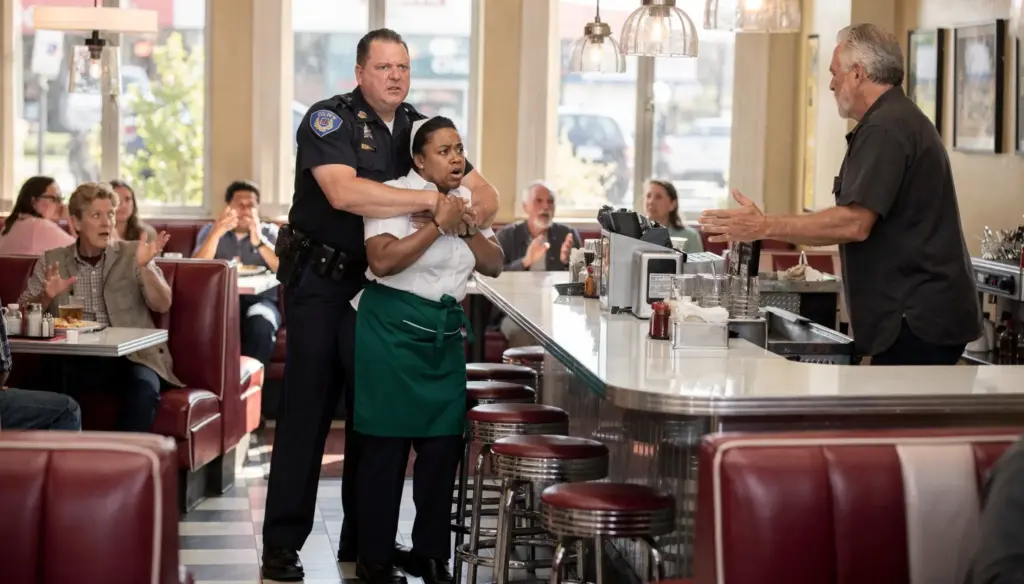
“Some of it is.” Price pointed toward her notebook. “That’s why the facts are being separated from the interpretation.”
Brett looked toward Maya. “What case number?”
Maya said nothing. Price looked at her. “You can answer now.”
Maya hesitated, then gave Price the identifier she remembered. Price wrote it down.
Brett immediately said, “That proves nothing.”
Price nodded. “Then you should have no problem with the system check.”
For the first time that evening, Brett had no immediate response.
The first verification did not come from the card itself; it came from the department’s own records: the case identifier existed; the archive reference existed; a prior version entry existed.
Price did not smile. She did not announce a victory. She only asked for the preservation request to be expanded to include the linked access history.
Brett watched her closely. “You still haven’t proved who changed anything.”
“No.”
“You haven’t proved I accessed it.”
“No.”
“You haven’t proved the card came from the department.”
“No.” Price closed her notebook. “But now I’ve proved there is something in the official system worth examining.”
Maya looked at the sealed envelope. The card had not established who was guilty, who was innocent, or what had happened in the old case; it had done something smaller and more important: it had shown Price where the official record had left a trail. Brett had spent the night trying to control the object; now, the object no longer mattered as much as the records it pointed toward.
Price remained at the counter while the patrol officer confirmed that the preservation request had been accepted. She reviewed the information once more, then looked toward Brett.
“From this point forward, the record issue will be reviewed outside the immediate chain involved in the original case.”
Brett kept his voice controlled. “You’re escalating this based on incomplete information.”
“I’m preserving incomplete information so it can be examined properly.”
“You still have no evidence that I changed anything.”
“I know.”
“No evidence that I created the card.”
“I know.”
“No evidence that I knew who left it here.”
Price nodded. “Correct.”
Brett looked around the diner. “Then what exactly are you accusing me of?”
“Nothing tonight.”
That answer appeared to bother him more than an accusation.
Price continued. “Your conduct here will be documented separately. The record history will be examined separately. Whoever reviews both will decide whether they connect.”
Brett glanced at Maya. “She has a grievance.”
“That will be documented.”
“She had access.”
“That, too.”
“She concealed information from you.”
“Yes.”
“And you still believe her?”
Price closed her notebook. “This is not about belief.”
Brett said nothing.
Price looked toward one of the patrol officers. “Officer Kellen will not participate in any further recovery or handling of material related to this matter tonight. Notify the watch commander that I’m requesting he be removed from active field duties until command reviews the incident.”
Brett stepped forward. “You can’t make that determination based on this diner.”
“I’m not making the final determination. I’m making a supervisory request based on what occurred here.”
“This will not hold up.”
“Then the review will say so.”
He stared at her, but there was nothing left to argue without repeating himself. For most of the evening, Brett had controlled the room by forcing everyone else to respond to his version of events; now, every statement, every record, and every action would be examined outside his control.
Price turned to Caleb. “I need to finish with you.”
Caleb stood beside his booth. “Go ahead.”
“You warned Brett before you touched him?”
“Yes.”
“You waited until Maya had asked to be released?”
“Yes.”
“You used only enough physical control to separate them?”
“Yes.”
“You stopped immediately afterward?”
“Yes.”
“Did you intend to interfere with the investigation involving the card?”
“No.”
“Did you know anything about the card?”
“No.”
“Did you know Maya’s previous employment?”
“No.”
Price looked toward Maya. “You understand that?”
Maya nodded.
Caleb continued, “I wasn’t deciding whether she was right about the evidence.”
Price looked back at him. “Then what were you deciding?”
“Whether a man should keep holding someone who had told him to let go and couldn’t get free.”
Price considered that. “You could have made the situation much worse.”
“That’s why I didn’t.”
She gave a small nod and closed her notebook.
“At my age,” Caleb added, “you learn there’s a difference between keeping the peace and keeping quiet.”
Price looked at him for a moment. “I think everyone in this room learned something about that tonight.”
Later, after the officers had finished collecting statements, Price asked Maya to speak with her near the register.
“Why didn’t you tell me who you were when I walked in?”
Maya looked toward the sealed evidence envelope. “Because Brett already had a description of me ready: former employee, access problem, grievance. If I started with that, everything else would have been judged through it.”
“Your history was relevant.”
“I know.”
“So was the fact that you’re a Black woman dealing with a police officer who had more institutional authority than you.” Maya held her gaze; Price continued: “That doesn’t make you automatically right. It also doesn’t make your account disposable.”
Maya nodded slowly.
“His badge mattered. Your past mattered. Your race can affect how people see you. None of those things gets to replace evidence.”
“That was all I wanted.”
“No,” Price said. “You wanted the record preserved.”
Maya gave a small smile. “That, too.”
Brett was escorted from the diner without another confrontation. He was not arrested that night: the investigation had not reached that point, and Price refused to pretend otherwise. What changed was simpler: Brett no longer controlled the official account.