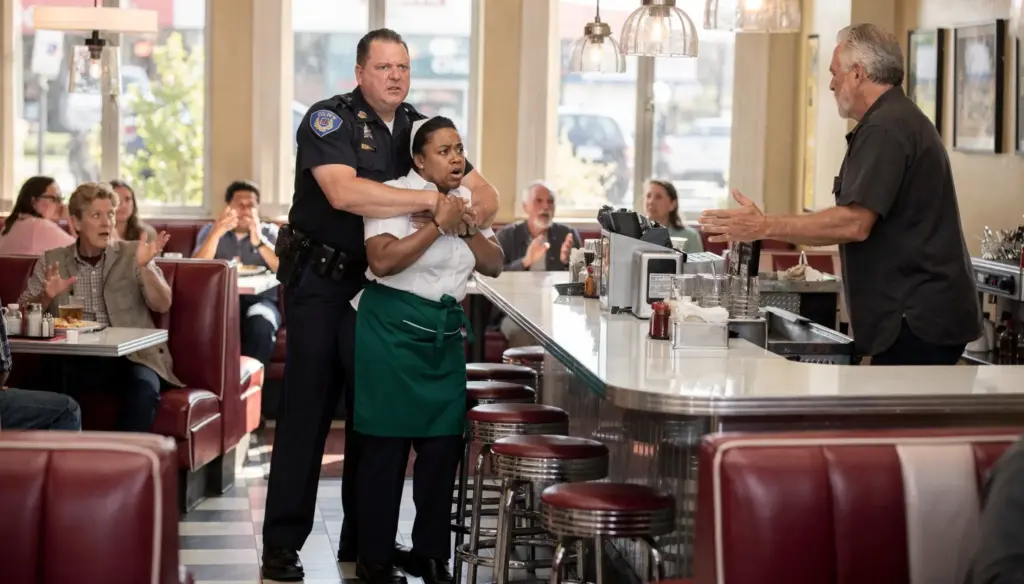
“I don’t know what he legally considers department property.”
“You heard him refer to a card?”
“Yes.”
“Do you know what card he means?”
Maya hesitated again. “Yes.”
Daniel looked over from the counter; Price noticed, but kept her attention on Maya.
“What kind of card?”
“I’m not answering that yet.”
Price closed her notebook halfway. “You understand how that sounds?”
“I do.”
“You want me to evaluate whether Brett had a legitimate reason to be here, but you won’t tell me what he came for.”
“I want you to evaluate what he actually did here.”
“That’s part of it. It isn’t all of it.”
Maya folded her hands on the table.
Price continued. “Did somebody give you the card?”
“I’m not answering that yet, either.”
“Did you steal it?”
“No.”
“Did you copy anything from a police system?”
Maya looked directly at her. “No.”
Brett spoke again. “Ask her whether she accessed records she wasn’t assigned to.”
Price stood. “Officer Kellen, I have warned you twice.”
“I’m giving you relevant information.”
“You’re interfering with an interview.”
“I’m the officer whose department property is missing.”
Price’s expression remained controlled. “You already chose not to answer questions until your interview status is clarified. That choice does not give you the right to answer mine for other people.”
Brett said nothing. Price pointed toward one of the patrol officers. “Take Officer Kellen to the far side of the room. He stays inside, but I don’t want another interruption.”
Brett looked at her. “That necessary?”
“Yes.”
The patrol officer moved with him toward the entrance. Price sat down again.
“You said you worked with records. Where?”
Maya took a breath. “Briarwood.”
“The police department?”
“Yes.”
Price’s expression changed slightly. “What was your position?”
“I worked with evidence records.”
“Sworn?”
“No.”
“Civilian?”
“Yes.”
“How long ago?”
“Not long enough for me to forget how reports work.”
Price studied her. “That explains the language.”
“What language?”
“The way you answer questions: the distinction between what somebody said and what they meant; the way you keep narrowing everything.”
Maya did not respond.
Price continued. “It also raises another question: why didn’t you tell me that when I walked in?”
“Because I wanted you to look at what happened before you decided what my history meant.”
Price leaned back. “You think I would have judged you differently?”
“I think people hear ‘former police employee’ and immediately start asking why the word ‘former’ is there.”
Across the diner, Brett called out, “There’s a reason!”
Price looked toward him. The patrol officer beside Brett said something quietly, and Brett stopped.
Price returned to Maya. “What reason?”
Maya’s face remained controlled. “There’s a file.”
“What kind of file?”
“Personnel.”
“What does it say?”
“That I accessed material outside the scope of my duties.”
“Did you?”
Maya did not answer immediately. Price waited.
“I accessed a record that became a problem after I accessed it.”
“That is not the same answer.”
“No.”
“Was the access authorized?”
Maya looked at the tabletop. “The record about that says one thing, and you say something else.”
“I say there are versions of records.”
Price remained still. “What does that mean?”
“It means the last version of a record is not always the first version.”
Brett heard enough to speak again. “Used to work with evidence records,” he said. “That’s the part you need to pay attention to.”
Price turned toward him. “Officer Kellen, one more interruption and you wait outside with an officer.”
Brett’s expression hardened, but he stayed quiet.
Price looked back at Maya. “Do you have a personal dispute with him?”
“No.”
“You expect me to believe there is no history between you?”
“I didn’t say there was no history. I said this isn’t personal.”
“Then what is it?”
Maya glanced toward the counter where Brett’s badge still rested. “Something he doesn’t want examined.”
Price opened her notebook again. “Now we’re getting somewhere. What is on the card?”
“I didn’t say I had seen what’s on it.”
“Do you know what’s supposed to be on it?”
“Yes.”
“What?”
“Internal data.”
“From what?”
Maya did not answer. Price waited several seconds. Maya shook her head. “Not yet.”
Brett gave a short laugh from across the diner. Price ignored him.
“Officer Kellen says the card contains sensitive department material.”
“That is what he says.”
“Is he wrong?”
Maya looked at her. “He is being very careful about the words he uses.”
Price wrote that down. “So are you.”
“Yes.”
“Why?”
“Because words become reports.”
Price closed the notebook. For the first time since entering Magnolia Road Diner, she had a clearer picture of why Brett had come there, but it created more questions than answers: Maya was not simply a waitress who happened to be caught in a police dispute; she had worked inside the same record system Brett now claimed had been compromised.
Price looked toward Brett. He was no longer watching Caleb; he was watching Maya—not because she had challenged his authority, but because she knew enough to challenge his version of what existed before he entered the diner.
Price asked Maya to remain at the table while she moved back toward Daniel.
“I need to go over your statement again.”
Daniel nodded. “All right.”
“When Officer Kellen came in, did he tell you that you were detained?”
“No.”
“Did he physically block the door?”
“No.”
“Did he tell you that you could not leave?”
“Not in those words.”
Price wrote that down. “What did he say?”
“He said anyone who walked out would have their name added to the suspect list in his report.”
“Did that make you believe you were free to leave?”
Daniel looked toward Brett, then back at Price. “Technically, maybe. Practically, no.”
Brett spoke from the other side of the diner. “That’s an interpretation.”
Price looked at Daniel. “He’s right about one thing: I need to separate what you heard from what you concluded. Tell me only what happened.”