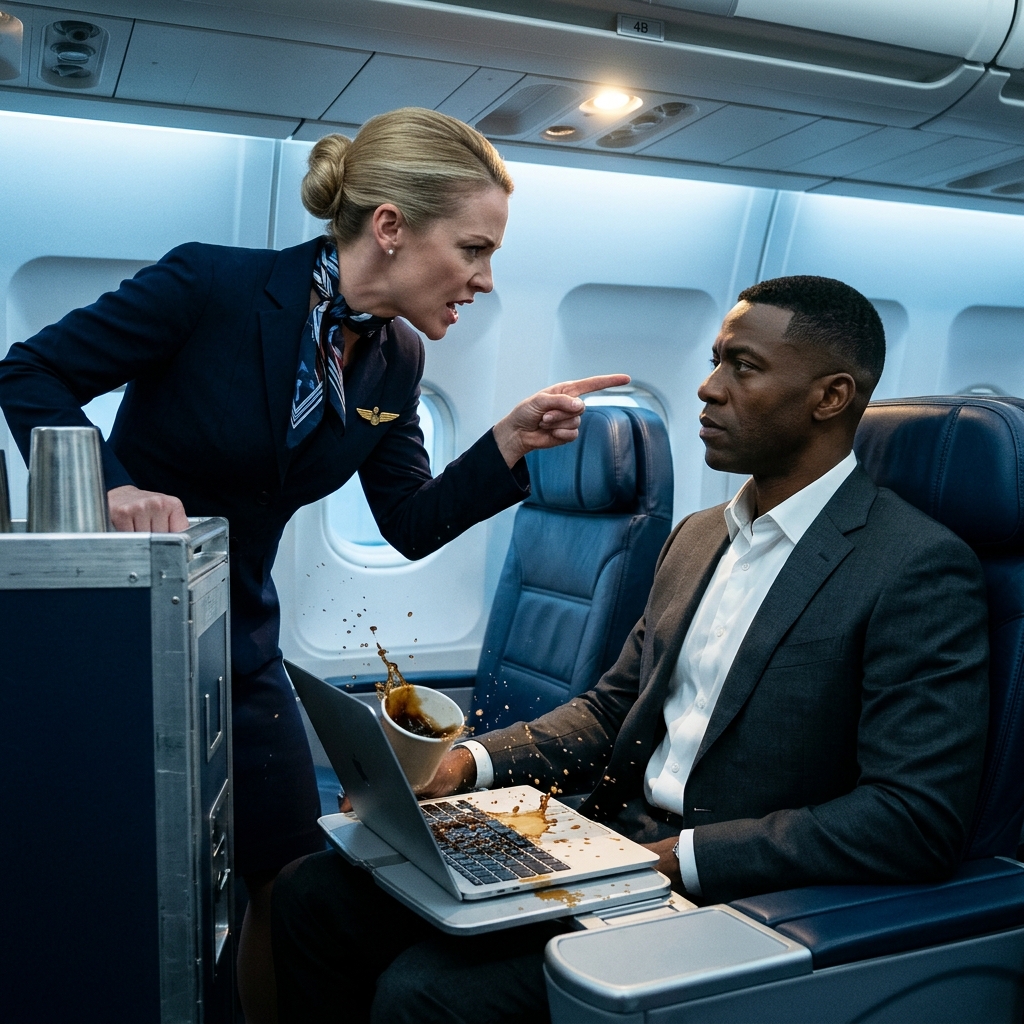
They led him into Holding Room 104—a windowless box with cinderblock walls painted municipal beige, an iron bench bolted to the concrete floor, and a single wooden table beneath a flickering fluorescent tube.
Kowalski pushed Anthony onto the bench, unhooked his radio, and keyed the mic. “Dispatch, we have the 44902 suspect from Meridian 2208 in custody. Notify the regional FBI duty officer that we have an interference transfer ready for processing.”
Anthony sat back against the cold cinderblock.
The steel cuffs were tight, digging into the radial bones of his wrists, but he felt no pain. He felt only the cold, sharp focus of a chess player who had just watched his opponent slide their queen into the center of a quadruple fork.
He looked at the digital clock on the wall.
07:58 EST.
“Sergeant Kowalski,” Anthony said.
The trooper was leaning against the table, writing in his field notebook. “Don’t bother talking, Davis. Anything you say goes in the probable cause affidavit.”
“I am not going to ask for a lawyer, Sergeant,” Anthony said, his voice ringing through the small cinderblock room with absolute authority. “I am going to ask you to open my leather briefcase. The small side pocket. Inside is an encrypted satellite transponder and a federal credential case.”
Kowalski paused, his pen hovering over the paper. He frowned, looking at the man on the bench.
Suspects in first-class interference cases usually fell into two categories: wealthy drunks who threatened to sue his department, or terrified working-class travelers weeping into their shirts. This man was neither. He had not broken a sweat. His heart rate, visible in the steady pulse at his neck, was that of an athlete at rest.
“You carrying a federal ID?” Kowalski asked, his voice losing some of its aggressive edge.
“I am Special Agent Anthony Davis. Office of the Inspector General, United States Department of Justice. Special Investigations Division.”
The room went dead silent.
The second trooper, standing by the door, shifted his boots on the linoleum. He looked at Kowalski with an expression that had suddenly turned very pale.
“Open the briefcase, Sergeant,” Anthony repeated softly. “And do it now.”
Chapter VII: The Unsealing of the Ledger
Kowalski did not rush, but his fingers were noticeably less steady as he unzipped the black leather bag resting on the wooden table.
He flipped through the standard travel items—the spare shirt, the toiletry kit, the noise-canceling headphones. Then his fingers found the hidden interior sleeve behind the laptop partition.
He pulled out a heavy, dark-blue leather credential folder.
He flipped it open.
Beneath the clear plastic shield was a gold federal shield bearing the eagle of the United States Department of Justice, flanked by an identification card bearing Anthony’s photograph, his signature, and the embossed seal of the Attorney General of the United States.
Across the top, printed in bold, red-embossed capital letters, was the authorization:
SPECIAL AGENT ANTHONY DAVIS
OPERATIONAL CREDENTIAL: LEVEL NINE (EXECUTIVE JURISDICTION)
AUTHORITY: SPECIAL INVESTIGATIONS DIVISION / CIVIL RIGHTS SPECIAL PROBE
ALL LAW ENFORCEMENT OFFICERS ARE HEREBY DIRECTED TO RENDER IMMEDIATE, UNCONDITIONAL COOPERATION UNDER TITLE 18 U.S.C. § 3053.
Kowalski stared at the badge for four seconds.
The color drained from his weathered face, leaving him the shade of wet cardboard. His mustache twitched once. He slowly raised his eyes from the credentials to the man sitting in handcuffs on the iron bench.
“Jesus Mary and Joseph,” the second trooper whispered from the door, his hand dropping off his belt.
“Key,” Anthony said, holding his wrists forward.
Kowalski reached for his belt with frantic haste, fumbling with his brass key ring. His hands shook as he inserted the small key into the keyways of the cuffs, twisting twice until the ratchets clicked open.
Clink.
The steel bracelets fell away. Anthony rubbed his wrists slowly, restoring the circulation to his thumbs. He did not stand up immediately. He reached into his suit jacket, retrieved a clean silk handkerchief, and wiped a smear of dry coffee from his cuff.
“Sergeant,” Anthony said, his tone entirely conversational, “what is the name of the Massachusetts State Police Troop Commander for Logan?”
“Major… Major Robert Sullivan, sir,” Kowalski stammered, standing at rigid attention, his notebook forgotten on the table.
“Get Major Sullivan down here. Along with the Assistant United States Attorney on airport duty. And tell your troopers to secure Gate C19. No crew member from Flight 2208 leaves the terminal concourse. Nobody boards a connecting flight. Nobody leaves the jet bridge.”
“Yes, sir. Immediately, sir.” Kowalski practically lunged through the doorway, shouting orders into his radio before the heavy steel door had even swung shut.
Anthony stood up. He walked to the wooden table, opened his ThinkPad, and plugged in a small, hardware-encrypted thumb drive.
He tapped four keystrokes.
The audio feed from his lapel mic had already been converted into a synchronized digital waveform, cross-referenced with the flight’s black-box telemetry data which his team had been mirroring via satellite since takeoff.
Twenty minutes later, the door to Holding Room 104 opened again.
A tall, silver-haired man in a dark-green state police uniform entered, flanked by an athletic woman in a tailored black suit carrying an official legal portfolio.
Major Robert Sullivan. And Assistant U.S. Attorney Elena Vance.
“Agent Davis,” Vance said, extending her hand with sharp, professional familiarity. “We’ve been monitoring your tracking beacon since you crossed the Maryland line. Are you all right?”
“I’m in one piece, Elena,” Anthony said, shaking her hand. “The trap closed precisely where we anticipated.”
Sullivan was staring at the table, his expression dark with fury. “Davis, my troopers were told they were intercepting an active physical assault on an aircrew. Reynolds declared an in-flight emergency.”
“Reynolds declared an emergency based on a fabricated statement provided by his lead flight attendant,” Anthony said, turning the laptop screen toward the prosecutor and the police commander. “Play track four.”
He pressed the spacebar.
The speakers of the ThinkPad filled the room with crisp, studio-grade audio:





