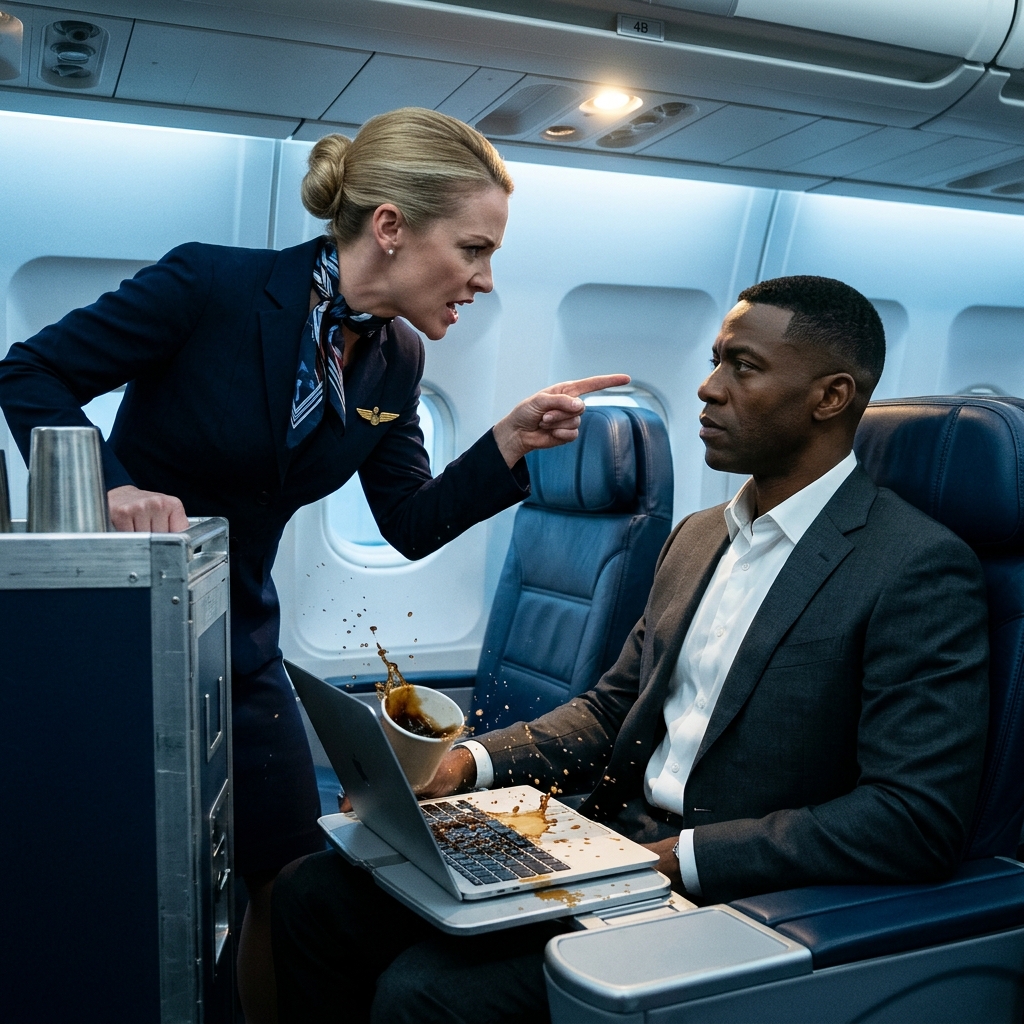
Chapter I: The Gate at the Edge of Night
The pre-dawn air inside Concourse B of Hartsfield-Jackson Atlanta International Airport had the dry, recycled taste of ozone, bleached linen, and scorched espresso. Beneath the vaulted steel ribbing of the ceiling, thousands of travelers moved through the terminal’s blue-gray fluorescent haze like sleepwalkers caught between time zones. Beyond the panoramic glass of Gate B22, the southern morning was only a bruise of violet and indigo smeared across the horizon, cut by the amber strobes of fuel tankers crawling over the damp concrete apron.
Special Agent Anthony Davis sat three rows back from the boarding podium, a lukewarm paper cup of black roast cupped between palms that remained entirely still.
At forty-one, with broad shoulders trimmed into a bespoke charcoal wool suit and an open-collared white twill shirt, he projected the effortless, weary polish of a senior risk consultant heading north for a quarterly audit. His black oxfords were shined to a dull, military discipline; his leather briefcase bore the subtle scuffs of a carry-on that lived in overhead bins.
There was nothing about him that suggested the Department of Justice Special Investigations Division, nothing that hinted at the encrypted digital recorder threaded through the left lapel buttonhole of his jacket, and nothing that betrayed the six weeks of quiet, simmering fury coiled beneath his ribs.
This was his thirteenth sector on Meridian Atlantic Airways. Over forty-two days, he had traced a deliberate zigzag across the carrier’s domestic route network: Dallas to Charlotte, Chicago to Miami, Atlanta to Philadelphia. He had spent those weeks compiling a forensic ledger of humiliations.
The case had landed on his desk in Washington disguised as a collection of disjointed customer service complaints—eighty-six in total, filed over nine months. Seventy-one of those dossiers shared an identical architectural profile: Black business travelers, surgeons, professors, and tech founders who had paid full fare for first-class accommodations, only to be systematically scrubbed from the premium cabin before the boarding door closed.
The internal audit logs from Meridian’s headquarters in Dallas had told an even darker story. Whenever an aggrieved passenger complained of being singled out, threatened with gate ejection, or forced into the last row of coach, the airline’s customer relations apparatus deployed a prefabricated corporate defense: “Crew member exercised safety discretion under 49 U.S. Code § 44902; passenger exhibited aggressive posture during pre-flight administrative review.”
Section 44902 was the federal statute that granted airline captains absolute authority to refuse transport to any passenger deemed inimical to safety. Conceived in the dawn of commercial aviation to combat hijackers and violent drunks, Meridian Atlantic had quietly converted it into a corporate weapon—a liability-free instrument to enforce social hierarchy and silence dissent.
Anthony took a slow sip of the coffee. At the gate podium, fifty feet away, the morning’s preliminary choreography was already taking shape.
A gate agent with hair pulled into an aggressive, lacquered bun was squinting at a desktop monitor, her fingers hammering the keyboard with sharp, rhythmic slaps. Her name tag read K. Hensley. Behind her, framed by the jet bridge entrance, stood the lead flight attendant assigned to Flight 2208 to Boston Logan.
Brittany Miller.
Anthony had studied her file for two weeks. Thirty-five years old, eleven years with the carrier, and the subject of nine separate civil rights complaints, every one of them successfully scrubbed from her personnel record by her uncle, a senior vice president of flight operations at Meridian’s corporate campus. She stood with her arms folded across her navy-and-gold uniform vest, her chin raised at a sharp, appraising angle as she scanned the gate area. She was not checking the passenger manifest for connecting gates or unaccompanied minors; she was surveying the waiting room like an overseer assessing a line of suspects.
“Zone One, premium cabin and Diamond Medallion only,” the gate agent’s voice crackled through the overhead speakers, metallic and flat. “Please have your government IDs and physical boarding passes visible. No mobile screenshots.”
A low murmur stirred through the line of travelers.
A tall man in a navy trench coat, carrying a monogrammed leather duffel, rose from the seats near the window and stepped toward the scanner. His name, Anthony knew from the preliminary manifest review his team had run at 0400 hours, was Kevin Johnson—a forty-four-year-old pediatric neurosurgeon flying to Boston Children’s Hospital to perform a scheduled cranial reconstruction. He had paid $1,400 for Seat 2B.
As Dr. Johnson presented his pass, the gate agent’s eyes flicked over his dark skin, down to the boarding document, and back up again. The polite, robotic cadence she had used to greet the white investment banker three seconds earlier evaporated.
“Step aside for a moment, please, sir,” Hensley said, her hand dropping across the scanner bed to block his path.
Johnson stopped, his boarding pass hovering in mid-air. “Is there an issue with the seat?”
“The system is showing a seat-reassignment hold on your reservation,” Hensley said loudly enough for the first six passengers in line to turn and stare. “You need to wait while I re-verify the ticketing class.”
Brittany Miller stepped through the jet bridge door, leaning over the counter. Her eyes raked Johnson from his hair down to his leather loafers.
“Is this 2B?” Brittany asked, her voice carrying a dry, dismissive rasp. “Because 2B is an executive tier. The app often defaults unpaid upgrades into that block.”
“I purchased this ticket three weeks ago,” Johnson replied. His tone was impeccably level, though the muscle along his jaw ticked once. “Full fare. First class. Here is the confirmation on my mobile wallet.”
“Sir, don’t raise your voice at my agent,” Brittany snapped, her posture stiffening as if she had just been threatened with a blade. “We’re verifying your authorization. If you argue with ground crew, we will not board you on this aircraft. Do you understand me?”
A young couple behind Johnson shifted their weight, their eyes darting away in uncomfortable, complicit silence.





