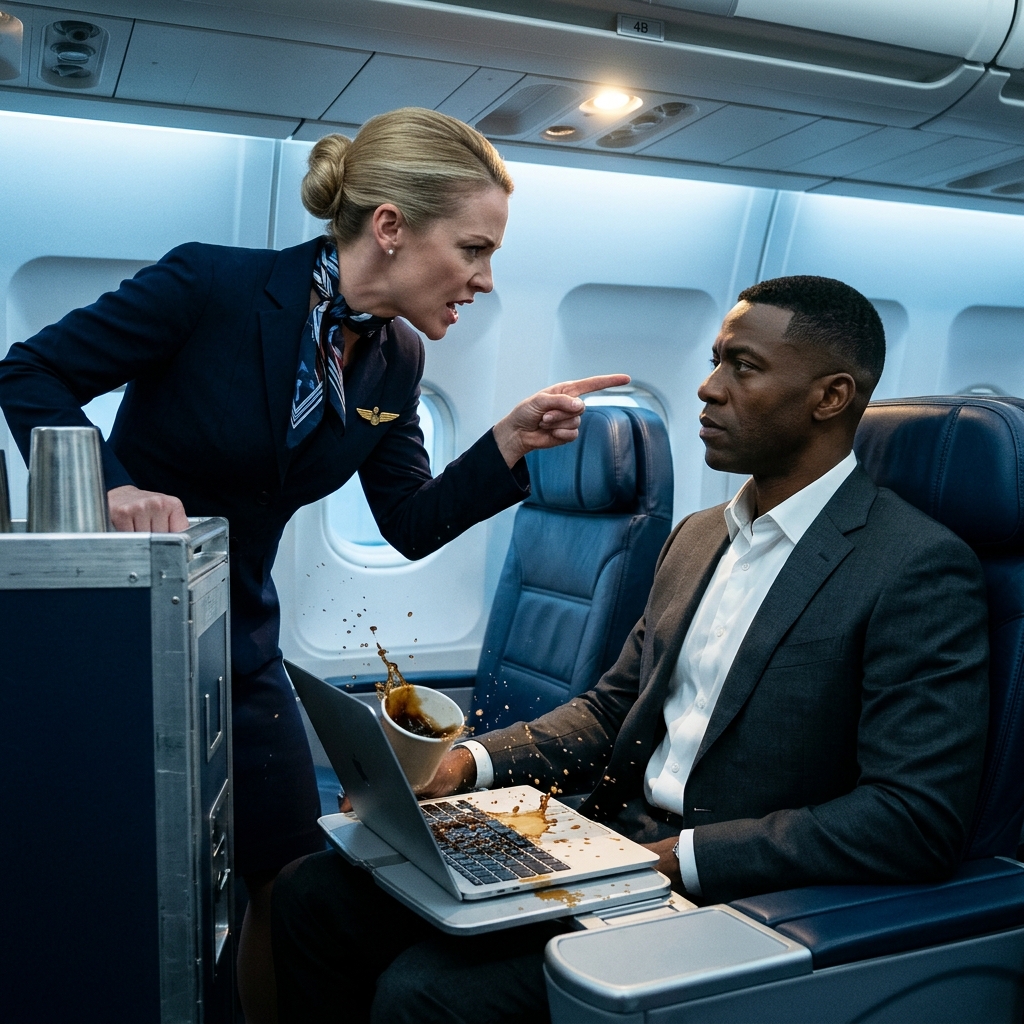
Anthony remained seated, his fingers tightening slightly around the paper cup. His micro-lapel recorder was running, transmitting a high-fidelity digital feed through an encrypted relay in his briefcase straight to an automated server in the Federal Building on Seventh Street.
Baseline established, he thought. The gate personnel provoke. The lead attendant characterizes composure as aggression. The threat of Section 44902 is deployed before the boarding bridge is even crossed.
Hensley hammered the keyboard for another thirty seconds before printing a new slip with an aggressive tug. “You’ve been moved to 18E. Center seat, main cabin. System rebalanced the forward trim.”
“I am a neurosurgeon,” Johnson said, his voice dropping into a desperate, controlled whisper. “I have six hours of surgery waiting at Logan. I paid for space to rest.”
“You can take 18E, or you can take tomorrow morning’s commuter shuttle,” Brittany told him, her smile tight, gleaming, and thoroughly poisonous. “Your choice, sir.”
Johnson looked at the printed slip in his hand, his shoulders sinking under the sudden, crushing weight of a humiliation engineered to leave no marks on his skin. He took the boarding pass, turned his face from the crowd, and walked down the jet bridge into the fluorescent throat of the aircraft.
Anthony rose. He discarded his paper cup in a recycling bin, adjusted the strap of his leather briefcase, and stepped into the queue.
When he reached the scanner, Hensley glanced up. She saw the dark wool suit, the polished shoes, the calm, unblinking eyes of a man who looked like he owned the bank that held her mortgage. She scanned his pass.
The machine chirped—a clean, high confirmation tone.
Seat 4B. First Class.
Brittany Miller was standing just past the threshold, greeting entering passengers with mechanical nod. When Anthony stepped onto the ribbed carpet of the boarding bridge, her gaze snagged on his face.
The smile did not fade; it curdled. Her eyes flicked down to the corner of his boarding pass, noting the large numeral 4B printed in bold thermal ink.
“Cabin bag goes under the seat in front of you if the overhead fills,” she said, her voice dropping all pretense of hospitality as he stepped past her into the cabin.
Anthony met her eyes for a fraction of a second. “Good morning to you as well,” he said quietly, and stepped into the aisle.
Chapter II: The Sovereign Territory of Row 4
The first-class cabin of the Boeing 737-800 was configured in four rows of wide, dark-navy leather recliners.
The air was dense with the low hum of the auxiliary power unit and the sharp, chemical tang of galley sanitizer. Anthony moved down the aisle and slid into Seat 4B—the aisle seat on the starboard side, directly in front of the bulkhead dividing premium from coach.
To his left, in 4A by the window, sat an elderly gentleman with silver hair, wire-rimmed spectacles, and a rumpled corduroy blazer. He was already engrossed in a printed copy of the Wall Street Journal, a fountain pen balanced between fingers spotted with age.
“Morning,” the old man muttered without looking up, tucking his elbow inward to yield the shared leather armrest.
“Good morning,” Anthony murmured.
Through the forward galley curtain, the voices carried with the clarity of stage dialogue. The aircraft had not yet closed its main boarding door, and the crew was still conducting their pre-departure inventory.
“Who’s in 4B?”
It was Brittany’s voice, sharp and low, speaking to the junior attendant, a woman in her mid-twenties named Ashley Brown, whose nametag was still crooked on her lapel.
“Just boarded,” Ashley replied, her voice cautious. “Solo traveler. Charcoal suit.”
“Keep an eye on him,” Brittany whispered, the hiss of her sibilants cutting through the engine hum. “He’s got that look. These guys buy a basic economy ticket, wait until the gate gets chaotic, and then drift into first class hoping nobody cross-checks the manifest. If he touches anything from the snack basket before we hit cruising altitude, tell me immediately. I’m not dealing with an illegal upgrade on a three-hour run to Logan.”
“His boarding pass was printed on premium cardstock, Brittany,” Ashley ventured, her voice dipping lower. “I saw it when he walked past.”
“You can reprint anything at an automated kiosk if you trick the interface,” Brittany snapped. “Watch him. And don’t pour him a pre-departure drink until I check the electronic jumpseat manifest. If he’s not supposed to be here, he doesn’t get a drop.”
Anthony did not shift his posture. He opened his briefcase, retrieved a slim, leather-bound notebook and a Montblanc ballpoint pen, and laid them on his tray table.
Beside him, the gentleman in 4A lowered his newspaper slightly. The older man’s eyes flickered toward the galley curtain, his brow furrowing with mild distaste. He glanced at Anthony, opened his mouth as if to offer an apology for what they had both clearly heard, then thought better of it and returned to his stocks.
Three minutes later, Brittany emerged from the galley holding a silver tray laden with crystal tumblers of orange juice and sparkling wine.
She glided down the port aisle, her performance flawless.
“Good morning, Mr. Vance, wonderful to have you back with us,” she cooed to the software executive in 1A. “Sparkling wine for you? Certainly.”
In Row 2, she leaned over with a warm, musical laugh, offering extra napkins to a woman traveling with a small dog. In Row 3, she lingered to discuss the weather in Boston with a pair of biotech venture capitalists.
Then she crossed the aisle to Row 4.
She stopped at the edge of Anthony’s seat. She leaned down toward the man by the window, her back turned entirely toward Anthony, effectively walling him off with her hip.
“Good morning, sir,” she purred to 4A. “Would you care for a pre-departure beverage? We have freshly squeezed mimosa, water, or our signature sparkling blend.”
The old man lowered his paper. “Just a seltzer, if you have it, young lady.”





