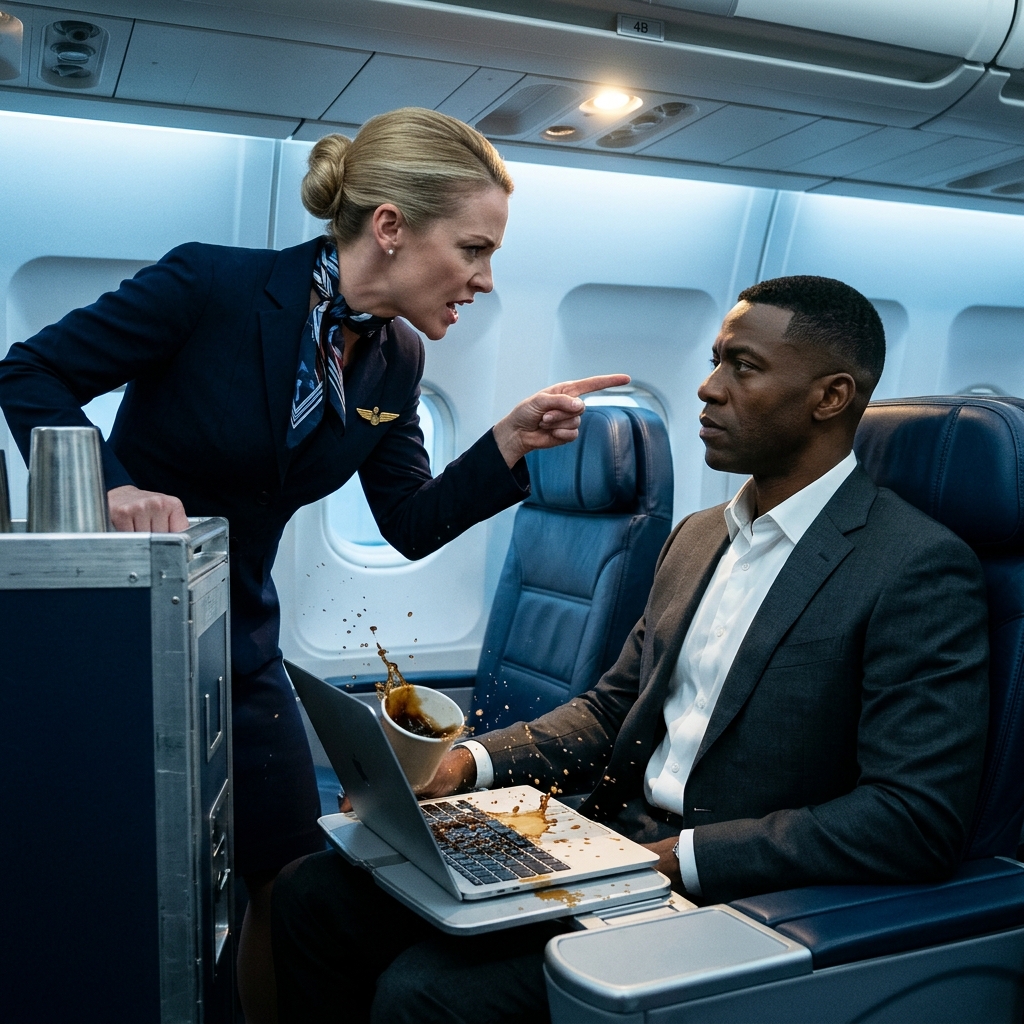
The woman had gone completely gray, her skin the color of dirty chalk, her hands fluttering at her throat as if she were suffocating. The smug, untouchable cruelty that had defined her career had vanished, replaced by the raw, paralyzed terror of a predator that had just realized it was standing inside an abattoir.
“For six weeks, Miss Miller,” Anthony said, each syllable falling like a stone on an anvil, “we have been documenting the systemic deployment of Section 44902 across Meridian Atlantic’s premium cabins. We have eighty-six cases. We have the internal emails from your uncle’s desk in Dallas authorizing the deletion of passenger complaints. We have the metadata from your personnel files.”
He reached into his pocket and placed the small digital recorder on the glass coffee table between them.
“And we have every single word you spoke on Flight 2208,” Anthony continued. “From the moment you told Ashley to watch Seat 4B at the gate, to the moment you threatened to reassign her to Bismarck if she didn’t lie to the federal authorities.”
In the corner, Ashley Brown buried her face in her hands and began to weep—not with terror, but with the sudden, overwhelming release of someone who had just been saved from the bottom of an ocean.
“Brittany…” Reynolds whispered, his voice cracking as he stared at his lead attendant, his career, his pension, and his freedom disintegrating in front of his eyes. “What did you do? What did you do?”
“Cuff them,” Major Sullivan ordered.
The four troopers moved in with clinical efficiency.
Kowalski stepped behind Brittany. He took her wrists—the same wrists that had signed the fraudulent incident report twenty minutes earlier—and pulled them behind her back.
Click. Snap.
The steel cuffs locked into place.
Brittany let out a high, strangled shriek, her legs buckling beneath her as the reality of the iron crashed into her central nervous system. She would not be staying at the luxury crew hotel in Back Bay. She would not be flying to Paris on Friday. She was going to the federal detention facility in Walpole, wearing a blaze-orange jumpsuit, to await an arraignment from which there would be no corporate rescue.
As they marched Reynolds and Brittany through the lounge doors, a small crowd of ground workers, baggage handlers, and passengers from Flight 2208 had gathered in the terminal corridor.
Among them stood Dr. Kevin Johnson, his coat over his arm, holding his boarding pass for his flight connection. Beside him stood Walter Sterling, the retired litigator, holding the black business card Anthony had given him two hours earlier.
When Brittany emerged in handcuffs, her head bowed, her mascara running in black streaks down her cheeks, Kevin Johnson’s eyes met Anthony’s across the polished floor of the concourse.
Johnson did not cheer. He did not smile. He simply stood tall, his shoulders back, his dignity fully and completely intact, and offered Anthony a single, quiet nod of absolute recognition.
Anthony returned the nod.
Epilogue: The Horizon at Dawn
The morning storm had cleared by ten o’clock, swept away by a brisk northwest wind that left the sky over Boston Harbor the color of polished sapphire.
Anthony Davis stood by the floor-to-ceiling glass of the observation lounge in Terminal C, holding a fresh cup of coffee—his first real cup of the day.
Behind him, the terminal monitors were already broadcasting the breaking news crawl across every cable network:
Elena Vance walked up beside him, leaning her shoulder against the window mullion. She held two manila folders stamped with the seal of the Attorney General.
“The board of directors in Dallas just fired the CEO,” Elena said, her voice quiet. “And Brittany Miller’s uncle resigned twenty minutes ago. The grand jury in Atlanta is already issuing subpoenas for every incident report filed in the southern district over the last five years.”
“And the junior attendant?” Anthony asked. “Ashley?”
“Full immunity,” Elena replied. “She spent the last forty minutes giving our investigators three years of internal memos. She’s going to be the government’s star witness.”
Anthony looked out through the glass toward the active runway.
A silver jetliner was accelerating down the asphalt, its twin turbofans roaring with full takeoff thrust. It lifted smoothly into the clean Atlantic air, banking gently toward the east, its wings catching the late morning sun until it gleamed like a silver blade against the horizon.
He thought of the eighty-six travelers whose complaints had been thrown into corporate incinerators. He thought of the humiliation endured in private cabins and public boarding gates by people whose only crime had been their audacity to sit in the seats they had paid for.
The law was an imperfect instrument. It was slow, it was clumsy, and it was often blind to the subtle, everyday cruelties that powerful people inflicted upon the weak. But every once in a while, if a person was willing to sit in the cold, endure the handcuffs, and carry the truth through the dark, the law could be made to do something magnificent.
It could be made to work.
Anthony Davis took a slow sip of his coffee, turned his back on the runway, and walked down the wide, sunlit concourse toward the gate that would take him home.





