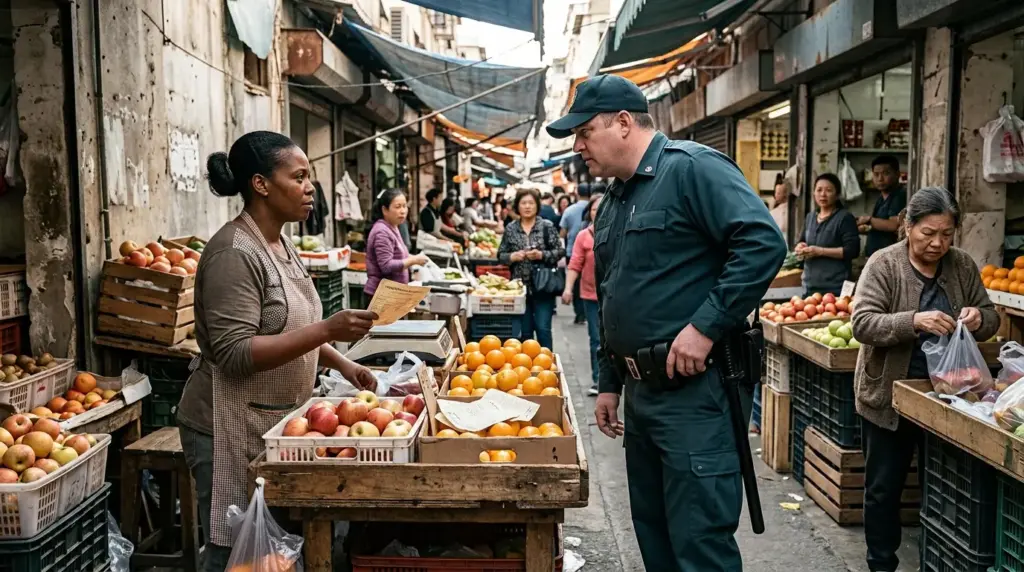
When the prosecutor asked, “Did you accept money from the Bravo Unit to overlook complaint reports?” Lang stammered, his voice cracking apart: “I… I only reviewed what was submitted.”
The stare from every corner of the room cut straight through his excuse. No one believed him; no one wanted to believe him anymore.
Kellen was brought in next, hands cuffed. He still tried to hold himself up with a furious, shouting voice: “That whole market was against me! I was just doing my job!”
His outburst poured gasoline on the anger simmering in the hallway. A woman stood abruptly, shouting, “Doing your job? That’s what you call beating a vendor?!” Security moved to calm her, but no one blamed her. No one blamed anyone who had endured Bravo Unit for so many years.
When Maddox entered, the air chilled. He said nothing, reacted to nothing, looked at no one. His eyes dropped toward his own shoes, as if searching for a place dark enough to hide beneath. Maya watched him and remembered how he shoved a woman to the brink of falling on her first day in the market—a small gesture, yet full of the arrogance of someone accustomed to viewing people as refuse.
Then came Hale’s turn.
The holding room door opened, and he walked in as though still commanding the entire unit: slow steps, steady, his posture so straight it bordered on pride. His gaze swept across the room like he was mapping a battlefield, then locked onto Maya. The look lasted a beat too long—dark and sharp, sending a cold line down her spine as though a blade had grazed past. He sat down, placing his hands on the table like this was merely another internal briefing, not a federal courtroom.
The prosecutor played Ali’s recording. “This is a direct order from Lieutenant Marcus Hale,” he announced, letting the audio echo throughout the room.
Hale’s voice in the recording was so clear that every rustle and breath could be heard distinctly: “Write the report exactly as I give it. Anyone who changes a word deals with the consequences.”
As that line filled the space, a thick silence fell over every row. No one moved; no one breathed deeply. Even Hale’s faint smirk slipped, though he still reclined slightly as if taunting: “That kid… you trust him more than me?”
The judge looked at Hale with calm but stone-hard eyes. “Do you have anything to say?”
Hale tilted his head just slightly and replied with a chillingly casual tone: “Justice does not exist in this city. I simply played by the rules you people set.”
A pen dropped from the jury box, startling the room. Hale stood as security closed in, but before being taken away, he turned, passing close to Maya. Only a few steps remained between them. He leaned just enough for the words to reach her alone—a whisper shaped like a threat:
“Your story is not finished yet.”
His breath was so cold Maya felt as though a curse had brushed her skin.
As Hale was escorted out the back door, angry shouts rose from the courthouse lawn. People called Brooks’s name; others demanded harsher charges. Royce stepped beside Maya, bending close to her ear to avoid camera mics.
“Do not react when he provokes you,” he murmured. “He has no shield now. But men like Hale are most dangerous when they know they’re losing everything.”
That afternoon, Royce received an urgent notice from a federal agent monitoring legal filings. He walked quickly to Maya and set a thin folder on the table.
“Hale just requested a private attorney,” he said.
Maya glanced at the name on the document, and for a heartbeat, her chest tightened: that attorney had past ties to a secretive organization absent from public records, known for defending individuals suspected of manipulating legal systems across several states.
Royce added, “No one knows who’s backing him. This is not normal.”
Maya turned toward the window. The Holston sky had darkened, streetlights flickering on, stretching long streaks of light across the damp pavement. Since the day Brooks died, the city had been drowning beneath the shadow of a rotten system. Now that the system was collapsing, the darkness had not lifted; she sensed everything shifting toward a deeper, colder direction.
In that moment, she understood what Royce had not said aloud: when power loses its protectors, it does not vanish—it runs, it hides, it searches for another way to survive. And Hale, with that look in his eyes, was not the kind of man who would let this story end inside a courtroom.
On the morning the DOJ signed the consent decree, Holston felt as though a new page had been opened. In front of the federal courthouse, a major press conference was held. Camera lights swept repeatedly across the faces of hundreds of residents standing under the sun: many holding “Justice for Brooks” signs, many simply standing still with their hands clasped, unable to believe the day had finally come.
The DOJ representative stepped up to the podium, his voice carrying clearly through the speakers: “As of today, the Bravo Unit no longer exists.”
For a second, silence fell like a passing shadow. Then cheers erupted all at once, bursting open like water crashing through a broken dam. People embraced each other; some cried outright. An elderly woman clutched Brooks’s photograph and whispered through sobs, “My boy… finally.”
Maya stood behind the security barrier, feeling the shift spread through the crowd like a wave. Royce stood beside her, giving a small nod as if confirming that a long, brutal chapter finally had an answer.





