Maya settled into the vehicle and glanced through the tinted window, where “Justice for Brooks” signs were scattered along the path. Some swayed in the afternoon breeze, hastily painted; others were meticulously assembled. All carried the same lingering grief. Maya pulled her jacket closer, not from cold, but from the awareness that she was about to live among these still-open wounds. She knew this would not be a short assignment; it could stretch for months, perhaps longer, if Bravo Unit concealed its tracks as thoroughly as the files suggested.
The vehicle began moving toward Harborline Market. Outside, the landscape shifted from office blocks to poorer streets, where peeling signs and narrowing walkways marked the transition. As the car turned onto the market road, Maya saw residents hauling goods, pushing fruit carts, and arranging wooden crates. Their faces tightened at the distant wail of a police siren. The air felt heavy as packed soil, pressing into each footstep. Maya placed a hand on the cloth bag, sensing that everything she had prepared over the past two days was crystallizing into reality.
A few dozen meters later, Maya saw three Bravo Unit officers standing in the middle of the walkway. They were not doing much—just standing, watching a vendor kneeling to gather spilled mangoes. The crushed fruit left wet marks on the ground as the woman’s trembling hands picked them up one by one in embarrassed haste. People moved quickly past, too afraid to stop. Maya observed the scene, seeing the imbalance between power and fear stretched sharply across the ground like a line traced through each fallen mango.
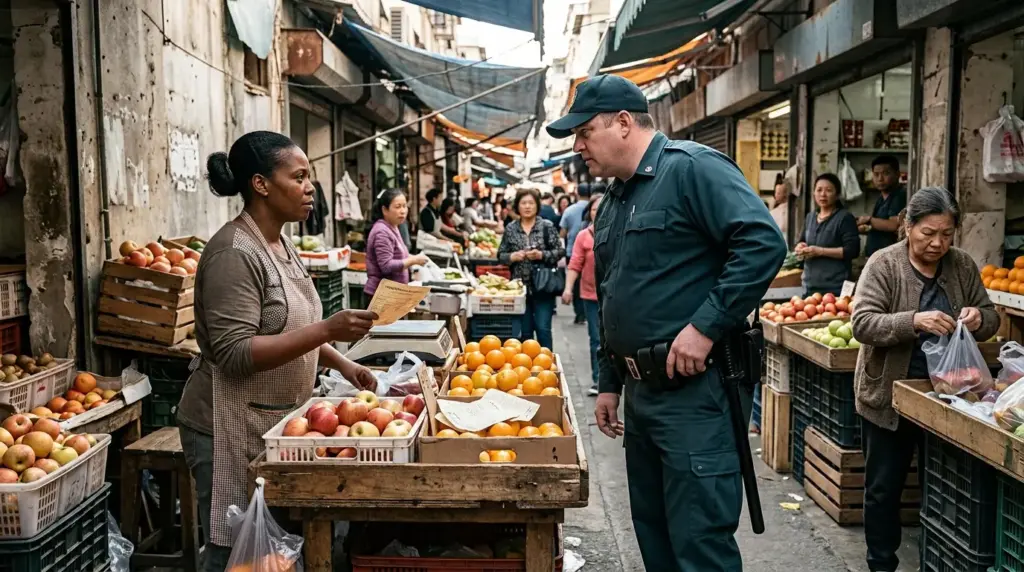
The first morning at Harborline Market unfolded with the scent of ripe fruit, the rasped calls of longtime vendors, and a humid breeze carrying dust from the old parking lot behind the stalls. Maya arranged trays of fruit on the newly rented wooden table, lining up apples and oranges neatly as she folded herself into the rhythm of the marketplace. Though she tried to appear ordinary, she still felt the glances drifting toward her, each one tinted with cautious assessment. No one approached to speak; they simply looked and then shifted their eyes away, as if sorting out whether she belonged to Holston or had any ties to Bravo Unit. That weariness appeared in every movement, every step, every street cry that faltered when a stranger arrived.
As Maya tightened her bun and bent down to pick up a few plastic bags, a hand reached in to help. Ruth Alvarez, a petite fruit seller at the neighboring stall, looked at her with the familiar gaze of someone who had lived far too long in a state of vigilance. Ruth handed Maya a fistful of bags and spoke quietly, as though afraid someone might overhear. She said that around here, it was better not to stare at anyone in uniform, because they hated being watched.
Maya nodded, thanking her in the tone of a newcomer seeking a place in the market: shy, but trying to be friendly. In that first minute, Maya recognized Ruth as the type who helped others through cautious kindness—a trait often born in places where power always stands on the opposite side.
The sounds of the market were steady until they froze for a single beat when a Bravo Unit patrol vehicle turned into the main lane. The entire market seemed to inhale at once and hold the breath in its chest. A man weighing apples tugged his shirt down to hide his anxiety. A crying child near the vegetable stall went silent the moment the blue-green of the uniforms came into view. Maya watched the scene as though the whole market were strung together by an invisible wire—one that snapped taut every time Bravo Unit appeared. The quiet was thin as a stretched pane of glass, twitching at the slightest touch.
As they walked through, a Bravo Unit officer tapped lightly on a plastic box at a dried goods stall. The vendor immediately stuffed money into it without asking what fee it represented. Other stalls hurried to do the same, their motions quick but steeped in reluctance. Maya observed, trying to memorize the market’s habits. No one spoke openly about the fee, but everyone knew what would happen if they refused. The sound of knuckles tapping the plastic container made the already tense air feel even heavier.
Across the lane, Omar Price, the gray-haired cobbler, watched Maya from his booth, his gaze pressed into her as if carrying an unspoken warning that stopped short of language. His hand tightened around the small hammer he held, his knuckles whitening. He looked like a man trapped between two impulses: wanting to approach her and tell her something, yet terrified that one wrong word could upend his entire life. Maya gave him a slight nod, a simple gesture meant to open a path. But Omar pulled his gaze back and leaned over the half-mended shoe, as if avoidance was the only way to survive here.
Near the market entrance, a young woman carrying a crate of tomatoes was shoved aside by Officer Maddox because she walked slower than he preferred. Maddox offered her a thin smile, half joke, half threat, telling her she should move faster if she didn’t want to be made uncomfortable. The woman bowed her head, apologized, and hurried off. Maddox turned to scan the others, testing to see who dared react. No one did.
From behind her fruit stall, Maya watched the behavior, sensing power abused so routinely it had become a form of daily practice. Maddox’s carelessness was proof that Bravo Unit believed they could do anything they wished.





