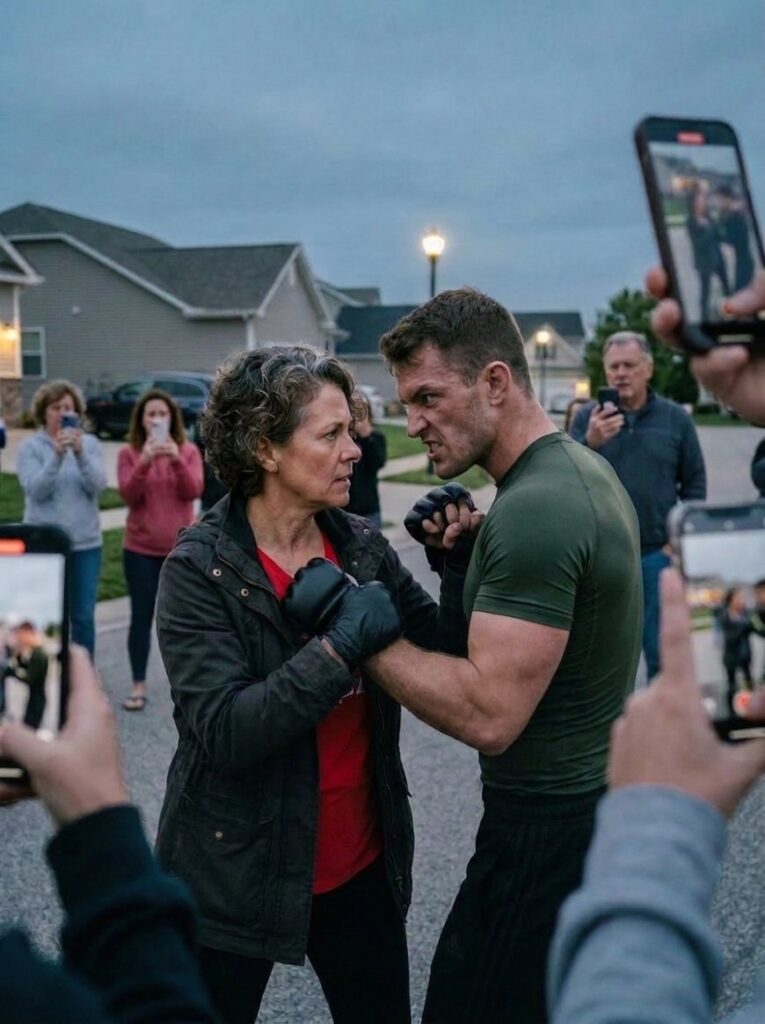
Logan’s first move was a probing jab, fast and clean, meant to measure distance and establish dominance. I let it pass an inch from my face. The crowd gasped anyway, a collective intake of breath that fed him more than the strike itself ever could. He circled left, and I turned with him, keeping my feet quiet on the pavement, my hands loose and high. “That all you got, Colonel?” he asked, loud enough for the phones to catch it. I didn’t answer. He threw a combination—jab, cross, hook—textbook mechanics, gym-perfect and predictably telegraphed by the way his hips shifted before each strike. I slipped the jab, parried the cross with my lead hand, and stepped inside the hook before it could land. For a heartbeat, we were chest to chest. I could smell his cologne, something sharp and expensive, and beneath it the sour edge of nervous sweat. “Your father’s camera is on your left,” I said quietly. “You keep checking it.” His eyes flickered, just for an instant, and I saw the boy beneath the black belt—the one who had spent years learning how to fight because learning how to be loved had never been offered as an option. Then his expression hardened, and he shoved me back with both hands. I allowed the separation. The neighbors cheered, mistaking retreat for weakness. Grant’s voice cut through the noise. “That’s it, Logan! Pressure! Don’t let her breathe!” Logan came forward again, and this time there was something different in his movement—desperation dressed up as aggression, technique sacrificed for spectacle. He threw a spinning back kick, the kind that looked devastating in highlight reels and left a fighter completely exposed if it missed. I stepped inside the rotation, caught his extended leg against my hip, and used his own momentum to guide him off balance. He stumbled but didn’t fall. The crowd murmured, a ripple of uncertainty passing through the lawn chairs and open garages. Grant lowered his phone a fraction of an inch. “Lucky,” he called out. “She got lucky.” Logan reset his stance, but his breathing had changed—shorter now, less controlled, the rhythm of a fighter who had expected a quick finish and was beginning to understand that his opponent had not. I watched his eyes. They kept drifting left, toward the phone, toward his father, toward the version of himself that existed only when someone was watching. “Logan,” I said. He blinked. “You don’t have to do this.” “Shut up.” “I’m not your enemy.” “You’re embarrassing me in front of everyone I know.” “No,” I said. “I’m refusing to let you embarrass yourself.” Something cracked behind his eyes—not anger, but something older and rawer, the kind of wound that never fully closes because the person who made it keeps pressing on it. He charged. This time, there was no technique at all—just raw forward momentum, arms wide, trying to grab me and drag me down through sheer physical force. I could have ended it in three different ways. A hip throw would have put him on his back and knocked the wind out of him. A joint lock would have made him tap in seconds. A single well-placed strike to his solar plexus would have dropped him to his knees. I did none of those things. Instead, I stepped into his charge, caught both his wrists, and used his own weight against him—not to throw him, but to stop him, to hold him there in the middle of the street while the whole neighborhood watched and the cameras recorded every second. We stood face to face, breathing hard, his arms trapped in my grip, his eyes wide with something between fury and confusion. “Look at me,” I said. He tried to pull away. I held firm. “Not at the phone. Not at your father. At me.” His jaw clenched, but his eyes found mine. “You think I wanted this?” I asked. “You think I moved to this street so I could fight a twenty-two-year-old in front of his father’s camera?” “Then why are you here?” “Because you threw gloves at my feet and gave me no choice.” “You could have walked away.” “No,” I said. “I couldn’t. And you know why.” His expression flickered. “Because if I walked away, you would have followed my son to school with your videos and your followers and your father’s money, and you would have made him pay for a fight I refused to finish.” Logan’s arms trembled in my grip. “I wouldn’t—” “You already did. You posted about him. You made him the story.” “I was angry.” “At me. Not at him. But you used him because he was easier to reach.” The words landed like strikes, and I watched them hit, one after another, each one finding a target I hadn’t fully understood until that moment. Logan’s resistance softened, just slightly. “I didn’t mean to—” “Mean to what? Hurt a fifteen-year-old boy who asked you politely to move your motorcycle?” He looked away. I released one of his wrists. “Your father is still filming.” Logan’s gaze darted toward Grant, who had raised the phone again, sensing the shift in momentum, waiting for the ending he wanted. “He’s waiting for you to knock me out,” I said. “Or for me to hurt you badly enough that he can play the victim. Either way, he wins. Either way, you’re just the footage.” Logan’s face twisted. “That’s not—” “Isn’t it?” He didn’t answer. I released his other wrist and stepped back, giving him space, giving him a choice. “One round,” I said. “That was the agreement. You’ve had your round. You’ve landed strikes. You’ve shown everyone what you can do.” “I haven’t won.” “No. You haven’t.” The admission hung between us. Logan’s hands dropped to his sides. “I don’t know how to stop,” he said quietly, and the words sounded like a confession, like something he had never said out loud before, not to his father, not to his trainers, not to





