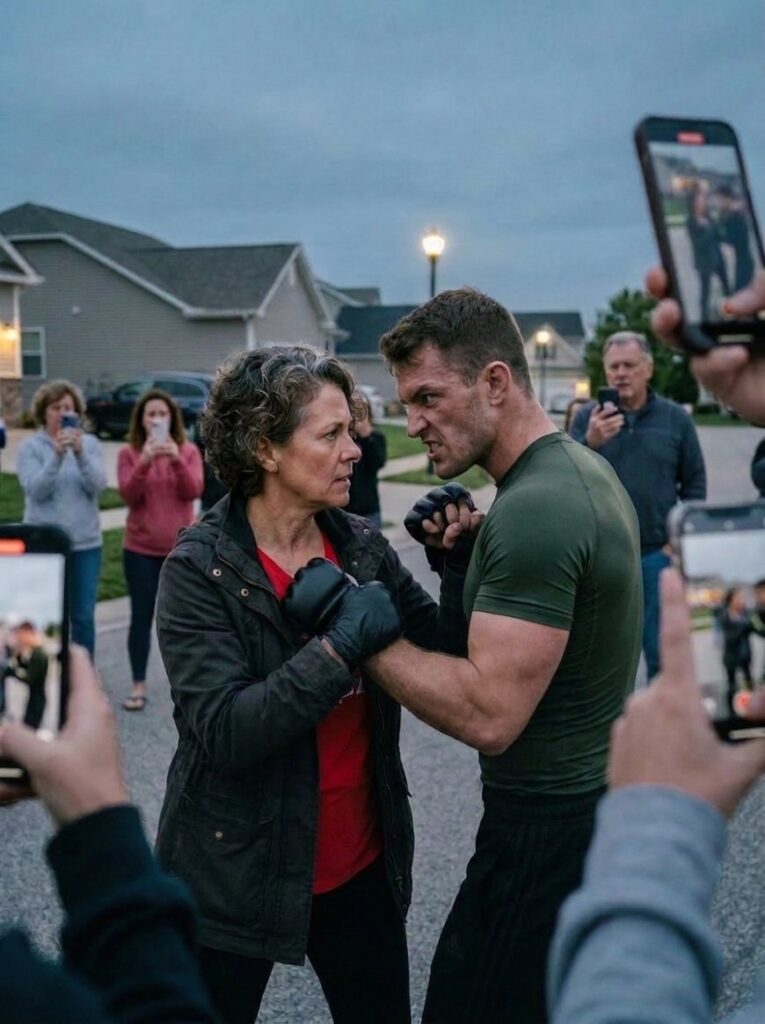
said no. Then I looked at the photograph, at the soldiers I hadn’t seen in years, at the life I had tried to leave behind and carry with me at the same time. “Sure,” I said. “Start with the ones marked ‘fragile.'” Logan picked up a box and carried it to the shelf by the wall. For an hour, we worked in silence, unpacking memories and setting them on shelves where they could be seen. Some of them were heavy—photographs of people who hadn’t come home, medals I never wore, letters I had never answered. Some were lighter—Noah’s childhood drawings, a baseball from his first little league game, a shell from the beach where we had spent one perfect week when he was seven. Logan handled each one carefully, the way a person handles something they know matters. When we finished, he stood in the middle of the garage and looked at the shelves. “That’s a lot of life,” he said. “Yes.” “Does it get easier? Carrying it?” I considered the question. “No. But you get stronger.” He nodded. “I’m going to go,” he said. “But I wanted to ask you something first.” “What?” “You said once that you stopped me because I thought stopping meant losing.” “Yes.” “How do you know when you’ve lost? And when you’ve just decided you don’t want to fight anymore?” I thought about that. “The difference is whether you’re running away from something or walking toward something else.” He absorbed that. “Which one am I doing?” “I don’t know yet. That’s for you to figure out.” He nodded, and walked out of the garage, and I watched him go—a young man with a long road ahead of him and no map to follow, which was probably the only honest way to start. — That night, Noah found me on the porch again. He sat down without asking and handed me a cup of coffee he had made without being asked. “You’re getting good at that,” I said. “Don’t sound so surprised.” We drank our coffee and listened to the crickets and didn’t say anything for a while. Then Noah said, “Logan came by today.” “I know.” “He talked to me. For like twenty minutes. Didn’t ask for anything, didn’t try to explain himself, just talked about what he’s been working on.” “What did you tell him?” “I told him it was a start. I told him I still didn’t forgive him. And he said that was okay.” I nodded. “That sounds like the right conversation.” Noah was quiet for a moment. “He asked about you. What you were like. In the Army.” “What did you tell him?” “The truth. That I don’t really know. That you didn’t talk about it much.” I looked at him. “I should have.” He shrugged. “Maybe. But I get it now.” “Get what?” “Why you didn’t. Why you wanted us to just be a normal family in a normal house on a normal street.” “And did we get that?” He laughed, just a little. “Not even close.” “No.” “But maybe that’s okay.” I looked at him. “How so?” He set his coffee down and stared out at the dark street, at the houses with their lights on, at the lives being lived behind closed doors. “Because normal is boring,” he said. “And boring doesn’t teach you anything.” I felt something loosen in my chest—something I had been holding for years, maybe since the day I retired, maybe longer. “You’re a smart kid,” I said. “I know.” “Don’t let it go to your head.” He grinned and picked up his coffee again. For a while, we sat there in the dark, two people who had been through something together and come out the other side with more questions than answers, which was probably the most honest place to be. Then Noah said, “Mom.” “Yeah.” “I’m proud of you.” I didn’t say anything because I couldn’t. He didn’t wait for an answer. He just finished his coffee, stood up, kissed me on the forehead like he used to do when he was small, and went inside. I stayed on the porch for a long time after that. The street was quiet. The mountains were dark against the sky. The way they always were, the way they always would be, indifferent to the small dramas of the people living beneath them. I thought about Logan, about Grant, about the gloves still sitting on the shelf in my garage. I thought about Noah, about the man he was becoming, about the life I had tried to give him and the life he was choosing for himself. I thought about the soldiers I had trained and the ones I had lost, and the ones I still thought about at odd hours, their voices in my head, their names on a wall somewhere. And I thought about what Logan had asked me—how you know when you’ve lost, and when you’ve just decided you don’t want to fight anymore. The answer, I realized, was simpler than I had made it sound. You know you’ve lost when you’re fighting for something that doesn’t matter anymore. You know you’ve walked away when you’re fighting for something that does. I had spent years fighting for my country, for my soldiers, for the idea that the world could be better if someone was willing to defend it. I had spent months fighting for peace, for quiet, for the chance to be just a mother in a normal neighborhood. And I had spent one afternoon fighting for my son, in front of a camera and a crowd and a father who had never learned how to love his own child without conditions. That was the fight that mattered. That was the one I would do again. I finished my coffee, went inside, and locked the door. The house was quiet. Noah was already asleep. And for the first time in a long time, I felt like I was exactly where I
PART 2: “Put Them On, Colonel,” the Rich Neighbor’s Black Belt Son Sneered — The Quiet Single Mom