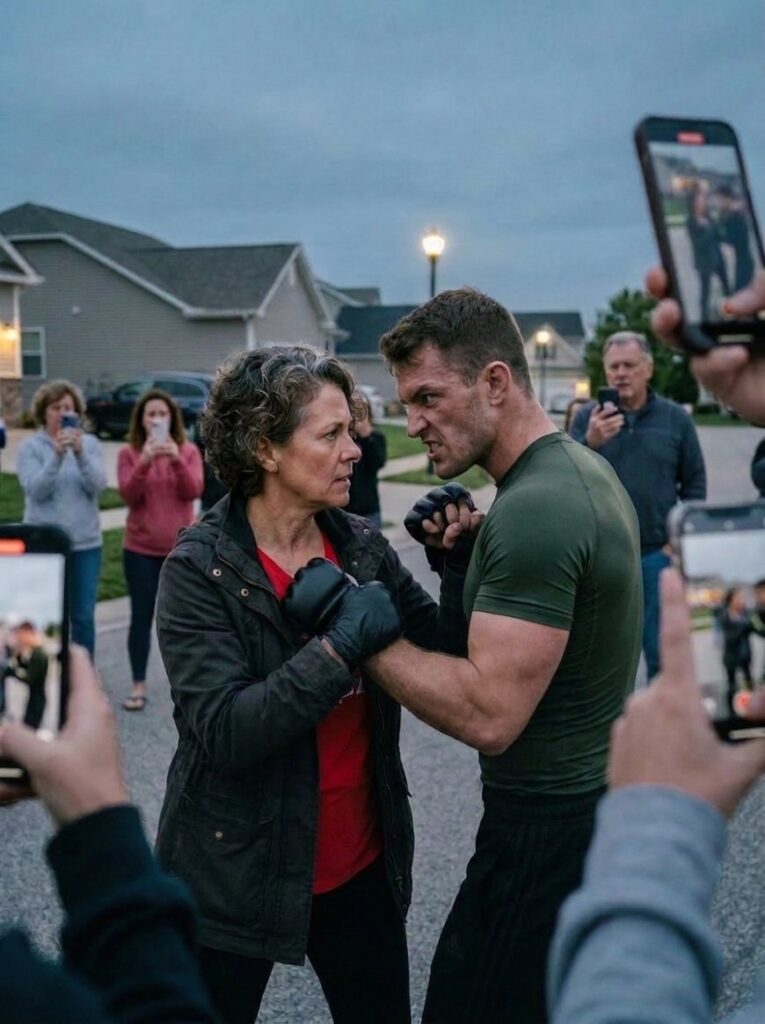
you?” I considered the question. “I was thinking that he was never the problem.” “Then what was?” “His father. And the people who let him be that way because confronting him was inconvenient.” “Like the neighbors.” “Like all of us.” Noah thought about that. “You said we moved here for peace.” “We did.” “This isn’t peace.” “No,” I said. “It’s not.” We sat in silence for a while longer. Then Noah asked, “What happens now?” “I don’t know. Maybe nothing. Maybe Logan figures things out. Maybe he doesn’t.” “And Grant?” “Men like Grant don’t change because they lose one fight. But they do learn what they can get away with. That’s something.” Noah nodded slowly. “Are you going to tell people? About the Rangers?” I sipped my coffee. “I didn’t tell them today.” “You kind of did.” “I said I served. I didn’t say where or what I did. That was enough.” He looked at me. “Will it ever be enough?” I didn’t have an answer. Some questions don’t have answers, not the kind that fit in a sentence. — Three weeks passed. The neighborhood settled into a new rhythm—quieter, more careful, like a house that had weathered a storm and was still checking for leaks. Grant stopped posting videos. His SUV no longer blocked the cul-de-sac, though that might have been coincidence. Logan disappeared from social media entirely, and his motorcycle sat covered under a tarp in the Whitmore driveway, gathering dust. The gossip faded quickly, replaced by new scandals and new stories, because that was how neighborhoods worked—today’s crisis became next week’s forgotten anecdote, and the people who lived through it were expected to do the same. I went back to my routine. Morning coffee on the porch. Afternoon runs on the trails behind the neighborhood. Evening dinners with Noah, who had stopped asking about the fight and started asking about college, about his future, about the kind of man he wanted to become. I answered the questions I could and deflected the ones I couldn’t, and I tried not to notice that he was watching me more closely now, the way he used to when he was small, when I came home from deployments and he would follow me from room to room as if I might vanish again. One Saturday morning, I was in the garage sorting through boxes of old uniforms and photographs—things I had brought from my last house and never unpacked—when I heard footsteps on the driveway. I looked up. Logan stood at the edge of the garage, wearing a plain gray T-shirt and jeans, no gloves, no camera, no father. He looked older than he had three weeks ago, though that might have been the absence of the swagger. “Morning,” he said. “Morning.” “Can I come in?” I gestured at the open garage. He stepped inside, and for a moment we just stood there, surrounded by the quiet clutter of a life that had been lived in other places. “I wanted to—” he started, then stopped, then tried again. “I wanted to say something that isn’t just sorry.” “Okay.” “Your son doesn’t have to forgive me. I mean that. But I wanted you to know that I’m not going to pretend it didn’t happen. I’m not going to delete the videos and act like it was someone else.” “That’s a start.” “I started therapy.” I looked at him. “My mom suggested it. She left when I was sixteen, and I hadn’t talked to her in years, but she reached out after the video—the first one, the neighborhood fight. She saw it somewhere, someone shared it, and she called me.” He paused. “It was the weirdest thing. I hadn’t heard her voice in six years, and she just said, ‘Logan, that’s not you.'” “And?” “And she was right. Or mostly right. Or—” He shook his head. “I don’t know what I am. That’s the problem. I’ve spent my whole life being what my dad wanted, and I don’t know what’s left when he’s not in the room.” I nodded. “That’s not a small thing to figure out.” “No.” He looked around the garage, at the boxes, at the half-unpacked life I had never fully claimed. “You know what I thought when I first saw you?” he asked. “No.” “I thought you were a target. Not because you did anything wrong—because my dad pointed you out. He said you were a soldier, some kind of officer, and that you thought you were better than us.” “I never said that.” “I know. But he said it. And I believed him, because I always believe him.” Logan’s hands hung at his sides. “That’s the thing I’m trying to unlearn.” I picked up a framed photograph from one of the boxes—me in uniform, standing with a group of soldiers in a desert somewhere, all of us younger than we should have been, all of us pretending we knew what we were doing. “This is what your father was talking about,” I said. Logan looked at the photograph. “You were in combat.” “More times than I can count.” “Why didn’t you—” He stopped. “Why didn’t you just destroy me? In the street. You could have. Everyone saw it.” “I could have.” “So why didn’t you?” I set the photograph down. “Because I’ve spent twenty years training people to fight, and one of the first things I learned is that the fights worth winning are the ones that make everyone better. Not the ones that make someone smaller.” Logan was quiet for a long time. Then he said, “You could have made me smaller. Nobody would have blamed you.” “Maybe not. But I would have blamed myself.” He nodded slowly, the way a person nods when they are hearing something true and it hurts. “I don’t know how to be better yet,” he said. “I just know I don’t want to be him.” “That’s enough to start.” He looked at the boxes. “Do you need help unpacking?” I almost
PART 2: “Put Them On, Colonel,” the Rich Neighbor’s Black Belt Son Sneered — The Quiet Single Mom