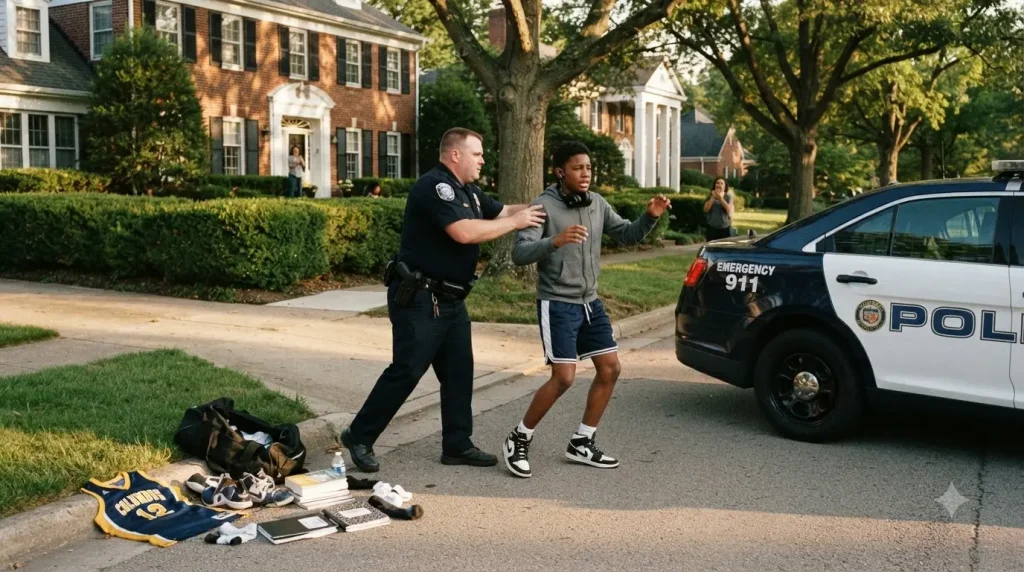
Then picked up her son’s school ID from beside the bag.
She held it between two fingers.
“This was inside?”
“Yes.”
“You saw it?”
“Yes.”
“Franklin High?”
“Yes.”
“Student-athlete?”
“Yes.”
The senior officer’s face tightened.
The mother continued.
“He told you he was walking home from basketball practice?”
“Yes, but—”
“But you dumped the bag anyway.”
“We needed to make sure.”
“Make sure of what?”
The officer said nothing.
The squeak of rubber on varnished maple echoed through the Franklin High gymnasium long after the final bell had cleared the hallways. Marcus Vance bent at the waist, hands braced on his knees, sucking in air that tasted of floor wax and stale sweat. His lungs burned. Beside him, the rest of the varsity squad looked equally hollowed out, their practice jerseys plastered dark against their spines.
“Again!” Coach Briggs barked from the baseline, his whistle dangling from his teeth like a silver fang. “If you rotate that slow against Westside on Friday, they’re going to hang forty on us by halftime. Marcus, you’re the point. Talk to your wings!”
Marcus straightened, wiped his forearm across his brow, and clapped his hands twice. “Lock in! Talk on the screens!”
They ran the defensive shell drill four more times before Briggs finally blew the whistle twice—the sharp, merciful double-blast that ended practice forty-five minutes past schedule. By the time Marcus trudged out of the locker room, the late-October sun had already begun its slide toward the treeline, painting the asphalt parking lot in long, amber strokes. Most of the team had already cleared out, piling into parents’ sedans and older brothers’ beat-up Hondas.
Marcus shifted the heavy black duffel bag higher onto his shoulder. Inside, his chemistry textbook and World History binder pressed sharp corners against his ribs, cushioned only slightly by his spare blue-and-gold game jersey, a pair of high-tops, and a half-empty water bottle. His stomach gave a low, hollow growl.
He pulled his phone from the pocket of his navy gym shorts. Three missed texts from his mother, spaced twenty minutes apart, all asking when practice would wrap. He thumbed out a quick reply as he pushed through the double doors into the cooling autumn air.
Walking. Don’t send the SUV.
The three dancing dots appeared almost instantly.
Stay on the main roads. It gets dark early now.
Marcus huffed a quiet laugh and sent back an eye-roll emoji. He loved his mother, and he was proud of her—proud of the way she held a room, proud of the historic margin by which she had won City Hall the year before. But being sixteen meant wanting to exist without a shadow, and lately, his mother’s job cast a shadow the size of the entire municipal district. He hated the black Escalade idling at the curb after school, hated the way other kids stared at Darnell in his dark suit, hated feeling like a dignitary’s cargo instead of a junior who just wanted to walk two miles home and raid the refrigerator.
His phone buzzed one more time.
I am still your mother even when I am at City Hall.
He smiled, slipped the phone back into his pocket, and draped his headphones around his neck. He didn’t put them on—his father’s voice, calm and gravelly from a dozen late-night talks before the divorce, still lived in the back of his mind: Keep your ears open when you’re walking alone, Marc. Music can wait until you’re through the front door.
At the corner of Sycamore Avenue, Marcus paused. The main road stretched ahead, loud with five-o’clock commuter traffic and exhaust fumes, adding a full fifteen minutes to his trek. To his left, a brick archway marked the entrance to Brookstone Estates.
Brookstone was an island of quiet wealth tucked between the high school and the Vance family’s older, tree-lined neighborhood. Wide, curving streets, stone mailboxes, manicured hedges, and sprawling brick colonials set far back on emerald lawns. Marcus had walked through it dozens of times. His mother had attended enough Brookstone neighborhood association meetings that half the residents had her yard signs up during the election. The other half had voted for her opponent, a former prosecutor who had run on a platform of “restoring order,” though nobody in Brookstone had ever been able to articulate what disorder had threatened their cul-de-sacs.
Marcus turned left under the brick archway. The roar of Sycamore Avenue faded behind him, replaced by the distant whine of a lawn mower, the rhythmic tick-tick-tick of an automatic sprinkler, and the occasional bark of a dog behind a cedar fence.
Halfway down Oakridge Drive, his left sneaker felt loose. He glanced down and saw the lace trailing across the concrete, frayed at the aglet. Stopping beside the edge of a sweeping brick driveway, he let the heavy duffel slide off his shoulder and set it down on the grass verge. He dropped to one knee, tugged the laces tight, and looped them into a double knot.
As he straightened, he caught a flicker of movement across the street.
Behind the glass storm door of a pale yellow colonial, a woman stood motionless. She was in her late fifties, wearing a cream cardigan, one hand resting on the brass door handle. She wasn’t waving. She wasn’t smiling. She was staring straight at him, her gaze fixed with an intensity that made the sweat on the back of Marcus’s neck turn suddenly cold.
He hesitated for half a second, raised two fingers in a polite, automatic nod, and hoisted his bag back onto his shoulder. The woman didn’t nod back. She simply stepped slightly deeper into the shadow of her foyer, raising a cordless phone to her ear.
Marcus turned away and kept walking, his pace brisker now. You’re being paranoid, he told himself. Maybe she’s expecting a delivery. Maybe she’s just bored.
He had barely cleared three more houses when the low, familiar thrum of a V8 engine rolled up behind him.
He didn’t turn around immediately, but the shadow of the vehicle stretched across the sidewalk beside him, moving at walking speed. Out of the corner of his eye, he saw the white-and-navy paneling, the heavy black push bumper, the lightbar resting dark and silent on the roof.
The passenger window whined down.
“Hey. Stop right there.”





