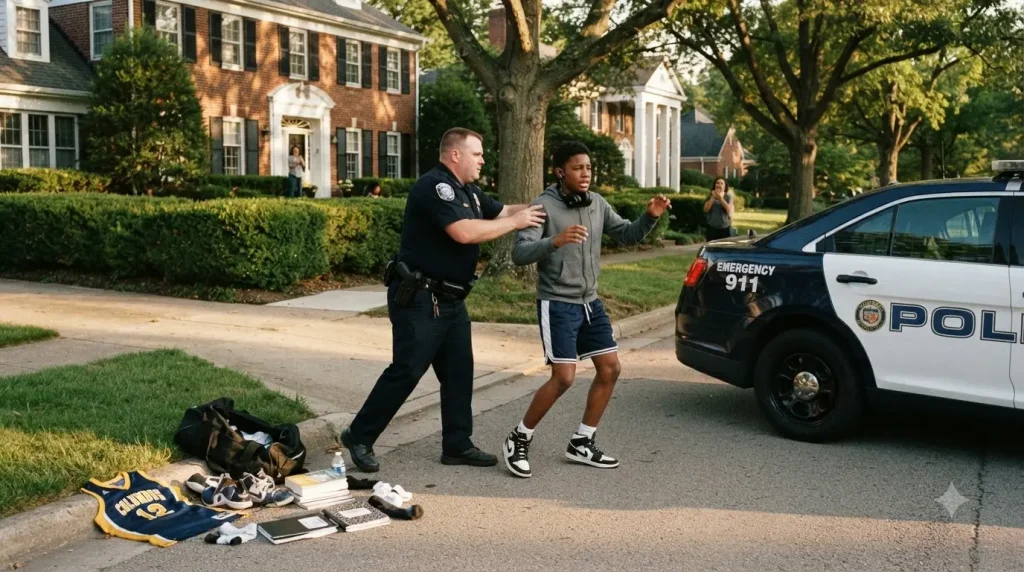
Miller caught the shift in his expression and glanced over his shoulder. “What?”
“That’s my mom,” Marcus said.
The SUV pulled sharply to the curb ten feet past Miller’s cruiser. Before the engine had even fully died, the rear passenger door swung open.
Elena Vance stepped out onto the asphalt.
She wore a tailored navy suit, low heels, and a small gold city-seal lapel pin. A thick leather portfolio remained tucked beneath her left arm. Her dark hair was swept back into a neat chignon, though a few loose strands framed her face from a long day of fighting over transit appropriations and police overtime.
For one breathless, terrifying second, as her eyes took in the scene—her sixteen-year-old son standing rigid with his hands visible, two uniformed officers flanking him, his blue-and-gold jersey soaking in sprinkler runoff, his textbooks splayed in the grass—every title she held evaporated.
She was not the Mayor of Oakridge. She was not the chair of the Public Safety Committee. She was not the woman who had stood on a stage at the civic center six months ago, shaking hands and handing out graduation certificates to the newest class of police recruits.
She was just a mother looking at her boy standing beside a patrol car, and every nerve in her body screamed at her to run to him.
Instead, she forced herself to walk. Slowly. Deliberately. Her heels clicked against the concrete with a quiet, measured cadence.
Miller raised a hand, palm out, his posture automatically stiffening into command mode. “Ma’am, stay back. You need to step back to your vehicle.”
Elena stopped three paces from the edge of the scattered belongings. She didn’t look at Miller yet. She looked at Marcus. The relief in her son’s eyes—and the quiet, bruised humiliation lingering just beneath it—cut deeper than panic ever could have.
“Marcus,” she said, her voice steady and warm. “Are you hurt?”
“No, Mom. I’m okay.”
“Did either of them touch you?”
“No.”
Miller stepped forward, puffing his chest slightly. “Ma’am, I told you to step back. We’re in the middle of an active investigation—”
Elena turned her head and looked directly at him.
Miller stopped mid-sentence.
Recognition didn’t hit him all at once; it seeped in, cold and paralyzing. He had seen that face on the local evening news. He had seen it at the front of the City Council chambers. He had seen it framed on the wall of the precinct lobby right beside the Police Chief’s portrait.
Beside him, Officer Reyes went pale. His hand dropped from his belt, his posture snapping instinctively to attention. “Mayor Vance,” Reyes said, his voice barely above a whisper.
The color drained from Miller’s face, leaving his skin the shade of wet chalk. Slowly, almost mechanically, he reached up and pulled off his sunglasses.
Elena did not acknowledge the title. She did not raise her voice. She let her gaze sweep slowly over the sidewalk—taking in the overturned water bottle, the sneaker wedged beneath the hedge, the soaked jersey, the chemistry textbook face down in the damp grass.
“What crime was reported, Sergeant?” she asked. Her voice was so quiet that the distant hum of the lawn mower sounded deafening.
Miller swallowed hard, his Adam’s apple bobbing. “Mayor—uh, ma’am. We received a 911 call regarding suspicious activity in the neighborhood.”
“What activity?”
“An individual stopping near private residences with a large bag. Possible casing of properties.”
“I was tying my shoe,” Marcus said.
Miller shot him a sharp, reflexive glare. “I wasn’t talking to you—”
“No,” Elena cut in, her eyes hardening to flint. “You are going to let him speak. And you are going to stop speaking to my son like he is a suspect in a felony.”
Miller’s mouth snapped shut. Behind him, Darnell had stepped out of the driver’s seat of the Escalade and stood silently beside the open door, his arms loose at his sides, watching everything.
Elena shifted her gaze to the younger officer. “Officer Reyes, isn’t it? I handed you your certificate in May.”
“Yes, ma’am,” Reyes said miserably.
“Tell me what the dispatch call actually said.”
Reyes glanced at Miller, who stared rigidly at a point somewhere over Elena’s left shoulder. “Dispatch reported a Black male teenager in a gray hoodie carrying a large black duffel bag, stopped near the driveway of 114 Oakridge,” Reyes said, the words tumbling out cleanly. “No weapon reported. No attempted entry. Just standing near the driveway.”
Elena nodded once. She looked back at Miller. “And when you arrived, what did you observe?”
“He was walking down the sidewalk, ma’am,” Miller said, trying to salvage a shred of official composure. “When I asked what was in the bag, he became defensive and refused to cooperate.”
“He exercised his constitutional right to decline a consent search,” Elena said, her voice crisp. “Which, unless the department has stopped teaching the Fourth Amendment since my last briefing with the Chief, is not probable cause.”
“We had reasonable suspicion based on the call—”
“Reasonable suspicion allows a brief investigative detention to verify identity,” Elena said, stepping forward just enough to crouch gracefully beside the open duffel. She didn’t touch the clothes. Instead, she looked up at Miller. “Where is his school ID?”
Miller hesitated, then reached stiffly into his breast pocket and pulled out the laminated card. He handed it to her.
Elena held it between two fingers, examining the smiling photograph of her son. “Franklin High School. Grade eleven. Varsity Athletics. You saw this?”
“Yes, ma’am.”
“You saw his face matched the photograph?”
“I couldn’t be certain—”
“You saw the Franklin High crest on his shorts,” she continued, her voice never rising, yet slicing through the afternoon air like a scalpel. “He gave you his name, his age, his address ten minutes from here, and offered to let you call his mother. And yet, Sergeant, his chemistry textbook is lying face down in the grass, and his basketball jersey is sitting in sprinkler water.”





