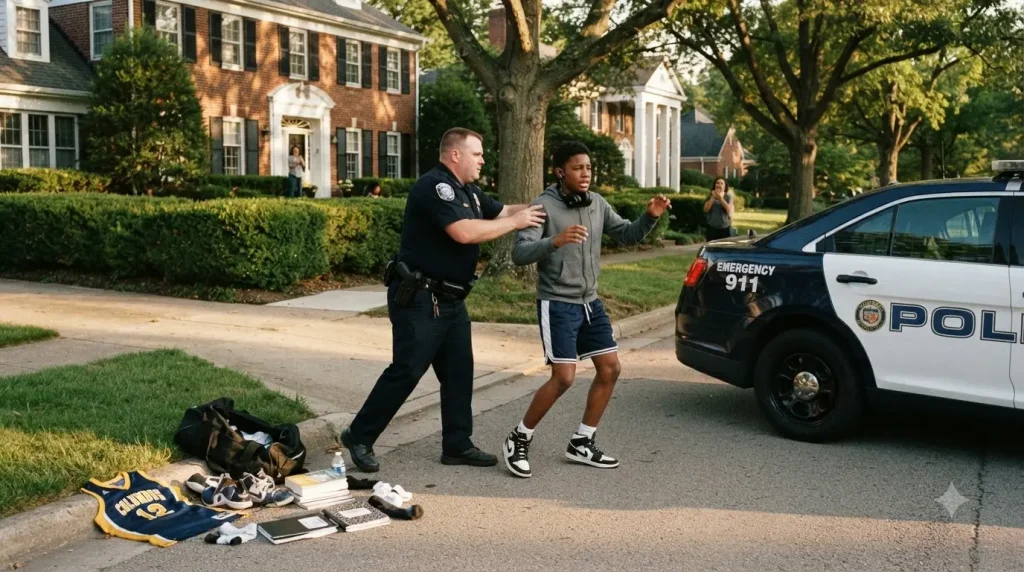
Marcus stopped. His heart gave a single, heavy thud against his ribs. He turned slowly, keeping his hands out of his pockets, just as he had been taught since he was twelve years old.
“Me?” he asked, his voice steadier than he felt.
The officer behind the wheel didn’t answer the question. He was a broad-shouldered man in his mid-forties with a closely cropped graying buzz cut and sunglasses that hid his eyes completely. “Put the bag down. Step away from it.”
Marcus frowned, confusion momentarily eclipsing caution. “Why? I’m just walking home.”
“I didn’t ask where you’re going,” the officer said, his tone flat and metallic. “Bag on the ground. Now.”
Marcus lowered the duffel to the concrete beside his feet and took a half-step back. The cruiser’s engine cut off. The driver’s door swung open with a heavy groan, and the officer stepped out, his utility belt creaking with the weight of leather and steel. His nameplate read A. MILLER, pinned above a silver sergeant’s chevrons.
Before Miller had even rounded the hood of the cruiser, a second patrol car glided up the street and parked twenty feet behind the first. A younger officer stepped out—late twenties, clean-shaven, his uniform crisp enough to look freshly issued. He glanced at Marcus, then at the quiet street, and finally at Miller, his brow furrowing slightly.
“What’s your name?” Miller asked, stopping just inside Marcus’s personal space. He smelled of stale coffee and spearmint gum.
“Marcus Vance.”
“How old are you, Marcus?”
“Sixteen.”
“Where are you coming from?”
“Franklin High,” Marcus said, gesturing slightly toward his navy gym shorts, where the faded gold FHS crest was printed near the hem. “Basketball practice. We ran late.”
“And where are you headed?”
“Home. 412 Linden Lane. It’s about ten minutes from here.”
The younger officer—his nameplate read D. REYES—nodded slightly. “Linden’s just past the park, Sarge. Straight shot.”
Miller didn’t look at Reyes. He kept his mirrored lenses trained on Marcus. “That your bag?”
“Yes, sir.”
“What’s inside it?”
“Basketball stuff. My jersey, sneakers, schoolbooks.”
Miller tilted his head, a faint, humorless smile tugging at the corner of his mouth. “Mind if I take a look?”
Marcus paused. He thought of his father, sitting at the kitchen table four years ago, his voice quiet and dead serious as he explained the Fourth Amendment like it was a survival manual. Never fight on the street, Marc. Never raise your voice. Keep your hands where they can see them. And never, ever consent to a search. Say it politely, say it clearly, and let the record hold it.
“Yes,” Marcus said.
Miller blinked behind his sunglasses. “Yes, I can look?”
“No,” Marcus clarified, swallowing against the dryness in his throat. “I mean, yes, I mind. I don’t consent to a search.”
The air between them shifted instantly. It wasn’t loud, and it wasn’t violent, yet Marcus felt the temperature drop ten degrees. Across the street, a neighbor had stepped onto a brick porch, arms folded tightly over her chest. Two houses down, a curtain twitched.
Miller took a slow step closer. “Why would you mind if it’s just basketball stuff?”
“Because it’s my bag,” Marcus said. “I didn’t do anything wrong.”
“We received a 911 call about a suspicious individual,” Miller said, his voice dropping into a practiced, rhythmic cadence. “A male matching your description, carrying a large black duffel bag, loitering near a private residence.”
“I wasn’t loitering,” Marcus said, frustration creeping into the edges of his voice. “My shoelace came untied. I stopped for ten seconds to tie it.”
“Near a driveway.”
“On the sidewalk.”
Reyes shifted his weight, his hand resting lightly on his belt buckle. “Do you have any ID on you, Marcus? A school ID?”
“Yeah,” Marcus said, relief flickering briefly. “It’s in the front zippered pocket of the bag.”
Reyes started to step forward, reaching toward the duffel, but Miller thrust an arm out, blocking him.
“I’ve got it,” Miller said. He crouched beside the bag, unzipped the small front compartment, and began rooting through it with thick fingers.
“I didn’t say you could go through it,” Marcus said, his voice tightening. “I told you where the ID was. I can grab it—”
“Don’t reach for anything,” Miller snapped without looking up. “You told us where your ID is. I’m retrieving it for officer safety.”
He pulled out the laminated Franklin High identification card. It showed Marcus smiling awkwardly in a collared shirt, the blue VARSITY ATHLETICS sticker gleaming in the bottom corner. Miller turned it over, studied it for a long moment, and then looked back up at Marcus.
“Could be anybody’s,” Miller muttered.
Marcus stared at him, stunned. “It has my picture on it.”
“Could be a cousin. Could be stolen.”
“Sarge,” Reyes said quietly, leaning in to glance at the card. “That’s clearly him. Same face, same school crest on his shorts. We can just run the name or let him call his parents.”
Miller rose to his full height, slipping the ID into his breast pocket instead of handing it back. “I’ve been doing this eighteen years, Reyes. You’ve been out of the academy six months. When I want your assessment of a scene, I’ll ask for it.”
Reyes’s jaw tightened, a flush creeping up his neck, but he stepped back and fell silent.
Something cold and heavy settled in the pit of Marcus’s stomach. It wasn’t pure fear—not yet. It was a sudden, sickening clarity. He had grown up listening to the warnings from his mother, his father, his uncles, his coaches. He had nodded along while privately believing they were talking about a different city, a different decade, a different kind of kid. He was an honor-roll student. He played varsity ball. He lived in a nice house.
Standing on the sun-warmed concrete of Brookstone Estates, he realized none of that was visible to the man in front of him.





