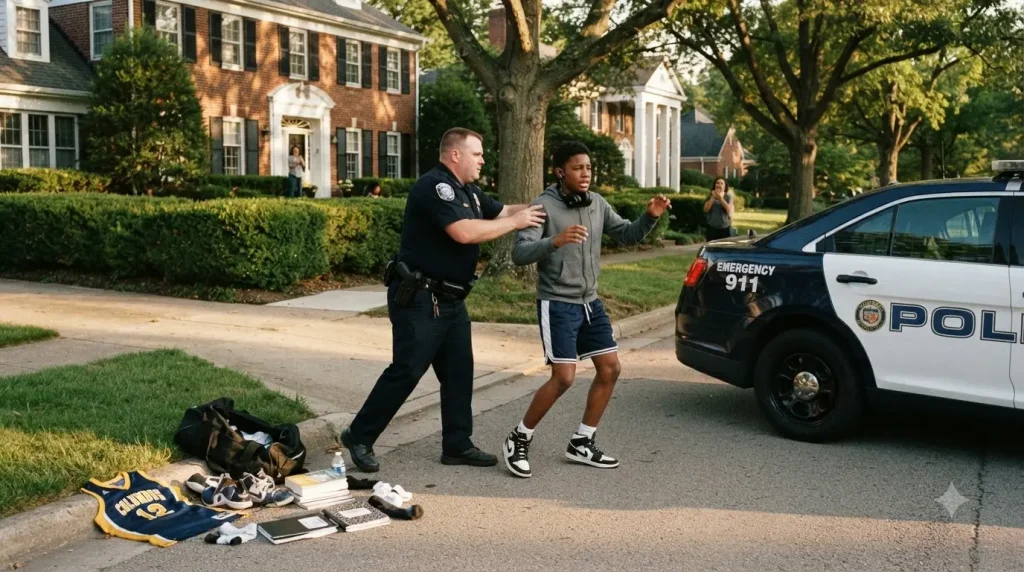
“You can call my mother,” Marcus said, keeping his voice low and even. “Her number’s on my phone.”
Miller smiled again, the expression never reaching the rest of his face. “We’ll get to Mom in a minute. Where’s your phone?”
“Right pocket.”
Miller held out an open palm. “Take it out slowly. Set it on the sidewalk.”
Marcus hesitated for a fraction of a second. “Why do you need my phone?”
“There you go again,” Miller said, shaking his head with theatrical disappointment. “Questioning every lawful order. You want to make this harder than it needs to be, son?”
“I’m not—”
“Phone. Sidewalk. Now.”
Slowly, using two fingers, Marcus pulled his phone from his shorts and knelt to place it on the concrete beside the duffel. As he straightened, he noticed more eyes on them. A man walking a golden retriever had stopped fifty feet away, watching in silence. On the second-story balcony of the house directly across from them, a teenage girl in a faded sweatshirt was leaning over the railing, her smartphone held steady in both hands, the tiny glass lens pointed straight down at the curb.
Miller crouched again. Without another word, he gripped the heavy brass zipper of the duffel’s main compartment and ripped it open.
“I told you I don’t consent to a search,” Marcus said, his voice trembling just slightly now—not from fear, but from the hot, helpless sting of humiliation.
Miller didn’t answer. He reached in, grabbed the blue-and-gold Franklin High jersey, and tossed it onto the sidewalk. One sleeve landed squarely in a dark, wet puddle left by a malfunctioning sprinkler, the fabric instantly darkening as it drank up the dirty water.
Marcus’s mouth fell open. “Hey—that’s my game jersey—”
Miller pulled out the black-and-white basketball sneakers next, dropping them carelessly. One bounced against the curb; the other rolled backward until it vanished halfway beneath a trimmed boxwood hedge. Then came the chemistry textbook, landing face down in the damp grass with its pages splayed. World History followed, slapping down hard on top of the wet jersey. A pair of rolled gym socks skittered toward the storm drain. Resistance bands, a small tube of muscle rub, two squashed protein bars, a spiral notebook. Finally, Miller tipped the bag completely upside down and shook it.
Marcus’s half-empty water bottle tumbled out, the flip-top cap snapping open on impact. A steady, thin stream of water began to snake across the pavement, pooling around the edge of his notebook.
Everything he had carried home from three hours of grueling practice lay scattered across a stranger’s sidewalk like the contents of a ransacked locker.
Nothing illegal. Nothing dangerous. Just the ordinary, heavy clutter of a sixteen-year-old’s Tuesday afternoon.
Miller stood up, brushing his palms together. He looked down at the chemistry textbook, nudging it slightly with the toe of his polished boot. “Where’s the basketball?”
Marcus stared at him, disbelief hollowing out his chest. “In the equipment room.”
“You play basketball without carrying a basketball?”
“The school owns the practice balls,” Marcus said, each word feeling like gravel in his throat.
Miller gave a short, derisive chuckle. “Convenient.” He looked at the scattered gear, then back up at Marcus. “You carry all this every day?”
“Yes.”
“Seems heavy.”
“It is.”
Marcus looked down at his water-soaked jersey, then at the woman standing on her porch with her phone raised, then at the pale yellow house across the street where the original caller still hovered like a ghost behind the storm door. He felt himself shrinking, as if the weight of every stare were pressing him down into the concrete.
“Can I pick my stuff up now?” he asked quietly.
“We’re not finished,” Miller said.
“With what?”
“Watch your tone.”
“I’m just asking what you think I did,” Marcus said.
Miller stepped forward, closing the distance between them until Marcus could see his own warped reflection in the sergeant’s sunglasses. Instinctively, Marcus took a half-step backward.
Miller’s finger shot out, stabbing the air inches from Marcus’s chest. “Don’t walk away from me.”
“I’m not walking away,” Marcus said, his hands rising slightly higher beside his shoulders. “You stepped into my face.”
“Sarge,” Reyes said again, his voice sharper this time, laced with genuine unease. “There’s nothing in the bag. His ID matches. Let’s just clear this and move on.”
Miller whipped his head toward the younger officer, his face flushing a dull, angry red. “Get back by the cruiser, Reyes. I know how to handle a suspicious person.” He turned back to Marcus, his jaw set. “You ever been arrested, Marcus?”
“No.”
“Suspended from school?”
“No.”
“Any gang affiliation?”
Marcus blinked, the sheer absurdity of the question hitting him like a slap. “What?”
“You heard me.”
“No.”
“Friends in gangs?”
“No!”
Down at the far end of Oakridge Drive, a black SUV turned smoothly off Sycamore Avenue.
Marcus didn’t notice it at first. His eyes were locked on Miller, his pulse hammering in his ears. He had no idea that five minutes earlier, six blocks away, Elena Vance had finished a brutal six-hour municipal budget session—one in which the Police Benevolent Association had threatened a work slowdown over her proposed civilian oversight board—and had glanced down at her phone in the back seat of her SUV.
She had opened the family location-sharing app out of sheer maternal habit, expecting to see Marcus’s blue dot nearing Linden Lane. Instead, the dot was stationary in the middle of Brookstone Estates. She had waited two minutes. It hadn’t moved. She had called him. It went straight to voicemail.
“Darnell,” she had said, her voice dropping an octave, “turn left into Brookstone. Oakridge Drive.”
Now, the heavy black Escalade glided down the quiet street, its tinted windows reflecting the late-afternoon sun. Marcus caught sight of the grille, the familiar municipal plates, the subtle gleam of the headlights. Before he could stop himself, a wave of raw, overwhelming relief broke across his face.





