“Do not confuse legal rights with physical safety.”
She had no counter to her own words.
She had said that exact sentence to him when he turned thirteen, standing in the kitchen before his first day of middle school.
Now, hearing it repeated back to her in his bedroom, it felt like an indictment of every compromise she had ever made.
“Get some sleep,” she said softly, stepping toward the door.
“I will.”
“I love you, Marcus.”
“Love you too, Mom.”
She closed the door and walked downstairs into the dark living room.
She did not turn on the lamps.
She sat on the sofa with her hands folded in her lap, watching the distant headlights sweep across the ceiling as cars passed on Parkview Lane.
At midnight, her phone buzzed on the coffee table.
A text message from the city attorney, David Vance:
The 911 audio has been transcribed. You need to read this before the press conference tomorrow.
Attached was a PDF document.
Karen opened the file.
The screen illuminated her face in sharp blue light.
The transcript began with the first call:
DISPATCHER: 911, what is the address of your emergency?
CALLER: There is a suspicious boy in Brookstone Estates. He’s walking down Briarwood with a massive black duffel bag.
DISPATCHER: Is he attempting to enter any property, ma’am?
CALLER: He stopped at the driveway of 412. He’s loitering.
DISPATCHER: Is he committing a crime right now?
CALLER: You know who he is. It’s Karen Davis’s kid.
DISPATCHER: The Mayor’s son?
CALLER: Yes! And he has no business walking through here with that hood up, carrying that heavy bag like he owns the sidewalk. Send an officer to check what’s inside.
DISPATCHER: Ma’am, walking on a public sidewalk is not a crime. If there is no active disturbance, I cannot dispatch units for loitering.
CALLER: Then I’ll find someone who will.
The call disconnected at 4:18 p.m.
The second call began at 4:22 p.m.:
DISPATCHER 2: 911, what is your emergency?
CALLER: I have a trespasser casing homes on Briarwood. He’s attempting to breach private property with a concealed container.
DISPATCHER 2: Are weapons visible?
CALLER: He has his hands in his pockets. He refused to leave when observed. I feel directly threatened. Dispatch an armed unit immediately.
Karen lowered the phone.
The deliberate deception was laid bare in plain, unvarnished black and white.
Evelyn Gable had known exactly which words would trigger a high-priority, code-three response.
She had manufactured an imminent threat out of thin air, knowing that dispatchers had no choice but to route the call to the nearest patrol car.
And Officer Brian Miller had accepted the assignment with the full CAD summary glowing on his terminal:
Subject: Marcus Davis (juvenile). Caller reports subject walking on sidewalk.
Miller had seen the boy’s identity before he ever put his cruiser into drive.
He had not been fooled by Mrs. Gable’s escalation.
He had simply chosen to participate in it.
By seven o’clock the following morning, the front steps of City Hall were overrun with television cameras, print journalists, and civil rights advocates.
The early autumn air was crisp, carrying a faint scent of burning leaves from the outskirts of Columbus.
Inside the Mayor’s briefing room, Karen sat at the head of the conference table.
Beside her sat Chief Robert Hayes, City Attorney David Vance, and her communications director, Lisa Torres.
Lisa laid three printed newspapers on the polished wood.
The headlines were as brutal as Karen had anticipated:
MAYOR’S SON STOPPED IN BROOKSTONE: RACIAL PROFILING SCANDAL ROCKS POLICE DEPARTMENT.
THE 911 CALL THAT SPARKED OUTRAGE: ‘TEACH HIM NOT TO MAKE RESIDENTS UNCOMFORTABLE.’
“The morning news shows have been running the neighbor’s video on a loop since six,” Lisa said, tapping the center paper.
“Over two million views on Twitter.”
“The community coalition has called for a march outside the third precinct this afternoon.”
Karen did not look at the papers.
She looked at Chief Hayes.
“Where is Officer Miller?”
“He arrived at Internal Affairs twenty minutes ago with his union representative,” Hayes replied.
“Has he reviewed his body-camera footage?”
“Yes.”
“And?”
Hayes looked down at his leather portfolio.
“He claims he acted within his discretionary authority to conduct an investigative detention based on the second 911 call.”
Karen let out a cold, humorless laugh.
“The second call that contradicted the first call from the exact same phone number four minutes earlier?”
“His attorney argues that patrol officers are not responsible for evaluating caller credibility during an active response,” Vance interjected smoothly.
“They argue that once the call was coded as a suspected burglary in progress, Officer Miller had a legal obligation to stop and identify the suspect.”
Karen turned her dark, piercing eyes toward the city attorney.
“David, did you watch the video?”
Vance paused, shifting uncomfortably in his chair.
“Yes, Mayor.”
“Did Officer Miller identify my son?”
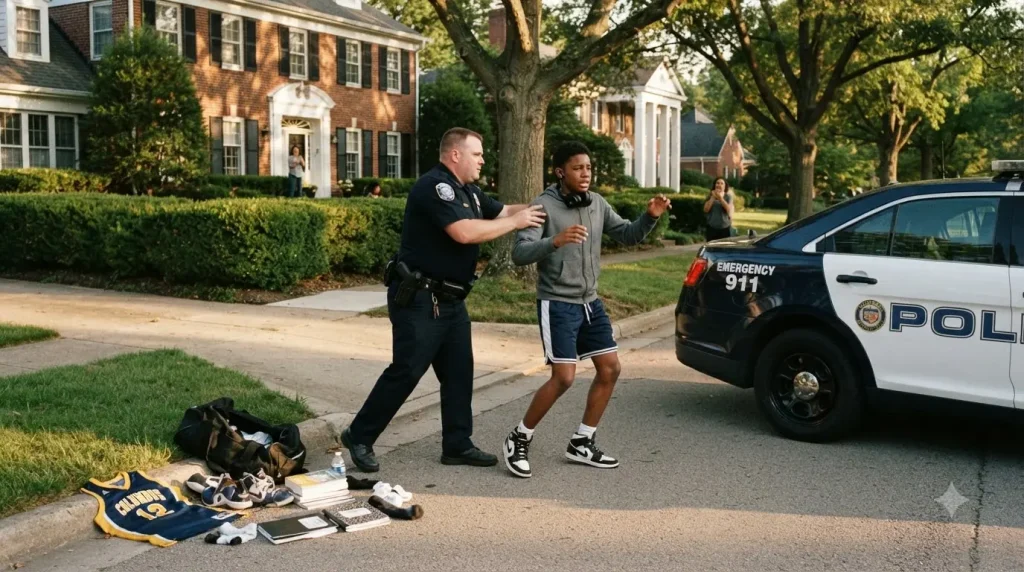
“He took his student ID from his pocket, yes.”
“And after he held a government-issued photo identification confirming Marcus was a sixteen-year-old high school student, what did he do?”
Vance offered no defense.
“He threw his chemistry book into the mud, David.”
“He dumped his basketball shoes onto the sidewalk.”
“He asked a sixteen-year-old honor student if he had gang affiliations.”
Karen stood up, her navy blazer pristine, her posture commanding and absolute.
“That is not investigative discretion.”
“That is punitive degradation under color of law.”
She looked at Chief Hayes.
“I am not going to micromanage your Internal Affairs investigation, Robert.”
“You will follow every step required by the collective bargaining agreement.”
“You will interview the younger officer, Officer Keller, who told Miller to run the ID.”
“You will interview the dispatcher who accepted the second call.”
“And you will interview Officer Miller.”
Hayes nodded.
“We have already subpoenaed the phone records from the 911 center.”
“Good,” Karen said.
“Now, what are we doing about Evelyn Gable?”
The room went entirely still.
David Vance cleared his throat.





