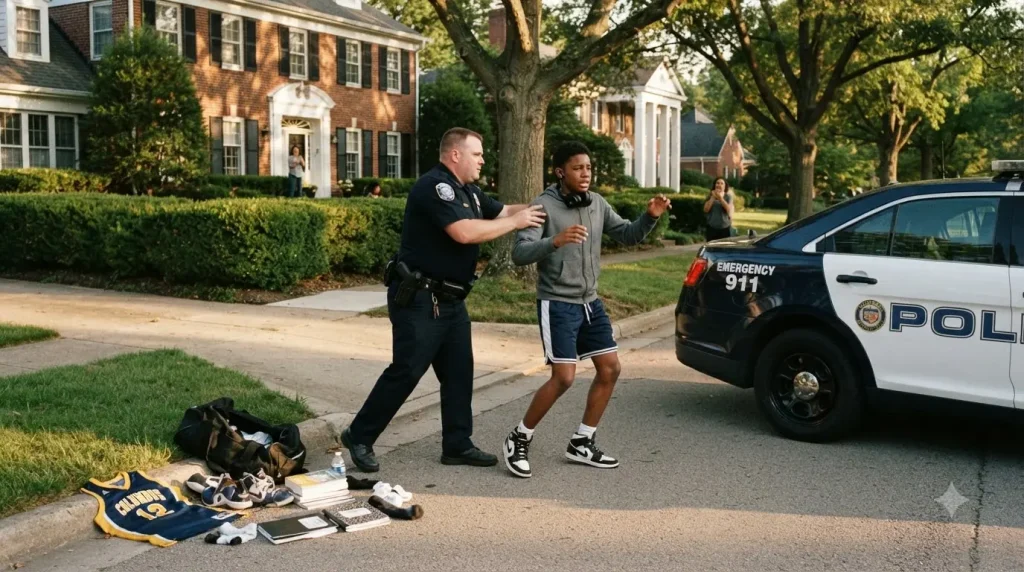
“If no active crime was observed,” Lin asked, “why did you command the juvenile to place his bag on the sidewalk?”
Miller’s jaw worked silently for a moment.
“I needed to ensure officer safety.”
“Officer safety?”
Lin pulled another document from her folder.
“The juvenile was sixteen years old.”
“He wore gym shorts and athletic shoes.”
“He had his hands visible at all times.”
“He immediately presented his school identification card.”
She leaned across the table, her dark eyes locking onto his.
“Did you feel physically threatened by a Franklin High student carrying a World History textbook, Officer Miller?”
Miller did not answer.
“Why did you empty the duffel bag, Brian?” Lin pressed, using his first name for the first time.
“He told me I couldn’t search it,” Miller rasped, his voice dropping into a register of raw, defensive anger.
“He was evasive.”
“He questioned my authority on the street.”
Investigator Lin clicked the remote once more.
The audio played again, capturing Marcus’s quiet, respectful voice:
“I didn’t say you could search it. It’s my bag.”
Lin stopped the playback.
“A citizen asserting their Fourth Amendment right to refuse a warrantless search is not evasive conduct, Officer Miller.”
“That is the fundamental law of the United States.”
“You have fifteen years on this force.”
“You have attended forty hours of constitutional search and seizure training in the last three years alone.”
Lin set her pen down with a sharp, decisive click.
“You didn’t empty that bag because you suspected a burglary, Brian.”
“You emptied that bag because a sixteen-year-old Black kid dared to remind you of the Constitution, and you wanted to put him in his place.”
Miller closed his eyes.
He did not argue.
He did not look at his union representative.
The reality of the investigation had finally breached his defenses.
The body-camera footage, the dispatch logs, and the neighbor’s video had formed an unbroken, inescapable trap.
Across town, on Briarwood Lane, the afternoon sun was beginning to cast long shadows across the immaculate lawns of Brookstone Estates.
A marked police cruiser pulled into the curved driveway of 412 Briarwood.
Two uniformed officers from the court services division stepped out, carrying a legal summons.
They walked up the flagstone steps to the front porch.
The glass storm door was locked.
Officer James Davis knocked firmly on the wooden frame.
After twenty seconds, the interior door opened.
Evelyn Gable stood behind the glass.
She wore an expensive cream-colored cardigan and gold hoop earrings.
Her face was pale, tight with an indignation that had curdled into fear over the last twenty-four hours.
“Can I help you?” she asked through the glass.
Officer Davis held up the legal document.
“Mrs. Evelyn Gable?”
“Yes.”
“I have a criminal summons issued by the Franklin County Municipal Court.”
“You are formally charged with one count of making a false report to law enforcement authorities under Section 2921 of the Revised Code.”
Evelyn Gable’s mouth opened in stunned disbelief.
“This is ridiculous!” she sputtered, her voice rising in pitch.
“I called police because someone was lingering outside my property!”
“I am a tax-paying resident of this subdivision!”
“I have a right to feel safe in my own home!”
Officer Davis did not argue.
He slid the folded summons through the narrow gap between the storm door and the jamb.
“Your initial arraignment is scheduled for Tuesday morning at nine o’clock in Courtroom 3B,” he said calmly.
“Failure to appear will result in the issuance of a bench warrant for your arrest.”
He turned and walked down the steps.
Evelyn Gable stood behind the glass, staring down at the blue legal paper resting on her threshold.
Across the street, three neighbors were standing near their mailboxes, watching her with silent, unyielding gazes.
None of them waved.
None of them walked over to ask if she was all right.
The curtain of suburban solidarity had shredded the moment her own words were broadcast across the evening news.
At 4:45 p.m., the final bell rang at Franklin High School.
Students poured through the double doors of the gymnasium building, laughing and shouting in the crisp afternoon air.
Marcus Davis walked out into the sunlight.
He wore his navy school shorts and a clean white Franklin Basketball hoodie.
His duffel bag was slung over his right shoulder, the weight balanced and familiar.
Beside him walked his coach, David Miller, a tall, broad-shouldered man with a whistle hanging around his neck.
Coach Miller stopped at the edge of the school parking lot.
He laid a heavy, supportive hand on Marcus’s shoulder.
“You ready for the tournament on Friday, Davis?”
Marcus adjusted the strap of his bag.
“I’m ready, Coach.”
“You played tough defense today.”
“Thanks, Coach.”
“You got a ride home?”
Marcus looked across the parking lot toward the street.
The black city SUV was parked near the curb under the shade of an old maple tree.
The rear window was rolled down.
His mother was sitting in the back seat, working on a tablet with her reading glasses pushed up into her hair.
She saw him through the windshield and smiled.
Marcus looked back at his coach.
“My ride’s here,” Marcus said.
He walked across the asphalt toward the SUV.
He opened the rear door and tossed his duffel bag onto the floorboard.
He climbed inside and pulled the heavy door shut.
The interior of the vehicle smelled of leather, spearmint gum, and the lavender perfume his mother had worn since he was a little boy.
Karen set her tablet aside and turned to him.
“How was practice?”
Marcus buckled his seat belt.
“Coach had us running suicides for twenty minutes because Kevin missed three free throws.”
Karen smiled faintly.
“Sounds exhausting.”
“It was.”
He leaned his head back against the leather headrest, closing his eyes as the driver shifted the SUV into gear.
The vehicle rolled smoothly out of the high school parking lot and turned onto the main avenue.





