“Mayor, prosecuting a citizen for misuse of 911 is notoriously difficult in this state.”
“The statute requires proof of malicious intent to cause an unlawful police action.”
“She will claim she was genuinely frightened by the large duffel bag.”
“She will claim she didn’t know whether Marcus had a right to be there.”
Karen walked to the window overlooking the plaza below.
A crowd of fifty people had already gathered near the fountain, holding hand-painted signs demanding police accountability.
“Read page two of the transcript, David,” Karen said without looking back.
“She told the first operator that she knew he was my son.”
“She told the first operator that she wanted him taught a lesson about making residents uncomfortable.”
“That is not fear.”
“That is malice.”
“That is filing a false police report with the specific intent to harass a minor on a public roadway.”
She turned around to face the city attorney.
“If an ordinary citizen in the South Ward calls police and lies about an armed burglary to harass their neighbor, what does your office do?”
Vance hesitated.
“We charge them with a Class A misdemeanor for making a false report.”
“Then you will draft the criminal complaint against Evelyn Gable this morning,” Karen ordered.
“The law in Columbus applies equally on Briarwood Lane as it does on Martin Luther King Boulevard.”
“No special protection for wealthy neighborhood associations.”
“No exceptions for residents who think a gated street exempts them from the municipal code.”
Vance nodded slowly, writing the instruction on his pad.
“Yes, Mayor.”
At ten o’clock sharp, Karen stepped onto the podium in the press briefing room.
The room erupted with camera flashes and shouted questions.
Karen raised both hands, her expression completely composed.
The room fell quiet.
She adjusted the microphone.
She did not read from a prepared statement.
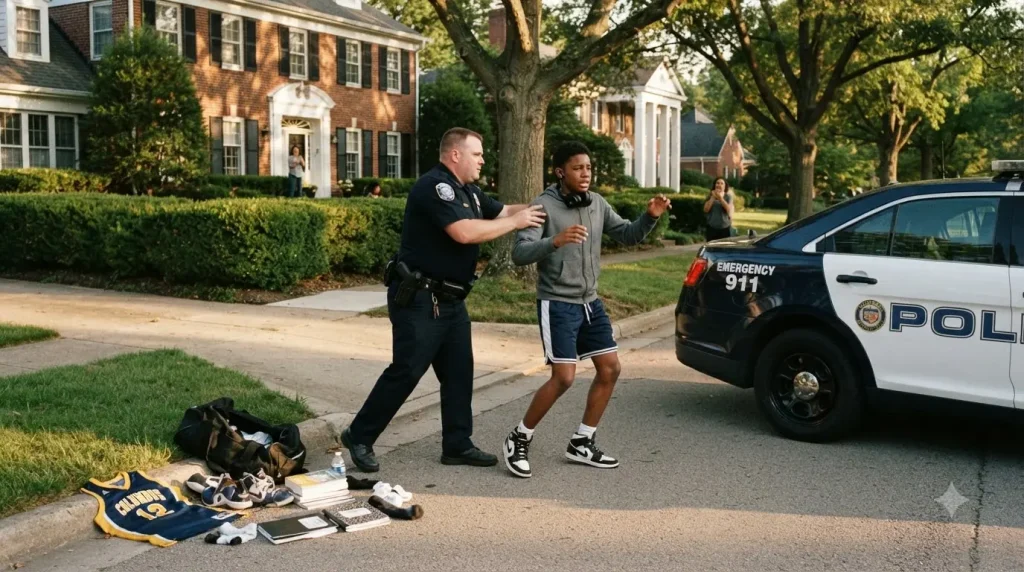
“Yesterday afternoon, on Briarwood Lane in Brookstone Estates, my sixteen-year-old son, Marcus, was stopped by two officers of the Columbus Police Department while walking home from basketball practice.”
She paused, letting the silence settle over the room.
“He had not run.”
“He had not trespassed.”
“He had stopped beside a public curb to tie his shoe.”
“His school books, his athletic jersey, and his personal belongings were emptied onto the pavement.”
“He was questioned about criminal activity despite presenting valid school identification that proved who he was and where he attended classes.”
A reporter in the front row stood up.
“Mayor Davis, will you seek the termination of Officer Miller?”
Karen met the reporter’s eyes directly.
“Officer Miller’s conduct is currently the subject of an expedited Internal Affairs investigation overseen directly by Chief Hayes.”
“He has been stripped of his badge and service weapon, and placed on administrative leave without public contact.”
“As Mayor, I will not preempt the findings of that disciplinary process.”
“However, as a mother and as the chief executive of this city, I can state with absolute clarity that the behavior visible in those recordings represents a catastrophic failure of basic constitutional policing.”
She gripped the edges of the podium.
“An officer who views a young Black man walking through an affluent neighborhood as an inherent threat is an officer who cannot safely wear our uniform.”
Another reporter called out:
“What about the caller, Mayor Davis?”
“Will the city take action against the resident who dialed 911?”
Karen leaned forward slightly.
“Earlier this morning, the City Attorney’s Office filed formal misdemeanor charges against Evelyn Gable for making a false report to law enforcement authorities under Section 2921 of the Ohio Revised Code.”
A sharp murmur rippled through the press corps.
Filing criminal charges against a prominent Brookstone homeowner was a dramatic, unprecedented step for the administration.
“The emergency 911 system exists to protect life and property,” Karen continued, her voice ringing clear through the auditorium speakers.
“It is not a concierge service for private bigotry.”
“It is not a weapon to be used by residents who wish to exclude their fellow citizens from public streets.”
“If you use this city’s emergency resources to harass a child because you do not like the color of his skin or the neighborhood he chooses to walk in, you will face the full criminal consequences of that act.”
She stepped back from the microphones, turned, and walked out the side door before the shouting could resume.
Three miles away, inside the third-floor conference room of the Internal Affairs Division, Officer Brian Miller sat opposite two senior investigators.
Beside him sat his union representative, a heavy-set sergeant named Tom Bradley.
A large flat-screen monitor mounted on the wall displayed a frozen high-definition image from Officer Miller’s body camera.
On the screen, Marcus Davis was kneeling on the sidewalk, reaching toward his chemistry book while Miller’s gloved hand pointed down at him.
Investigator Sarah Lin clicked the remote.
The video played with crystal clarity.
Miller’s voice boomed through the speakers:
“We received a suspicious-person report.”
“I’m walking home,” Marcus replied on the recording.
“You stopped near a private residence.”
“To tie my shoe.”
“With a large bag.”
“It’s my basketball bag.”
Investigator Lin paused the video.
She turned to Miller.
Miller wore a plain dark suit.
His hands were clasped tightly on the table, his knuckles white against the dark laminate.
“Officer Miller,” Lin said, her tone level and professional.
“At the moment you initiated this stop, what specific articulable crime did you suspect the juvenile of committing?”
Miller shifted in his seat.
“The dispatch code indicated a possible burglary in progress.”
“Did you read the narrative update before arriving on Briarwood?” Lin asked.
Miller looked at his union representative.
Bradley shook his head slightly, indicating he should answer.
“I saw the update,” Miller said.
“Read line four of the narrative for the record, Officer,” Lin instructed, sliding a printed copy of the CAD report across the table.
Miller swallowed hard.
His throat was dry.
“‘Subject identified by caller as Marcus Davis. No active crime observed.’”





