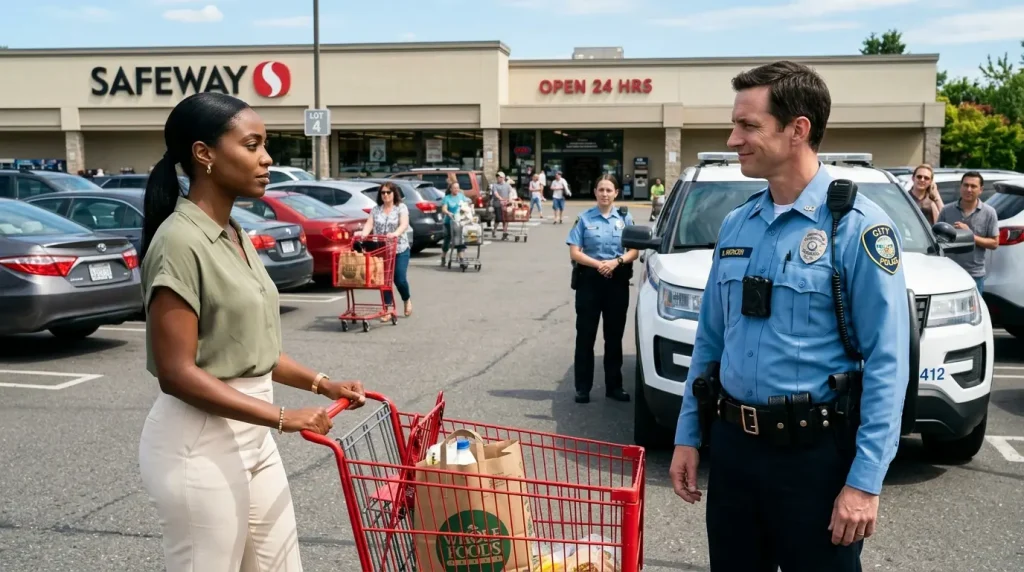
“Mind opening it up for me? Just so we can make sure everything’s squared away and we can both get on with our Saturday.”
Ava folded the thermal receipt once, twice, and slid it back into her pocket. She did not reach for the zipper of her bag. Her fingers remained resting on the cool plastic of the cart handle.
“I mind,” she said.
The parking lot seemed to lose some of its ambient hum. A woman loading boxes of sparkling water into the trunk of a minivan four stalls away paused, her hand hovering over the tailgate. A teenage boy pushing a train of nested carts stopped on the pedestrian walkway, the metal links groaning under the sudden brake.
Mercer’s eyes narrowed, the lazy authority in his stance hardening into something rigid. “Excuse me?”
“I said I mind, Officer,” Ava repeated, her tone neither rising nor falling. It possessed the clean, dry clarity of water running over river rock. “I’ve shown you my receipt for the items in the cart. I have not removed anything from the store without paying for it. I am not consenting to a search of my personal effects.”
“Ma’am, I’m not asking for your life history,” Mercer said, taking half a step closer. The smell of his aftershave—something chemical, pine-scented, and stale—overcame the smell of the bakery rolls. “I’m asking you to unzip the bag so I can look inside. If there’s nothing in there, you’re on your way in thirty seconds. You refusing to cooperate with an active investigation?”
“Refusing a search is not a failure to cooperate,” Ava said. “It is the exercise of a constitutional protection. You know that, Officer.”
Mercer let out a short, nasal bark that was supposed to pass for amusement. “Look at you. You an attorney?”
“I am a citizen standing in a parking lot with groceries I paid for.”
“Well, citizen, right now you’re matching the profile of an individual involved in a retail theft complaint, and your refusal to allow a simple visual inspection is providing me with reasonable suspicion to believe you may be concealing unpurchased property.”
Ava almost smiled. It was the specific phrasing—reasonable suspicion, unpurchased property—recited with the rote, mechanical cadence of a man who had memorized case-law summaries from a departmental bulletin ten years ago and had never once been challenged by someone who had actually read Terry v. Ohio.
“Reasonable suspicion requires specific, articulable facts,” she said evenly. “Not a hunch, and not an individual’s refusal to waive their Fourth Amendment rights. You cannot use my assertion of a right to manufacture the suspicion required to violate it. If you have probable cause to believe a crime has occurred, you may arrest me. If you do not, you must allow me to leave. So I will ask you plainly: Am I being detained?”
Mercer did not answer immediately.
His jaw worked, a muscle jumping beneath the pale skin just below his ear. He was unaccustomed to the syntax. Most people he stopped on this side of town fell into two categories: the terrified, who began apologizing before they were accused, emptying their pockets onto the asphalt in a pathetic rush to prove their harmlessness; and the combative, who cursed, reached for their phones, and gave him the legal cover of disorderly conduct or obstruction within forty-five seconds.
Ava Bennett was doing neither. She was standing still, her shoulders down, her breathing slow, her dark eyes looking directly into his pupils with the terrifying, clinical neutrality of an auditor checking an inventory sheet.
“Daniel.”
The second voice came from the driver’s side of the cruiser.
Officer Lucas Reed walked around the trunk, his boots scuffing the blacktop. Reed was thirty-five, with thinning brown hair, wire-rimmed glasses that gave him the look of a high school science teacher who had wandered into a police academy, and six months on the Oakhaven force after four years in a sleepy rural county upstate. He looked between Mercer and Ava, his forehead creased with the particular anxiety of a junior partner who had already begun to smell the smoke of a fire he couldn’t put out.
“Store manager says the alarm didn’t trip on the south vestibule,” Reed said quietly, keeping his voice below the level of the shoppers now lingering along the curb. “She just said somebody looked like they were stuffing something into a satchel near the seasonal aisle.”
Mercer didn’t turn around. His focus remained locked on Ava. “She’s got a satchel right there in the basket, Lucas.”
“It’s a purse, Daniel,” Reed muttered.
“Step back, Lucas,” Mercer snapped, the edge in his voice sharpening until it drew blood. He pointed a thick, blunt forefinger at the hood of the patrol car. “Ma’am, take the bag out of the cart and place it on the hood. Right now.”
“No,” Ava said.
“This is a lawful order.”
“It is an unlawful demand,” she corrected. “You have no description of an item taken. You have no description of a suspect. You have no confirmation from loss prevention that any inventory is missing. You saw a Black woman walking out of a supermarket with a shoulder bag, and you decided that was sufficient justification to demand entry into her private property.”
“Don’t play that card with me,” Mercer snarled, his face coloring a dark, angry brick-red that crept up from under his collar. “Don’t you dare stand here in front of these people and make this about race. This is about an active investigation into retail larceny!”
“Then make your arrest,” Ava said. She stepped away from the cart, took her hands off the handle, and held them out in front of her chest, palms open, wrists crossed. “If you believe you have probable cause to charge me with a felony or a misdemeanor committed in your presence, put the steel on my wrists. If not, step aside.”





