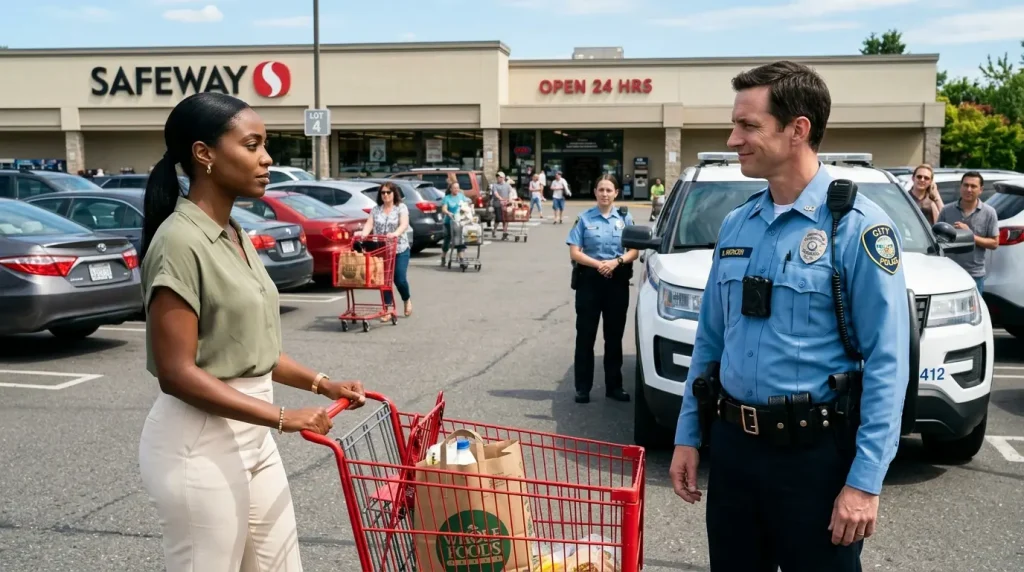
“Why should I have had to identify myself to avoid an unconstitutional search?” Ava asked. She didn’t shout; she didn’t raise her voice half an octave. Every word was delivered with the cold, measured weight of an indictment being read into the record. “Does the Fourth Amendment only protect state employees? Does the Constitution only apply to individuals who carry a gold shield in their pocketbook? If I were a cashier at the dry cleaners, would this search have been legal?”
“I was acting on information—”
“You were acting on an assumption,” she said. “You were told that an unnamed individual was seen in the store. You had no race. You had no clothing description. You had no inventory item. You arrived on the scene, looked across a parking lot of two hundred people, and decided that the thirty-one-year-old Black woman with four bakery rolls was the criminal you were looking for.”
“That’s not true,” Mercer stammered, looking around desperately.
The crowd wasn’t looking at the groceries anymore. They were looking at him. The boy with the phone had moved closer, holding the camera steady at chest height, capturing every drop of sweat running down Mercer’s temple.
“Then explain your reasonable suspicion, Officer,” Ava said. “Explain it right now. Your body camera is on. Your partner is listening. These citizens are listening. Tell me the specific, articulable facts that led you to believe that a woman with a receipt for her purchases had stolen property concealed in her handbag.”
Mercer’s mouth opened.
Nothing came out.
His throat clicked. He looked at Lucas Reed, his eyes wide and pleading—the universal look of a senior partner silently demanding that the rookie jump into the ditch to save him.
Reed looked at Mercer. Then Reed looked at his own boots, reached up with his left hand, and clicked the power toggle on his shoulder microphone.
“Unit twelve to dispatch,” Reed said, his voice trembling slightly but clear. “Show us ten-six at Oakridge Market. Have Sergeant Collins respond to this location immediately. Code two.”
Mercer spun on his partner. “Lucas! What the hell are you doing?”
“I’m calling the road sergeant, Daniel,” Reed said, refusing to look him in the eye. “Because this isn’t right. And I’m not going down on a civil rights complaint for something I told you not to do three minutes ago.”
Sergeant Michael Collins arrived eleven minutes later in an unmarked gray Tahoe.
At fifty-five, Collins had spent thirty-one years in uniform, starting on the beat back when the county was mostly pine barrens and peanut farms. He had three years left until his pension, a daughter who taught fifth grade at Oakhaven Elementary, and the worn, exhausted patience of a man who had seen every possible way an idiot with a badge could ruin his own life between sunrise and sunset.
He didn’t get out of his truck immediately. He sat behind the wheel for two full minutes, watching the scene through his tinted windshield: the crowd of forty people pressed against the supermarket windows; Mercer standing by the open cruiser door with his arms crossed over his chest like an angry schoolboy; Reed standing ten paces apart, looking at the treeline; and Ava Bennett sitting quietly on the bumper of her Subaru, a bottle of water in her hand, her black bag resting untouched on the hood of Mercer’s unit.
When Collins stepped down from the cab, he didn’t look at Mercer. He walked directly to Ava.
“Ma’am,” he said, touching the brim of his hat. “I’m Sergeant Collins. Are you injured?”
“I am not injured, Sergeant,” Ava said, standing up. “I am, however, the subject of an unlawful seizure of my person and effects conducted under color of authority by Officer Daniel Mercer.”
Collins looked at the black bag on the cruiser hood. He looked at the open wallet with the gold state seal still gleaming in the sun.
His eyes closed for a long, slow second. A faint, shuddering sigh escaped his nostrils.
“Officer Mercer,” Collins said without turning around. “My vehicle. Now.”
“Sarge, let me explain what happened—”
“Daniel,” Collins said, his voice dropping into a register that made the hair on the back of Reed’s neck stand up. “Get in the truck.”
Mercer walked toward the Tahoe, his boots dragging slightly on the asphalt, his face set in an ugly, wooden mask of grievance.
Collins turned back to Ava. “Investigator Bennett, I recognize the seal. I know Director Hall up in Atlanta; we worked the task force on the port authority audits back in eighteen.”
“Director Hall is my division head,” Ava said.
“Yes, ma’am. Look… I don’t know what Daniel thought he was doing here today, but—”
“He thought he was doing what he does every Saturday, Sergeant,” Ava said. She stepped closer, her voice dropping so that only Collins and Reed could hear her. “He thought he was dealing with someone who couldn’t fight back. He thought he was dealing with someone who would be so grateful to avoid a night in the county jail that she would let him dig through her tampons and her private papers without asking to see a warrant.”
Collins looked at her. There was no defense in his eyes—only the flat, gray weariness of a man who had spent three decades trying to protect a profession from the men who wore its clothes.
“Do you want to lodge a formal complaint, Investigator?”
Ava looked across the parking lot. She looked at Karen Mitchell, who had finally retreated from the glass doors back into the safety of her office. She looked at the young man with the phone, who was still recording. She looked at the families walking to their cars, their eyes darting nervously toward the three police vehicles.





