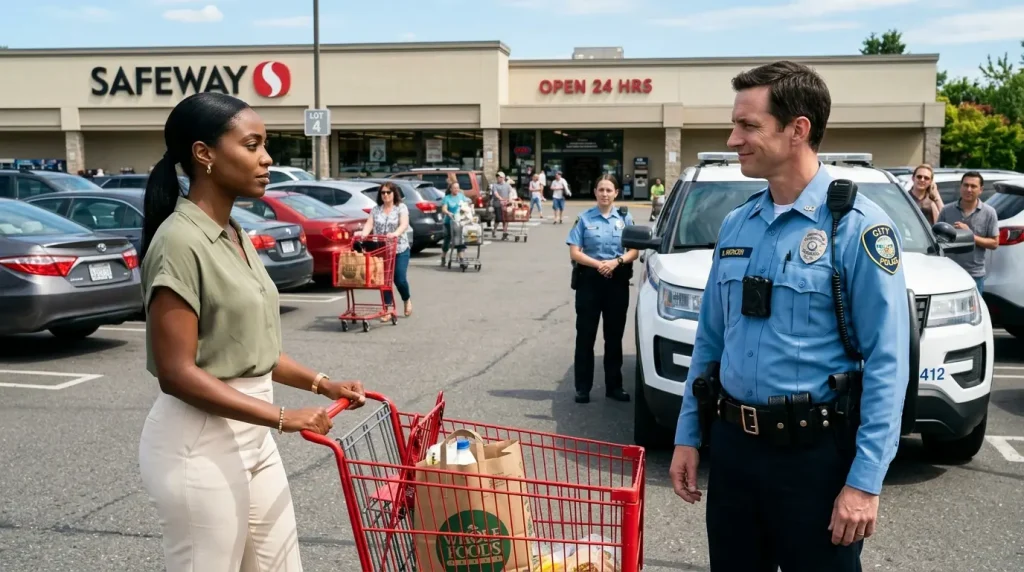
“A formal complaint?” Ava asked. “Sergeant, by eight o’clock on Monday morning, my office will have a subpoena duces tecum served on your chief for every body-camera file, every CAD report, and every disciplinary memorandum involving Officer Mercer for the last thirty-six months. And I will not be filing it as a citizen complaint.”
Collins went very still. “In what capacity will you be filing it, Investigator?”
“In my official capacity,” Ava said. “Under Title 45, Section 15 of the Georgia Code. The Special Investigations Division has statewide jurisdiction over municipal compliance with state civil rights standards and law enforcement operational integrity. Your department receives three hundred and forty thousand dollars annually in state criminal justice training grants. That funding requires compliance with statutory standards regarding unreasonable searches.”
She picked up her bag from the hood of the cruiser. She didn’t check the zipper. She didn’t look inside. She slung the strap over her shoulder with an easy, practiced grace.
“I am not a victim here, Sergeant Collins,” she said, her voice terrifying in its lack of heat. “I am an auditor who just watched a city employee fail an inspection.”
The conference room on the fourth floor of the Oakhaven Municipal Center smelled of stale floor wax, dry-erase marker solvent, and cold coffee. It was ten o’clock on a Wednesday morning, four days after the heat had broken over the coast.
Chief Robert Vance sat at the head of the long oak table, his large, spotted hands clasped over a file folder marked CONFIDENTIAL — PERSONNEL / I.A. 26-114. At sixty-one, Vance was a politician first and a cop second; his white hair was styled with salon precision, his cuffs were monogrammed, and his eyes were perpetually searching the room for whichever person held the most leverage.
Across from him sat Ava Bennett.
She was dressed in a tailored navy-blue pantsuit, a crisp white silk blouse, and small gold stud earrings. Her hair was pulled back into the same low ponytail, but the casual grace of the supermarket parking lot had been replaced by the armored, terrifying precision of an executive officer of the state government. Beside her sat David Thorne, a senior staff attorney from the Department of Law in Atlanta, who had spent the last two hours saying nothing at all, merely turning yellow legal pages with a slow, dry scrape.
On the other side of the table sat Daniel Mercer and his union representative, a retired lieutenant named Broder who looked like he had not slept since Monday.
Mercer was in his class-A dress uniform, but the crisp starch could not disguise the way his shoulders had collapsed inward. The arrogance that had carried him across the asphalt at Oakridge Market had evaporated, burned away by seventy-two hours of internal affairs interviews, digital forensics reviews, and the knowledge that the young man with the smartphone had posted a three-minute, forty-second video that had been viewed two million times before Sunday evening.
“We have completed the preliminary administrative review,” Chief Vance began, his voice sounding like an obsequious radio host attempting to navigate an airline crash. “Officer Mercer has provided a full statement regarding the events of the twenty-sixth. He acknowledges that his choice of language was… less than optimal. That his operational assessment was premature.”
Ava did not look at Vance. She looked directly across the table at Mercer.
“A premature assessment,” Ava said. She opened the manila folder before her. “Is that what we’re calling it, Chief?”
She slid three separate documents across the table. They were printed on state letterhead, each bearing the red stamp of the State Auditor’s Office.
“These are thirty-six separate incident reports filed by Officer Mercer over the preceding eighteen months,” Ava said, her voice filling the room with the steady, inescapable pressure of rising water. “All thirty-six involve pedestrian stops initiated without a primary moving violation or a dispatched call. All thirty-six involve individuals who were stopped within three hundred yards of a commercial retail establishment. Thirty-four of those thirty-six individuals were Black or Latino.”
Broder, the union rep, leaned forward. “Now, hold on. The racial demographics of the east precinct—”
“In twenty-nine of those cases,” Ava continued, cutting through Broder’s protest without even a glance in his direction, “Officer Mercer documented in his narrative that the subject ‘exhibited nervous behavior,’ ‘refused to make eye contact,’ or ‘became verbally uncooperative upon initial approach.’ In eighteen of those cases, he conducted a search of their personal effects. In zero of those cases were any weapons, drugs, or stolen goods recovered.”
She paused. The room was so quiet that the buzz of the fluorescent lights sounded like an electrical short.
“Officer Mercer,” Ava said, “you have a system.”
Mercer’s hands twitched on the table. “I do good police work. I take drugs off the street. I protect those store owners.”
“You don’t do police work, Officer,” Ava said. “You fish. You look for people who look like they don’t have the resources to hire David Thorne. You look for people who have three children in the back of an eight-hundred-dollar car, who know that if they miss three hours of work while you invent an obstruction charge, their utilities will be turned off. You bully them into giving up their privacy, you search their belongings to justify the time you spent harassing them, and when you find nothing, you let them go with a warning about their attitude.”
She leaned forward, her forearms resting flat on the mahogany.
“You didn’t make a mistake on Saturday, Daniel. You just stopped the wrong woman.”
Mercer’s face went white. “You think you’re better than me because of that badge?”
“No,” Ava said softly. “I know I am better than you because I don’t need a badge to treat human beings with decency.”
Chief Vance cleared his throat, his face gray with the realization that this was not going to be settled with an administrative reprimand and a two-week sensitivity seminar.





