“Investigator Bennett,” Vance said carefully. “The department is prepared to offer Officer Mercer a thirty-day suspension without pay, followed by reassignment to the property room pending completion of retraining on Fourth Amendment jurisprudence.”
David Thorne, the state attorney, spoke for the first time.
“The State of Georgia does not accept the proposed disposition, Chief,” Thorne said, his voice flat and administrative. “Under Section 45-15, the Office of Professional Standards is initiating a formal decertification referral to the Georgia Peace Officer Standards and Training Council. We are also filing an interim report with the Civil Rights Division of the United States Department of Justice regarding a pattern and practice of unconstitutional stops within the Oakhaven Police Department.”
Mercer lunged to his feet, his chair screeching against the floorboards. “Decertification? You’re taking my career? Over a search? Over a goddamn purse?”
“Sit down, Daniel!” Collins barked from the back of the room, his voice cracking like a whip.
Mercer didn’t sit. He stood there, his chest heaving, his hands trembling with a pure, impotent rage. “I gave fifteen years to this city! Fifteen years on these streets!”
“And for fifteen years,” Ava said, rising from her chair with a slow, deliberate majesty that made Mercer look small, broken, and utterly obsolete, “you have been carrying a gun and a badge while fundamentally failing to understand the only document that gave you the authority to hold them.”
She gathered her files, slipped them into her leather portfolio, and zipped it closed.
“Your career wasn’t taken from you today, Officer Mercer,” she said, looking him in the eye for the last time. “You threw it away the moment you decided that my dignity was something you had the right to search.”
Six weeks later, the heat had finally died out of the Georgia coast.
The first cool breeze of October was blowing through the live oaks near the Oakhaven waterfront, carrying the smell of salt marsh and woodsmoke from the oyster roasts down by the sound.
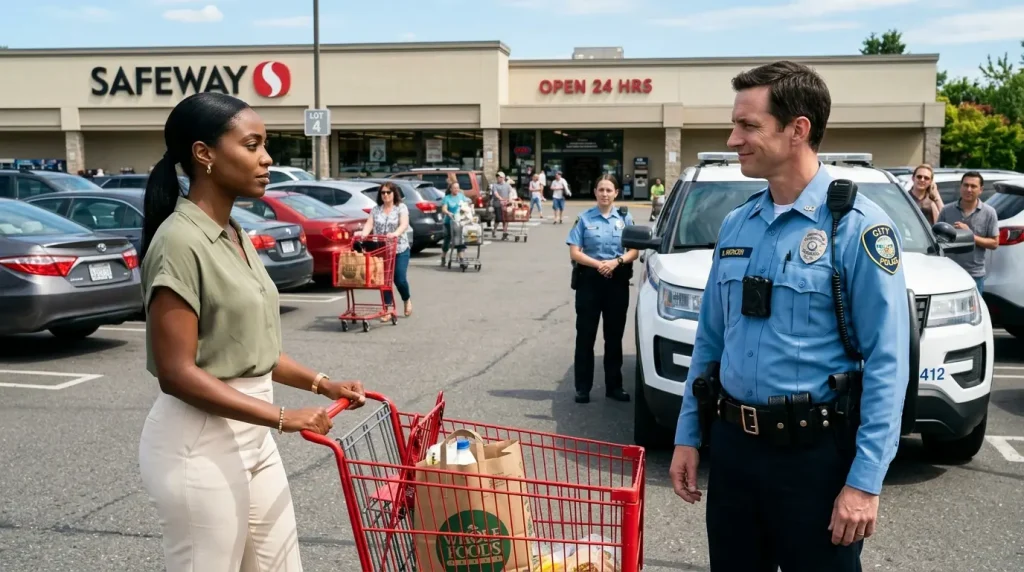
Ava Bennett walked out of the Oakridge Market carrying two brown paper bags. The store looked different now; Karen Mitchell had been reassigned to a regional inventory warehouse in Macon following a corporate review of loss-prevention protocols, and the young cashiers had all attended three days of de-escalation training that Ava’s office had quietly mandated as a condition of settling the state audit.
As she reached her Subaru, a young officer stepped out from the pedestrian walkway.
It was Lucas Reed.
He wasn’t wearing his eight-point hat; his hands were tucked behind his duty belt, his shoulders relaxed. He had a new silver sergeant’s chevron pinned to his collar—an emergency promotion following the department-wide restructuring that had seen three senior supervisors take early retirement.
“Investigator Bennett,” Reed said, stopping five paces away.
Ava turned, the grocery bags resting securely in her arms. “Sergeant Reed.”
“I just wanted to… well, I wanted to say something before the state oversight team finishes their final report on Friday.”
“Go ahead.”
Reed looked toward the spot by the curb where Mercer’s cruiser had been parked that afternoon. “I should have stopped him twenty seconds earlier. I knew what he was doing. I’d seen him do it twice before on patrol, and both times I told myself that he had ten more years on the job than I did. That he knew the line better than I did.”
He took a slow breath, his eyes meeting hers.
“He didn’t know the line at all,” Reed said. “He just knew how to make people afraid of it.”
Ava looked at the young sergeant. She saw the genuine, unvarnished shame in his face—not the defensive panic Mercer had shown, but the painful, necessary realization of a good man who had realized that his silence had been an act of complicity.
“The hardest part of your job isn’t the streets, Sergeant,” Ava said gently. “It’s the car. It’s sitting three feet from a man who wears the same uniform you do, watching him cross that line, and having the courage to tell him to pull his hands back.”
“I know that now,” Reed said.
“Good,” Ava said, unlocking her tailgate. “Because the next time it happens, there won’t be an investigator from Atlanta standing by the cart. It will just be a citizen. And she shouldn’t have to carry a badge to go home with her groceries.”
She loaded her bags into the back of the Outback, closed the hatch with a solid, satisfying thump, and climbed into the driver’s seat.
She adjusted her rearview mirror, backed smoothly out of the stall, and turned toward the avenue. The sun was dipping below the treeline, casting long, clean shadows across the pavement, and for the first time in a very long time, the road ahead was completely, undeniably clear.





