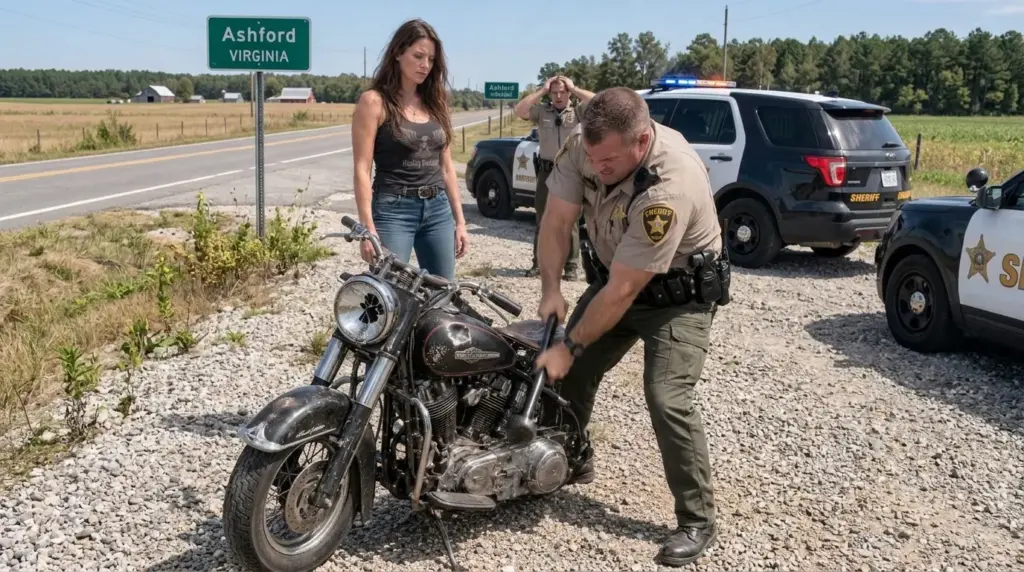
Laura looked at Daniel. “What was it actually worth?”
He checked an insurance record they had obtained. “Agreed-value policy for 86,000.”
Laura leaned back. “Where did it go?”
Daniel followed the record through several transfers. “Private storage, then administrative disposal after unpaid fees.”
“Who bought it?”
He looked at the auction file. “A company called Hanover Restoration Group.”
“Connection?”
Another agent, Michelle Grant, turned from her computer. “Registered agent shares an address with the brother-in-law of the owner of Hensley Recovery and Storage.”
Laura looked back at the screen. “Keep going.”
They worked through the records one case at a time: a vintage Triumph motorcycle, a restored Ford pickup, an older Mercedes convertible, a 1964 Corvette. The details changed, but the sequence became familiar:
-
A valuable older vehicle was stopped.
-
Some problem was raised involving ownership, identification, paperwork, or mechanical condition.
-
The vehicle was removed from the owner.
-
Once in storage, its condition or estimated value became worse on paper.
-
Storage fees accumulated.
-
Review was delayed.
-
Eventually, the vehicle moved into a disposal or auction process.
The same contractors appeared repeatedly. So did the same names: Mercer was involved in many of the roadside encounters; Boone approved several of the seizures or later administrative actions.
Laura drew six boxes across the top of her legal pad: Locate, Seize, Damage, Devalue, Delay, Dispose.
Daniel read the words. “You think that is the process?”
“I think it is the pattern. We still have to prove who knew what.”
Michelle turned around. “There’s something else.” She displayed a spreadsheet showing vehicle valuations. “These numbers drop immediately after county contact. Not every time, but often enough to matter.”
Laura studied the figures. “By how much?”
“Sometimes 70%. Sometimes more.”
“Who performs the valuations?”
“Different names on paper, but most of them route through two businesses. Hensley is one of them.”
Laura looked again at Ruth’s video. Mercer struck the Harley’s engine case after Noah confirmed the identification had returned normally. Then he called the number damaged. After that, he broke the headlight and dented the fuel tank. Later, he described the motorcycle as low-value salvage.
Laura replayed the sequence. “Pull every seizure Mercer handled involving a collector car, vintage motorcycle, or vehicle insured above 50,000.”
Daniel nodded. “And every Boone approval connected to them?”
“Every one.”
At the Ashford Sheriff’s Office, Noah sat alone in an interview room with his phone on the table. He had found Ruth’s public video through a local social media post before it was removed. He watched the roadside stop again. He had already lived through it once, but the recording showed him something he had not fully understood while standing there.
Mercer had not struck random parts of the Harley. The first blows went to the identification area, after Noah had confirmed the number was valid; then Mercer had claimed the number could no longer be verified. The next strike went to the headlight, then the fuel tank.
Noah remembered Mercer’s words: Not anymore.
He replayed that section. On the video, he could hear himself saying the motorcycle was worth far more than a thousand dollars. Mercer answered that it was not anymore.
Noah paused the video. He thought about other stops—not all of them, only the ones that had bothered him afterward: a restored Mustang taken after an ownership dispute; a vintage BMW motorcycle held because of a title problem; a Corvette that Mercer said had questionable identification markings. Noah had never seen those cases together; he had treated them as separate incidents.
Now he opened the internal system and searched older reports. He found the Mustang first: Mercer had initiated the stop; Boone had approved storage; the condition report listed damage to the front quarter panel. Noah remembered seeing that car before the tow truck arrived; he did not remember the dent.
He opened the BMW case: same towing company, same approval chain, low estimated value, delayed release.
He sat back. The problem was no longer what Mercer had done to the Harley; the problem was that Mercer appeared to know exactly what to damage and what words to use afterward.
Noah took out the unsigned report Boone had given him earlier. The language was familiar now: Identification could not be confirmed. Vehicle condition inconsistent with claimed value. Temporary retention required.
Noah read the phrases twice. Then he folded the report and put it inside his jacket.
At Hensley Recovery and Storage, Mercer was standing beside the Harley when Boone entered the warehouse carrying a printed draft.
“You changed it,” Mercer said.
Boone stopped. “Changed what?”
“The roadside narrative.”
“I corrected it.”
“You took your name out.”
“My name was never part of the roadside contact.”
Mercer held up the draft. “You approved the tow.”
“I approved nothing in writing.”
“You told me what to do.”
Boone looked toward the office where Maya was being held. “Keep your voice down.”
Mercer stepped closer. “If this goes bad, you are putting it on me.”
“You were the deputy on scene.”
“You built this process.”
Boone’s expression hardened. “What process?”
Mercer stared at him. The answer had come too quickly. Neither man spoke for several seconds.
Inside the office, Maya could hear enough to know what had happened: Mercer had finally understood what Boone had already accepted—if the scheme failed, loyalty would end before the investigation did.
Miles away, Laura placed another case file beside the others, then another. The numbers were no longer isolated; they formed a pattern.
Mercer followed Boone into the small office beside the warehouse and closed the door behind them. “You removed yourself from the report.”
Boone set the printed draft on the desk. “My name was never part of the roadside contact.”
“You approved the tow arrangement.”
“Not through county dispatch.”
“You told me to bring the Harley here.”
Boone looked at him. “Can you prove that?”
Mercer stopped.





