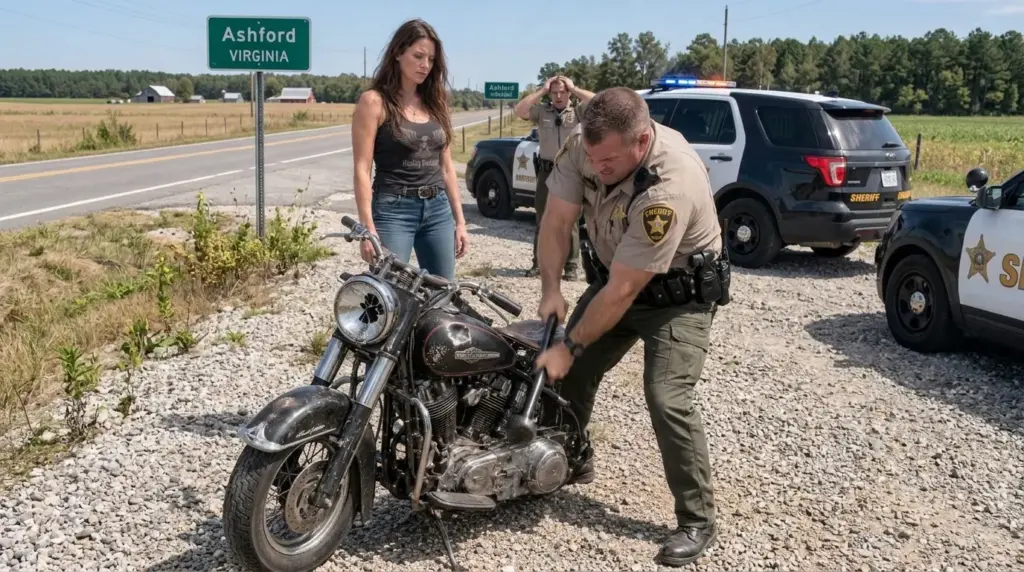
Boone said, “He does not know what he is talking about.”
The contractor turned toward him. “I know exactly what I signed.”
Laura moved toward the office. Maya was sitting beside the desk with one wrist still secured. Laura stopped when she saw her. “You all right?”
“I’m fine.”
Laura signaled to an agent, who began documenting the restraint before removing it. Maya stood once her wrist was free.
Laura looked toward the Harley. “We have the location history. Preserve the motorcycle first.”
“We will.”
“The saddlebag was forced open. The engine case was struck twice. The headlight and tank were damaged at the roadside.”
Laura nodded. “Ruth Walker’s video confirms that.”
Maya looked at her. “Ruth kept the original?”
“Yes.”
For the first time that night, Maya appeared relieved.
Laura continued, “Noah Alvarez contacted us, too.”
Maya gave a small nod. Then she looked toward Mercer and Boone.
Mercer was already speaking to one of the agents: “Boone ran the disposal process.”
Boone heard him. “He is lying! Mercer made the roadside decisions!”
Mercer turned. “You gave the instructions!”
“You acted on your own!”
The contractor interrupted. “I have records for both of them.”
Boone looked at him. “You need a lawyer before you say another word.”
The contractor answered, “So do you.”
Laura watched the exchange, but did not try to settle it. Another agent began photographing the warehouse: each vehicle was documented where it stood; inventory tags were photographed; storage records were collected; computers were left untouched until the forensic team could preserve them properly.
No one rushed. No one celebrated. The warehouse was no longer a place where Boone controlled the paperwork; it was a scene that had to be preserved exactly as it existed.
Noah arrived later under federal escort after giving a formal statement about the first yard in the transfer. He saw Maya standing near the Harley and stopped several feet away.
“I should have said something earlier.”
Maya looked at him. “You did. Eventually.”
“That does not erase the part before.”
“No.”
Noah waited.
Maya continued. “You knew the stop was wrong before you knew who I was.”
He lowered his eyes. “Yes.”
“That is the part you will have to live with.”
Noah nodded.
Laura walked over holding an evidence log. “The motorcycle is secured. The recordings are preserved. Ruth’s video is being authenticated. The contractor has agreed to maintain all business records.”
Maya looked toward Boone and Mercer. “Anything else?”
Laura glanced at the two men, who were now being interviewed separately. “They have both started blaming each other.”
Maya said, “That was always going to happen.”
Laura closed the evidence log. “This is not over.”
“I know.”
Outside, the first light of morning was beginning to appear over the industrial buildings. The immediate danger had ended; the case had not.
Over the next several months, the case moved through a process that was slower and less dramatic than the warehouse operation, but far more important. Federal investigators authenticated Ruth Walker’s video, the Harley’s recordings, and the location data collected during the transfers. They compared those records with towing logs, county reports, private storage documents, auction files, and bank transactions.
Old seizure cases were reopened. Former vehicle owners were contacted: some still had photographs showing the condition of their cars or motorcycles before they were taken; others had insurance records with values far higher than the amounts later entered in Ashford County paperwork.
The same names appeared repeatedly: Wade Mercer, Clay Boone, Hensley Recovery and Storage, and several private buyers connected to the same small group of companies. The investigation no longer depended on what happened to Maya’s Harley; that stop had exposed a system that had been operating for years.
Mercer was the first to change his position. Through his attorney, he offered to cooperate. He claimed Boone designed the seizure process and taught deputies how to create enough uncertainty to hold valuable vehicles. According to Mercer, Boone controlled the towing companies, valuations, storage delays, and disposal decisions; Mercer described himself as an officer who followed instructions.
For a while, the argument appeared possible. Then prosecutors played the roadside recording:
Noah’s voice came first: The VIN is normal, Wade. I checked it twice.
Then Maya: I ask that you do not strike the engine case.
The first impact followed, then the second.
After that came Mercer’s own voice: The VIN shows signs of unlawful tampering.
There was no supervisor telling him to swing the baton. No one told him to wait for Maya to resist. No one forced him to damage the headlight or fuel tank.
The audio continued.
You know that motorcycle isn’t worth a thousand dollars, Noah said.
Not anymore, Mercer replied.
The statement became one of the most important pieces of evidence against him: it showed that Mercer understood the damage had changed the motorcycle’s condition and value before he later described the damage as pre-existing. His attempt to become a minor participant failed.
Boone tried the opposite strategy: he described Mercer as an experienced deputy who had acted independently at the roadside. Boone admitted making administrative decisions afterward, but denied participating in any larger plan to seize and dispose of valuable vehicles.
Then investigators played the warehouse recordings: Mercer accused Boone of setting the seizure rules; Boone denied telling him exactly how to damage the identification area; Mercer discussed condition ratings; Boone told him to stop talking. They argued about transfers, low-value classifications, disposal procedures, and previous vehicles.
Financial records supported parts of those conversations. So did the contractor’s documents. Boone could distance himself from the baton, but not from the system built around what happened after it was used.
Noah gave his testimony without trying to protect himself. He described the valid identification return, Mercer’s two strikes, the false roadside claim, and the decision to take Maya to Hensley instead of the sheriff’s office. Then he addressed his own conduct.





