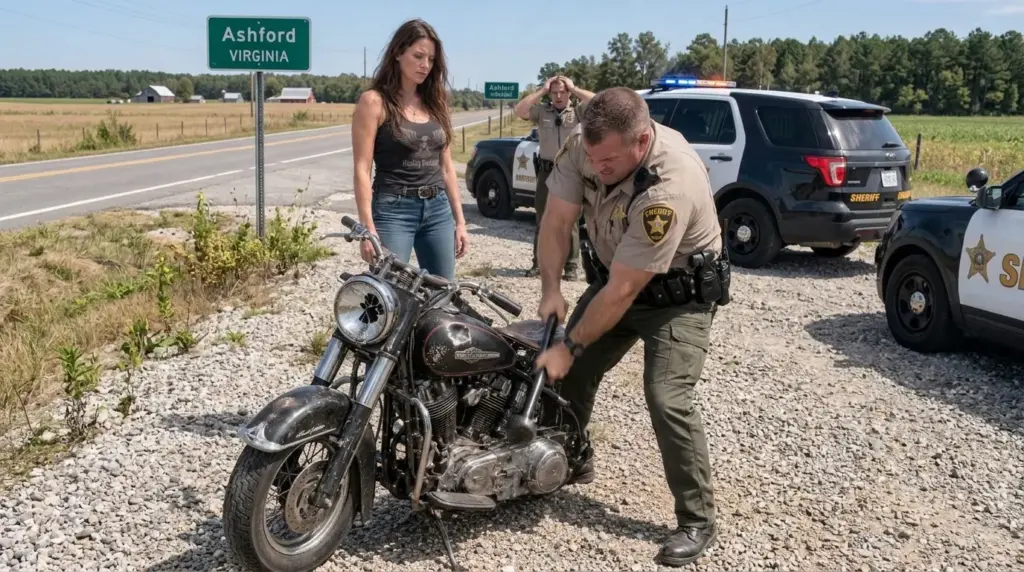
Boone stepped forward. “And I can prove you were the one standing beside every vehicle when the problem started.”
Mercer pointed toward him. “You approved the transfers.”
“You initiated the seizures.”
“You set the thresholds.”
“You signed the roadside reports.”
“You controlled disposal.”
“You damaged the property.”
Neither man noticed that Maya had stopped asking questions. She no longer needed to; they were doing the work themselves.
The towing contractor quietly moved away from the desk and slipped several papers into a folder. Mercer saw him.
“What are those?”
“Nothing.”
“Give them to me.”
The contractor held the folder against his chest. “These are my business records.”
Boone looked at him. “Put them down.”
The contractor shook his head. “No. If this falls apart, I am not letting either of you say I invented the transfers.”
Boone stared at him. Now there were three people protecting themselves. Maya remained seated and listened.
Several miles away, Laura Chen stood over a workstation with Ruth’s video open beside a county map. An agent next to her pointed at a new location that had appeared in the developing investigation.
Laura looked at the address. “Confirm it.”
The agent worked for several seconds, then nodded. “It matches a warehouse connected to one of the disposal companies.”
Laura looked at another screen: a signal was stationary inside the property beside the location data. A live audio waveform moved across the display. Laura put on a headset. At first, she heard only warehouse noise, then Mercer’s voice became clear: That was the point.
Laura stopped moving. A second voice followed: Boone, you are making this worse.
Laura looked at the agent beside her. “Start preserving everything.”
The waveform continued to move.
Laura Chen listened through the headset as the voices inside the warehouse continued. She heard Mercer argue that Boone had instructed him to create grounds for seizure. She heard Boone deny telling him exactly how to damage the identification area. Then Mercer admitted that breaking the headlight and denting the fuel tank had been done to reduce the motorcycle’s condition rating.
Laura removed one side of the headset and looked at the agent beside her. “Is the feed being preserved?”
“Yes.”
“From the beginning?”
The agent nodded. “From before the roadside contact.”
Laura looked back at the screen. The signal was coming from a concealed device installed on Maya’s Harley before she entered Ashford County. The equipment had been authorized as part of the ongoing public corruption investigation. Its purpose had been simple: preserve location data and ambient audio if the motorcycle was moved, seized, or transferred through a facility connected to the suspected network.
Mercer had searched the saddlebag. He had inspected the frame. He had looked beneath the seat. He had never found it.
Laura opened the archived recording from the roadside stop. “Start with the identification check.”
The agent moved to the correct timestamp. Noah’s voice came through first: The VIN is normal, Wade. I checked it twice.
Laura let the recording continue. Maya’s voice followed: I ask that you do not strike the engine case.
Then came the first impact: a hard metallic strike. A second followed almost immediately. Laura watched the timestamps appear beside each sound.
Mercer’s voice came next: The VIN shows signs of unlawful tampering. It cannot be identified at the scene.
Laura paused the recording. “There.”
The agent looked at her. “Valid return before the strikes. Damage after the return. Claim of tampering after the damage.”
He nodded. “The order is clear.”
“Preserve that segment separately, but do not alter the original.”
Laura restarted the audio. The next sound was the headlight assembly breaking. Then the fuel tank was struck.
Mercer’s voice came through: This thing is in rough condition.
Noah answered: It wasn’t when we got here.
A little later, another exchange appeared in the recording.
Noah said: That motorcycle is worth a lot more than a thousand dollars.
Mercer answered: Not anymore.
Laura stopped the playback again. “He knew the damage changed the condition.”
The agent beside her said, “Then later he called it pre-existing.”
“Exactly.” Laura found that section.
Maya asked: So your valuation changed because of its current condition?
Mercer answered that the motorcycle was damaged. Then he described it as low-value salvage and instructed the tow driver to mark it accordingly.
Laura leaned back from the screen. “He thought he was creating the evidence.”
The agent looked at her.
Laura continued, “He was timestamping it.”
Inside the warehouse, Mercer had stopped arguing with Boone. He stood several feet from the Harley and looked at Maya through the open office doorway. Something about her expression bothered him: she was listening, but she was no longer asking questions.
He turned toward the motorcycle. Boone noticed. “What now?”
Mercer walked toward the Harley. “You said Hensley was compromised because no one knew the address.”
“Yes.”
“And then we moved the bike here.”
“Yes.”
Mercer looked at the damaged engine case. Maya watched him. He moved closer to the motorcycle and placed one hand near the saddlebag mount.
“You knew we would move it.”
Maya said nothing. Mercer looked back at her.
“You knew it at Hensley, too.”
Boone stepped forward. “Wade, leave the bike alone.”
Mercer ignored him. He checked beneath the seat again, then along the frame. Nothing. He stood slowly.
“When we left the roadside, you checked the time.” Maya remained silent. “You watched every turn on the way to Hensley.” No answer. “You never asked where we were taking the motorcycle.”
Boone said, “You are wasting time.”
Mercer turned toward him. “No. I am finally asking the right question.” He looked at Maya again. “What is on the Harley?”
She did not answer.
Mercer walked closer to the office. “Is it a tracker?”
Maya’s expression did not change. Boone looked toward the motorcycle. Mercer saw it.
“You never thought of that.”
Boone said, “Federal agents do not plant devices on their own property without reason.”





